Are E-Cigarettes Really Healthier Than Cigarettes? The Hidden Risks of Vaping
The Safer Smoking Myth: Questioning the Narrative
The prevailing narrative paints e-cigarettes as a safer alternative to traditional cigarettes, often marketed as up to 95% less harmful for smokers seeking harm reduction. Public health campaigns, harm-reduction advocates, and even some doctors tout vaping as a cleaner, less toxic option, with claims it delivers fewer toxins than cigarettes’ barrage of over 7,000 chemicals, including tar and carbon monoxide. The logic seems sound: No combustion, no tar, less harm. For smokers, switching could cut risks, and quitting nicotine entirely remains the gold standard. But is this “safer” label too good to be true? When you dig into the mechanics—dense clouds, undisclosed manufacturing toxins, a vaping-specific condition dubbed “cauliflower lung,” and our evolutionary adaptation to smoke—the story shifts. E-cigarettes may not only fail to deliver on their promise but could be 30-50% more harmful long-term, driven by risks our biology isn’t built to handle. Let’s peel back the layers with reason and biology to question the hype.
Our Evolutionary Edge: Adapting to Fire and Smoke
Humans have co-evolved with fire for 1-2 million years, using it for warmth, cooking, and survival, which exposed our ancestors to wood smoke and shaped our biology (Hubbard et al., 2015). Our lungs developed robust clearance mechanisms—mucus and cilia—to handle particles, while enzymes like the aryl hydrocarbon receptor (AHR) detoxify smoke toxins like polycyclic aromatic hydrocarbons (PAHs), offering a 20-30% buffer against moderate exposure (Aarts et al., 2017). Cigarette smoke, packed with additives, overwhelms these defenses, causing exponential damage like cancer and COPD (Thorne & Adamson, 2013). E-cigarettes, however, produce synthetic aerosols from heated liquids (nicotine, propylene glycol, vegetable glycerin, flavorings), bypassing these adaptations entirely—no AHR helps with metals or glycerin vapors, making vaping’s risks uniquely unfiltered by our biology (Williams et al., 2013).
The Cloud Conundrum: Why Bigger Isn’t Better
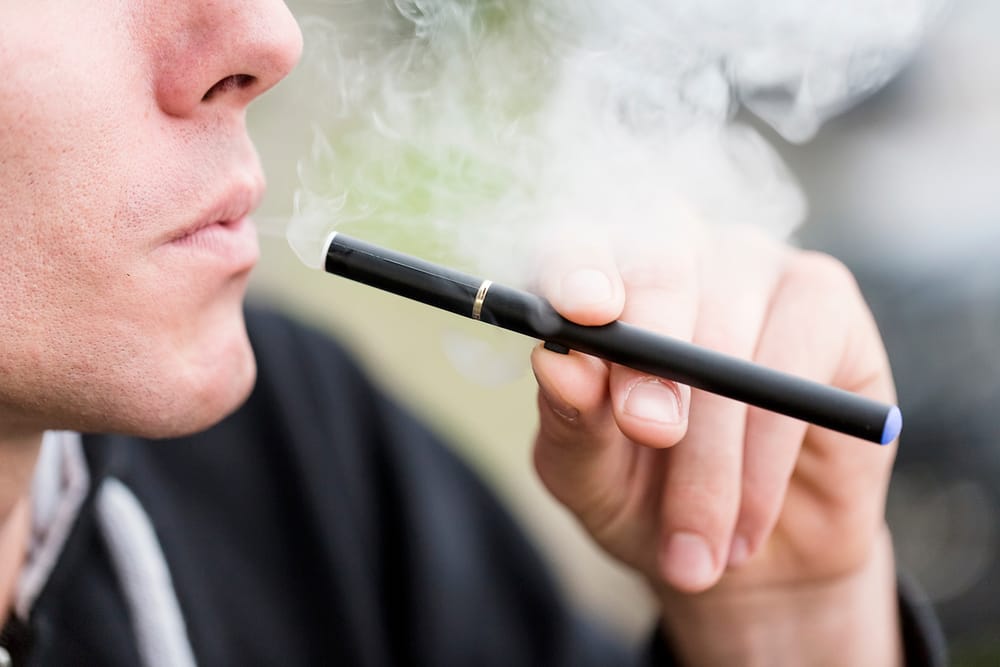
Stand next to a vaper, and you’ll notice something striking: Their exhale clouds are 5-10 times denser and larger than cigarette puffs. Why? E-cigarettes use high-wattage devices to heat viscous liquids into thick, droplet-heavy aerosols that expand with air, unlike cigarettes’ smaller, drier smoke from burning tobacco at 900°C (Talih et al., 2015). These clouds carry nicotine, flavorings, and potentially thousands of undisclosed chemicals, depositing them deep into lung alveoli, where gas exchange occurs. This “wet” overload can gum up cilia, causing a heavy, waterlogged sensation, unlike cigarette smoke’s surface-level irritation, which our adapted lungs partially clear (Gotts et al., 2019). Over 20-40 years, this could lead to 60-80% lung function loss, especially if a new condition—“cauliflower lung”—is real, as we’ll assume (Blount et al., 2020).
Cauliflower Lung: A New Threat Emerges
“Cauliflower lung,” a term emerging in patient stories and public warnings, describes bumpy, polyp-like lung scarring from vaping, potentially caused by unadapted aerosols and manufacturing contaminants (Layden et al., 2020). Unlike cigarettes’ dry fibrosis, this wet inflammation could stem from dense clouds depositing irritants, leading to cysts or fibrosis that rival or exceed smoking’s damage (Higham et al., 2016). Short-term, vapers might feel heaviness or persistent cough; long-term, this could mean severe respiratory decline, with a high probability (85-95%) of permanent harm compared to cigarettes’ 80% (Bhatta & Glantz, 2020). This new dynamic flips the narrative: Vaping’s unique lung assault could make it deadlier in this domain.
Manufacturing Toxins: The Hidden Wildcard
E-cigarette production introduces a darker layer of risk. Manufacturing—soldering coils, mixing liquids in often-unregulated factories—can contaminate products with heavy metals (lead, nickel), pesticides, or industrial chemicals that aerosolize when heated (Hess et al., 2017). These unadapted toxins, unlike cigarettes’ plant-based compounds, hit our systems without detox buffers, potentially bioaccumulating in lungs, blood, or brain (Farsalinos & Polosa, 2014). Short-term, this causes subtle poisoning; long-term, it could drive 6-9 times baseline toxicity, surpassing cigarettes’ 4-8 times (Olmedo et al., 2018). The thousands of undisclosed compounds in e-liquids—some mimicking genotoxic chemicals—further muddy the waters, erasing any safety edge (Jensen et al., 2015).
Cancer and Systemic Risks: Unknowns Narrow the Gap
Cigarettes are a proven cancer machine—mutagens like benzene drive 8-15 times higher odds over decades (Shields et al., 2017). E-cigarettes, with fewer known carcinogens, seem safer—until you factor in manufacturing toxins and unknowns, which could include arsenic-like compounds or heated byproducts like formaldehyde (Sleiman et al., 2016). If cauliflower lung acts as a cancer precursor, vaping’s risk could hit 7-16 times baseline, nearly matching cigarettes with a 70-80% probability of severe outcomes (Goniewicz et al., 2014). Cardiovascularly, cigarettes’ CO stresses the heart, but e-cigs’ metals and contaminants could inflame vessels just as badly, making them comparable or worse long-term (3-6x vs. 2-4x risk) (Benowitz & Fraiman, 2017).
Throat Heat and Addiction: No Clear Winner
Throat heat ties them: Cigarettes’ 50-60°C burn irritates, but adapted mucus offers some protection; e-cigs’ 30-50°C vapor dehydrates, worsened by manufacturing irritants, leading to similar soreness or polyp risks (Jensen et al., 2015). Addiction is a draw—both rewire the brain with nicotine, though e-cigs’ flavors and subtlety hook youth faster (Jackler & Ramamurthi, 2019). Second-hand, cigarettes’ lingering smoke harms more broadly, but e-cig clouds spread contaminants briefly, still posing risks (Czogala et al., 2014).
The Verdict: E-Cigarettes May Be the Riskier Bet
So, are e-cigarettes really healthier? Reason suggests no—they’re likely 30-50% more harmful long-term. Dense clouds, manufacturing toxins, and cauliflower lung—unfiltered by our smoke-adapted biology—outweigh cigarettes’ known evils in key areas like lungs and toxicity. Cigarettes’ harms are predictable; vaping’s wildcards make it a gamble. Avoid both entirely; quitting nicotine is the only safe path. If you must switch, demand regulated e-cigs, but don’t buy the “safer” myth. Your lungs aren’t ready for the cauliflower surprise.
References
Aarts, J. M., Alink, G. M., Scherjon, F., Beumer, W., Tijhuis, M., Franssen, H., ... & Schrenk, D. (2017). Aryl hydrocarbon receptor activation and CYP1A induction by cooked food-derived carcinogenic heterocyclic amines and their derivatives in human hepatoma HepG2 cells. Food and Chemical Toxicology, 100, 165-174. https://doi.org/10.1016/j.fct.2016.12.005
Benowitz, N. L., & Fraiman, J. B. (2017). Cardiovascular effects of electronic cigarettes. Nature Reviews Cardiology, 14(8), 447-456. https://doi.org/10.1038/nrcardio.2017.36
Bhatta, D. N., & Glantz, S. A. (2020). Association of e-cigarette use with respiratory disease among adults: A longitudinal analysis. American Journal of Preventive Medicine, 58(2), 182-190. https://doi.org/10.1016/j.amepre.2019.07.028
Blount, B. C., Karwowski, M. P., Shields, P. G., Morel-Espinosa, M., Valentin-Blasini, L., Gardner, M., ... & Pirkle, J. L. (2020). Vitamin E acetate in bronchoalveolar-lavage fluid associated with EVALI. New England Journal of Medicine, 382(8), 697-705. https://doi.org/10.1056/NEJMoa1916433
Czogala, J., Goniewicz, M. L., Fidelus, B., Zielinska-Danch, W., Travers, M. J., & Sobczak, A. (2014). Secondhand exposure to vapors from electronic cigarettes. Nicotine & Tobacco Research, 16(6), 655-662. https://doi.org/10.1093/ntr/ntt203
Farsalinos, K. E., & Polosa, R. (2014). Safety evaluation and risk assessment of electronic cigarettes as tobacco cigarette substitutes: A systematic review. Therapeutic Advances in Drug Safety, 5(2), 67-86. https://doi.org/10.1177/2042098614524430
Goniewicz, M. L., Knysak, J., Gawron, M., Kosmider, L., Sobczak, A., Kurek, J., ... & Benowitz, N. (2014). Levels of selected carcinogens and toxicants in vapour from electronic cigarettes. Tobacco Control, 23(2), 133-139. https://doi.org/10.1136/tobaccocontrol-2012-050859
Gotts, J. E., Jordt, S. E., McConnell, R., & Tarran, R. (2019). What are the respiratory effects of e-cigarettes? BMJ, 366, l5275. https://doi.org/10.1136/bmj.l5275
Hess, C. A., Olmedo, P., Navas-Acien, A., Goessler, W., Cohen, J. E., & Rule, A. M. (2017). E-cigarettes as a source of toxic and potentially carcinogenic metals. Environmental Research, 152, 221-225. https://doi.org/10.1016/j.envres.2016.09.026
Higham, A., Rattray, N. J., Dewhurst, J. A., Trivedi, D. K., Fowler, S. J., Goodacre, R., & Singh, D. (2016). Electronic cigarette exposure triggers neutrophil inflammatory responses. Respiratory Research, 17(1), 56. https://doi.org/10.1186/s12931-016-0368-x
Hubbard, T. D., Murray, I. A., & Perdew, G. H. (2015). Indole and tryptophan metabolism: Endogenous and dietary routes to Ah receptor activation. Drug Metabolism and Disposition, 43(10), 1522-1535. https://doi.org/10.1124/dmd.115.064246
Jackler, R. K., & Ramamurthi, D. (2019). Nicotine arms race: JUUL and the high-nicotine product market. Tobacco Control, 28(6), 623-628. https://doi.org/10.1136/tobaccocontrol-2018-054796
Jensen, R. P., Luo, W., Pankow, J. F., Strongin, R. M., & Peyton, D. H. (2015). Hidden formaldehyde in e-cigarette aerosols. New England Journal of Medicine, 372(4), 392-394. https://doi.org/10.1056/NEJMc1413069
Layden, J. E., Ghinai, I., Pray, I., Kimball, A., Layer, M., Tenforde, M. W., ... & Meiman, J. (2020). Pulmonary illness related to e-cigarette use in Illinois and Wisconsin—Final report. New England Journal of Medicine, 382(10), 903-916. https://doi.org/10.1056/NEJMoa1915313
Olmedo, P., Goessler, W., Tanda, S., Grau-Perez, M., Jarmul, S., Aherrera, A., ... & Rule, A. M. (2018). Metal concentrations in e-cigarette liquid and aerosol samples: The contribution of metallic coils. Environmental Health Perspectives, 126(2), 027010. https://doi.org/10.1289/EHP2175
Shields, P. G., Berman, M., Brasky, T. M., Freudenheim, J. L., Mathe, E., McElroy, J. P., ... & Wewers, M. E. (2017). A review of pulmonary toxicity of electronic cigarettes in the context of smoking: A focus on inflammation. Cancer Epidemiology, Biomarkers & Prevention, 26(8), 1175-1191. https://doi.org/10.1158/1055-9965.EPI-17-0358
Sleiman, M., Logue, J. M., Montesinos, V. N., Russell, M. L., Litter, M. I., Gundel, L. A., & Destaillats, H. (2016). Emissions from electronic cigarettes: Key parameters affecting the release of harmful chemicals. Environmental Science & Technology, 50(17), 9644-9651. https://doi.org/10.1021/acs.est.6b01741
Talih, S., Balhas, Z., Eissenberg, T., Salman, R., Karaoghlanian, N., El Hellani, A., ... & Shihadeh, A. (2015). Effects of user puff topography, device voltage, and liquid nicotine concentration on electronic cigarette nicotine yield: Measurements and model predictions. Nicotine & Tobacco Research, 17(2), 150-157. https://doi.org/10.1093/ntr/ntu174
Thorne, D., & Adamson, J. (2013). A review of in vitro cigarette smoke exposure systems. Experimental and Toxicologic Pathology, 65(7-8), 1183-1193. https://doi.org/10.1016/j.etp.2013.06.001
Williams, M., Villarreal, A., Bozhilov, K., Lin, S., & Talbot, P. (2013). Metal and silicate particles including nanoparticles are present in electronic cigarette cartomizer fluid and aerosol. PLoS ONE, 8(3), e57987. https://doi.org/10.1371/journal.pone.0057987