China's AI Surge: Outpacing the West in the Tech Race
A New Era Dawns
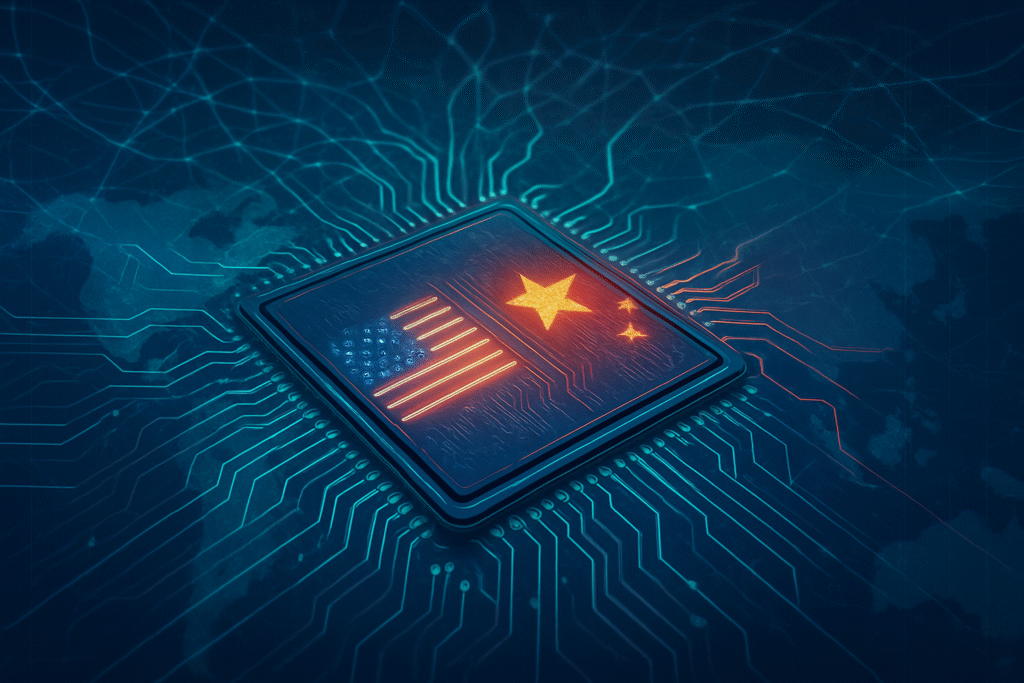
October 2025. Beijing’s Fourth Plenum gathers China’s top leaders, their decisions ringing beyond the capital’s walls. They endorsed proposals for the 15th Five-Year Plan, a roadmap that emphasizes self-reliance in technology, including artificial intelligence (AI). The Chatham House podcast, Independent Thinking: AI Plus, Generals Purged, China’s Leaders Plan for 2030, discusses this in the context of China’s broader strategic planning.¹ For a century, from 1839 to 1949, Western powers and Japan humiliated China, leaving it weak. Now, AI is seen as a tool in China’s efforts to enhance its global position by 2049, the 100th anniversary of the People’s Republic. The West, mainly the U.S. and Europe, struggles to keep up, bogged down by debates and disjointed efforts. Some analysts reflect on President Nixon’s 1972 decision to open China to the world, meant to counter the Soviet Union, as a pivotal moment in shifting global dynamics.² This article argues that China’s government-led AI strategy, tied to a tactic called “unrestricted warfare,” could outpace the West, shift global power, and threaten our sovereignty. But we can fight back. Let’s explore the past, present, future risks, and how to protect our freedom.
History’s Long Lessons
China’s AI push grows from a painful past. From 1839 to 1949, the “century of humiliation” saw Western nations and Japan bully China with wars, like the Opium Wars, and unfair trade deals, leaving it technologically behind.³ Mao Zedong’s 1949 revolution promised strength, but his focus on farms over factories fell short. In 1972, President Nixon’s historic visit to China, meeting Mao, opened the country to global trade, aiming to pull China away from the Soviet Union and integrate it into the Western-led world order.⁴ In 1978, Deng Xiaoping built on Nixon’s opening, blending global markets with tight government control, sparking today’s tech boom. The 15th Five-Year Plan continues Deng’s vision, using AI to connect factories, cities, and government systems.
History offers parallels. Japan’s Meiji Restoration, from 1868 to 1912, turned a weak nation into a modern power through government-led tech upgrades. Britain’s Industrial Revolution in the 1700s used steam and machines to dominate globally. The U.S.-Soviet space race in the 1950s and 1960s showed how technology crowns superpowers. China’s AI strategy follows these models, aiming to erase past shame and avoid Japan’s later mistakes, like over-militarization. But traps loom. In the late 1800s, China’s attempt to copy Western tech failed due to corruption. Today, China’s competition creates AI systems, but may not always spark groundbreaking ideas.⁵ China’s AI also powers surveillance, echoing troubling 20th-century moves by authoritarian regimes.⁶ Mixing tech with tight control can reshape the world, or sow chaos. If Nixon’s opening enabled this rise, some fear it handed China too much power, a decision with complex long-term implications.
Power Moves and Tech Triumphs in 2025
The Fourth Plenum was more than talk. It was a power shake-up. President Xi Jinping ousted nine generals and replaced them with loyalists like Zhang Shengmin, now a top military figure.⁷ The podcast discusses this purge in the context of preparing for future challenges. On October 21, 2025, the plenum shared a draft of the 15th Five-Year Plan, pushing AI into daily life: factories, schools, security. The Chinese AI market is projected to reach approximately $29.4 billion in 2025, with potential growth to $126.7 billion by 2030.⁸
China’s AI shines across sectors. A Chinese open-source humanoid robot demonstrated advanced capabilities, including a cartwheel and 360-degree spin.⁹ This could lead to robots in factories or disaster zones. In space, the Chang’e-6 mission hit the moon’s far side in June 2024. Its lander sent out a 5-kilogram mini-rover to collect soil samples. Using AI to navigate rough terrain, the rover took a photo of the lander with a Chinese flag.¹⁰ China leads in facial recognition, tracking people in cities, and autonomous cars, with Baidu’s driverless taxis in Wuhan.¹¹ AI also boosts healthcare, with AI diagnosing diseases like cancer faster than doctors. China’s 5G networks, led by Huawei, connect millions of devices, making AI-powered “Internet of Things” systems a reality.¹²
The West lags. The U.S. excels in chips, like NVIDIA’s, and AI models, like ChatGPT, but bureaucracy and ethical debates slow progress. Europe’s AI Act stifles speed. The U.S. fights back with DARPA’s $2 billion AI Next program and companies like OpenAI, while Europe’s Horizon Europe funds AI research.¹³ Alliances like AUKUS and the Quad push cooperation for defense, but private-sector rivalries and slow government coordination weaken efforts.¹⁴ China’s unified plan, blending civilian apps like WeChat with military tech, gives it an edge. A Xi-Trump meeting in South Korea could clash over AI rules. China pushes UN-led standards, pitching tech to poorer countries to build alliances.
Global Reach and Social Control
China’s AI reaches far. Through the Belt and Road Initiative, China builds “smart cities” in Africa, Southeast Asia, and Latin America, using AI for traffic, power, and security. Huawei’s AI surveillance systems in Kenya and Pakistan, for example, monitor streets, boosting safety but also control.¹⁵ This could lift millions from poverty and secure China’s grip on chip-making materials like rare earths. By 2025, China’s AI plans aim to contribute to international standards, enhancing global collaboration.¹⁶ This soft power, winning friends through tech, makes China a global force, building on Nixon’s opening that gave it access to Western markets and know-how.
At home, AI drives China’s social credit system, scoring citizens on behavior with cameras and data. Good scores bring perks, like loans; bad ones block travel or jobs.¹⁷ If countries like Venezuela or Zimbabwe adopt it, a high-tech control model could spread, clashing with Western values of privacy and freedom. The West debates AI ethics, like whether robots should decide who lives or dies, giving China a head start.
Future Boom or Battle
By 2030, China’s AI could be a substantial industry, fueling global trade and influence.¹⁸ But the podcast’s talk of military purges hints at darker uses: “intelligentized warfare” with AI-driven drones, cyberattacks, or fake videos to confuse enemies. Imagine 2027: a Taiwan crisis where China’s AI hacks U.S. ship networks, cutting communications. Fake videos flood social media, showing U.S. ships retreating, panicking Taiwanese citizens.¹⁹ By 2035, AI-powered hypersonic weapons could outmatch U.S. defenses, shifting Pacific power. In a 2040 economic standoff, AI could crash Western markets by targeting banks, while China reroutes trade through BRI partners.²⁰
Here’s what might happen:
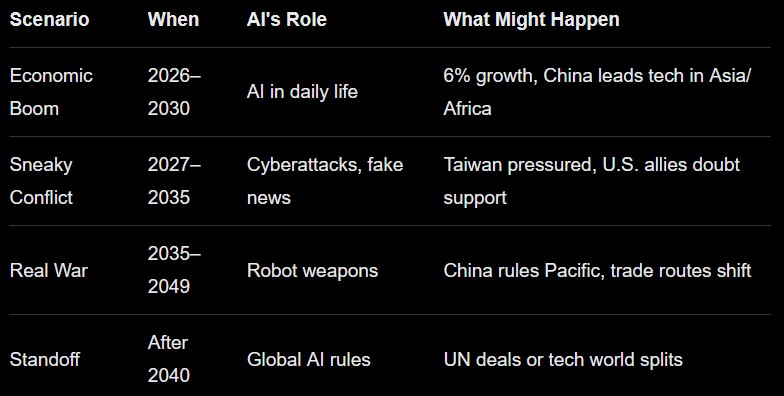
History warns of tech-driven errors. AI’s complex systems could misread signals, starting fights nobody wants.²¹
Unrestricted Warfare, Sneaky Wins
China’s AI fits a 1999 idea called Unrestricted Warfare, where wars are won without bullets, through money, media, or hacks.²² AI supercharges this. WeChat tracks users for shopping and spying. In 2023, a China-based hack of Microsoft’s cloud targeted U.S. officials, showing cyber prowess. In recent years, AI has been used in information warfare.²³ By 2030, AI could disrupt Western economies with hacks, like crashing banks, while China denies involvement. The military purges ensure loyalty to this plan. It’s an ancient Chinese principle, rooted in Sun Tzu’s The Art of War, where the greatest victory is achieved without the need to fight.
Risks exist. China’s AI systems are vulnerable, and its reliance on Western chip designs, despite sanctions, is a weak spot.²⁴ Fierce competition may limit big ideas, and global pushback against China’s AI rules could isolate it. AI errors, like misjudging U.S. moves, could spark accidental wars.
Countering the Threat
China’s AI lead threatens Western sovereignty, our ability to control our tech, economy, and values. But we can fight back. First, the West needs a unified AI strategy. The U.S. and Europe should blend government and private efforts, like China’s state-led model, to speed up innovation. The U.S. could expand DARPA’s $2 billion AI Next program, while Europe streamlines its AI Act to balance ethics and progress.²⁵ Second, focus on applied AI. Instead of just building models like ChatGPT, invest in real-world uses, like AI cybersecurity to block China’s hacks or autonomous systems for defense.
Third, strengthen alliances. AUKUS and the Quad should share tech to counter China’s BRI smart cities. The West can lead a democratic AI governance framework through the G7, offering an alternative to China’s UN push.²⁶ Fourth, secure supply chains. The U.S. and allies like Australia and Canada should mine their own rare earths and build chip factories to cut reliance on China. Fifth, promote ethical AI. By championing privacy and freedom, the West can appeal to the Global South, countering China’s control-based model.
Sixth, invest in AI research. Seventh, cyber defense. The West must harden critical infrastructure against AI-powered hacks, like those targeting power grids or financial systems. Eighth, shape global norms. Use the UN, G20, and other forums to push for AI transparency and accountability, countering China’s opaque systems.
The Stakes Are High
China’s AI push, rooted in its century of humiliation and influenced by Nixon’s 1972 opening, isn’t just about tech; it’s about rewriting global rules. The Fourth Plenum’s purges and AI plans signal intent. China could dominate markets, win wars without fighting, or spread control models worldwide. But the West can respond with unity, innovation, and values. History shows tech races reshape power: Britain’s steam, America’s rockets, now China’s AI. The next decade decides if the 21st century belongs to Beijing’s control or the West’s freedom.
This isn’t just geopolitical chess; it’s about everyday life. AI shapes how we work, learn, and think. If China leads, its values, like surveillance over privacy, could become global norms. The West must act now, not with fear, but with purpose. Unite, innovate, and defend what matters. The race is on. Let’s win it.
Notes
- Bronwen Maddox, Jie Yu, and James Kynge, Independent Thinking: AI Plus, Generals Purged, China’s Leaders Plan for 2030, podcast (Chatham House, October 2025), https://www.chathamhouse.org/2025/10/independent-thinking-ai-plus-generals-purged-chinas-leaders-plan-2030.
- Robert S. Ross, “Nixon’s Trip to China,” in The Week That Changed the World: Nixon’s Historic Visit to China, ed. Gerald L. Smith (Yorba Linda, CA: Richard Nixon Foundation, 2012), 45–67.
- Jonathan D. Spence, The Search for Modern China (New York: W.W. Norton & Company, 1990), 150–230.
- U.S. Department of State, “Rapprochement with China, 1972,” Office of the Historian, accessed October 24, 2025, https://history.state.gov/milestones/1969-1976/rapprochement-china.
- Grand View Research, “China Artificial Intelligence Market Size & Outlook, 2033,” Grand View Research, 2025, https://www.grandviewresearch.com/horizon/outlook/artificial-intelligence-market/china.
- Atlantic Council, “The West, China, and AI Surveillance,” Atlantic Council, December 18, 2020, https://www.atlanticcouncil.org/blogs/geotech-cues/the-west-china-and-ai-surveillance/.
- Reuters Staff, “Veteran Chinese General Zhang Shengmin Promoted in Military Reshuffle,” Reuters, October 23, 2025, https://www.reuters.com/world/china/veteran-military-leader-zhang-shengmin-promoted-chinas-number-two-general-2025-10-23/.
- Grand View Research, “China Artificial Intelligence Market Size & Outlook, 2033.”
- Interesting Engineering Staff, “Chinese Open-Source Humanoid Robot Stuns with Cartwheel and 360-Degree Spin,” Interesting Engineering, September 22, 2025, https://oodaloop.com/briefs/technology/chinese-open-source-humanoid-robot-stuns-with-cartwheel-and-360-degree-spin/.
- Space.com Staff, “China’s Tiny Rover Used AI to Take an Epic Photo on the Moon’s Far Side,” Space.com, July 24, 2024, https://www.space.com/china-change-6-mini-moon-rover-training-video.
- New York Times Staff, “China Is Testing More Driverless Cars Than Any Other Country,” New York Times, June 13, 2024, https://www.nytimes.com/2024/06/13/business/china-driverless-cars.html.
- Huawei Technologies Co., Ltd., Transforming Healthcare with 5G, report, 2025, https://www-file.huawei.com/-/media/corp2020/pdf/publications/winwin/winwin-38-en.pdf.
- Defense Advanced Research Projects Agency, “DARPA Announces $2 Billion Campaign to Develop Next Wave of AI Technologies,” DARPA, September 7, 2018, https://www.darpa.mil/news/2018/next-wave-ai; European Commission, “Horizon Europe: Artificial Intelligence in Science,” European Commission, accessed October 24, 2025, https://research-and-innovation.ec.europa.eu/research-area/industrial-research-and-innovation/artificial-intelligence-ai-science_en.
- Center for Strategic and International Studies, “Improving Cooperation with Allies and Partners in Asia,” CSIS, May 20, 2025, https://www.csis.org/analysis/improving-cooperation-allies-and-partners-asia.
- Atlantic Council, “The West, China, and AI Surveillance.”
- World Economic Forum, China’s Path to AI-Powered Industry Transformation, report, 2025, https://reports.weforum.org/docs/WEF_Blueprint_to_Action_Chinas_Path_to_AI-Powered_Industry_Transformation_2025.pdf.
- Samantha Hoffman, “China’s Social Credit System: What Businesses Need to Know,” China Briefing, March 24, 2023, https://www.china-briefing.com/news/chinas-social-credit-system-how-it-works/.
- Grand View Research, “China Artificial Intelligence Market Size & Outlook, 2033.”
- Center for Strategic and International Studies, “Lights Out? Wargaming a Chinese Blockade of Taiwan,” CSIS, 2025, https://www.csis.org/analysis/lights-out-wargaming-chinese-blockade-taiwan.
- RAND Corporation, “Thinking Through Protracted War with China: Nine Scenarios,” RAND, February 26, 2025, https://www.rand.org/pubs/research_reports/RRA1475-1.html.
- RAND Corporation, “Keeping a U.S.-China Conflict Under the Nuclear Threshold,” RAND, November 15, 2024, https://www.rand.org/pubs/research_reports/RRA2312-1.html.
- Qiao Liang and Xiangsui Wang, Unrestricted Warfare: China’s Master Plan to Destroy America (Beijing: PLA Literature and Arts Publishing House, 1999).
- Microsoft Corporation, “Analysis of Storm-0558 Techniques for Unauthorized Email Access,” Microsoft Security Blog, July 14, 2023, https://www.microsoft.com/en-us/security/blog/2023/07/14/analysis-of-storm-0558-techniques-for-unauthorized-email-access/; New York Times Staff, “China Turns to A.I. in Information Warfare,” New York Times, August 6, 2025, https://www.nytimes.com/2025/08/06/us/politics/china-artificial-intelligence-information-warfare.html.
- Dieter Ernst, “Competing in Artificial Intelligence Chips: China’s Challenge Amid Technology War,” CIGI Papers No. 236, March 2020, https://www.cigionline.org/publications/competing-artificial-intelligence-chips-chinas-challenge-amid-technology-war/.
- Defense Advanced Research Projects Agency, “DARPA Announces $2 Billion Campaign.”
- Center for Strategic and International Studies, “Improving Cooperation with Allies and Partners in Asia.”
Bibliography
Atlantic Council. “The West, China, and AI Surveillance.” Atlantic Council, December 18, 2020. https://www.atlanticcouncil.org/blogs/geotech-cues/the-west-china-and-ai-surveillance/.
Center for Strategic and International Studies. “Improving Cooperation with Allies and Partners in Asia.” CSIS, May 20, 2025. https://www.csis.org/analysis/improving-cooperation-allies-and-partners-asia.
———. “Lights Out? Wargaming a Chinese Blockade of Taiwan.” CSIS, 2025. https://www.csis.org/analysis/lights-out-wargaming-chinese-blockade-taiwan.
Defense Advanced Research Projects Agency. “DARPA Announces $2 Billion Campaign to Develop Next Wave of AI Technologies.” DARPA, September 7, 2018. https://www.darpa.mil/news/2018/next-wave-ai.
Ernst, Dieter. “Competing in Artificial Intelligence Chips: China’s Challenge Amid Technology War.” CIGI Papers No. 236, March 2020. https://www.cigionline.org/publications/competing-artificial-intelligence-chips-chinas-challenge-amid-technology-war/.
European Commission. “Horizon Europe: Artificial Intelligence in Science.” European Commission. Accessed October 24, 2025. https://research-and-innovation.ec.europa.eu/research-area/industrial-research-and-innovation/artificial-intelligence-ai-science_en.
Grand View Research. “China Artificial Intelligence Market Size & Outlook, 2033.” Grand View Research, 2025. https://www.grandviewresearch.com/horizon/outlook/artificial-intelligence-market/china.
Hoffman, Samantha. “China’s Social Credit System: What Businesses Need to Know.” China Briefing, March 24, 2023. https://www.china-briefing.com/news/chinas-social-credit-system-how-it-works/.
Huawei Technologies Co., Ltd. Transforming Healthcare with 5G. Report, 2025. https://www-file.huawei.com/-/media/corp2020/pdf/publications/winwin/winwin-38-en.pdf.
Interesting Engineering Staff. “Chinese Open-Source Humanoid Robot Stuns with Cartwheel and 360-Degree Spin.” Interesting Engineering, September 22, 2025. https://oodaloop.com/briefs/technology/chinese-open-source-humanoid-robot-stuns-with-cartwheel-and-360-degree-spin/.
Liang, Qiao, and Xiangsui Wang. Unrestricted Warfare: China’s Master Plan to Destroy America. Beijing: PLA Literature and Arts Publishing House, 1999.
Maddox, Bronwen, Jie Yu, and James Kynge. Independent Thinking: AI Plus, Generals Purged, China’s Leaders Plan for 2030. Podcast. Chatham House, October 2025. https://www.chathamhouse.org/2025/10/independent-thinking-ai-plus-generals-purged-chinas-leaders-plan-2030.
Microsoft Corporation. “Analysis of Storm-0558 Techniques for Unauthorized Email Access.” Microsoft Security Blog, July 14, 2023. https://www.microsoft.com/en-us/security/blog/2023/07/14/analysis-of-storm-0558-techniques-for-unauthorized-email-access/.
RAND Corporation. “Keeping a U.S.-China Conflict Under the Nuclear Threshold.” RAND, November 15, 2024. https://www.rand.org/pubs/research_reports/RRA2312-1.html.
———. “Thinking Through Protracted War with China: Nine Scenarios.” RAND, February 26, 2025. https://www.rand.org/pubs/research_reports/RRA1475-1.html.
Reuters Staff. “Veteran Chinese General Zhang Shengmin Promoted in Military Reshuffle.” Reuters, October 23, 2025. https://www.reuters.com/world/china/veteran-military-leader-zhang-shengmin-promoted-chinas-number-two-general-2025-10-23/.
Ross, Robert S. “Nixon’s Trip to China.” In The Week That Changed the World: Nixon’s Historic Visit to China, edited by Gerald L. Smith, 45–67. Yorba Linda, CA: Richard Nixon Foundation, 2012.
Space.com Staff. “China’s Tiny Rover Used AI to Take an Epic Photo on the Moon’s Far Side.” Space.com, July 24, 2024. https://www.space.com/china-change-6-mini-moon-rover-training-video.
Spence, Jonathan D. The Search for Modern China. New York: W.W. Norton & Company, 1990.
The New York Times Staff. “China Is Testing More Driverless Cars Than Any Other Country.” New York Times, June 13, 2024. https://www.nytimes.com/2024/06/13/business/china-driverless-cars.html.
———. “China Turns to A.I. in Information Warfare.” New York Times, August 6, 2025. https://www.nytimes.com/2025/08/06/us/politics/china-artificial-intelligence-information-warfare.html.
U.S. Department of State. “Rapprochement with China, 1972.” Office of the Historian. Accessed October 24, 2025. https://history.state.gov/milestones/1969-1976/rapprochement-china.
World Economic Forum. China’s Path to AI-Powered Industry Transformation. Report, 2025. https://reports.weforum.org/docs/WEF_Blueprint_to_Action_Chinas_Path_to_AI-Powered_Industry_Transformation_2025.pdf.