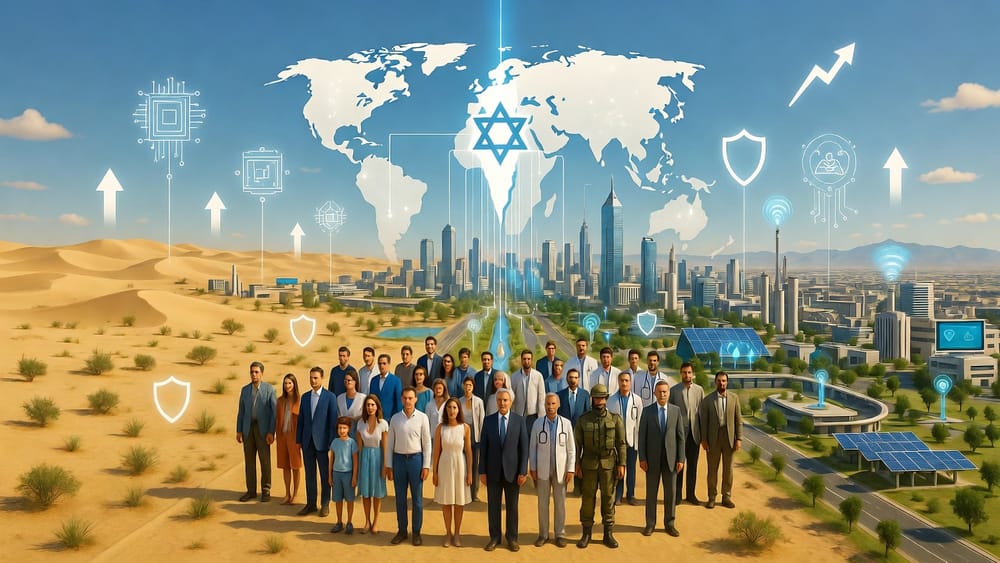
Forged by Necessity: How Adversity Transformed Israel Into a Global Power
Why the World's Most Threatened Nation Became Its Most Innovative
Nine million people living under constant threat. Enemies on every border. Half the country's nothing but desert. There's no oil, no natural gas, nothing in the ground worth digging up. The world won't sell them weapons. Most countries in this spot would've collapsed decades ago. Israel became a technological powerhouse instead.
This place is smaller than New Jersey, and it churns out more tech startups than Japan, China, India, Korea, Canada, and the UK put together1. When California has a drought, they start rationing water. Israel makes 20% more water than it needs and sells the extra2. Last year, when security analysts put together their list of the 30 hottest cybersecurity companies in the world, eleven of them were Israeli3.
So what's going on? Everyone's focused on the conflict, which means they're missing the real story. Every problem turned into an advantage. Not enough water? They became world leaders in desalination. Military threats? That built their cybersecurity industry. Waves of immigrants? That brought engineering talent. Nobody would trade with them? They built their own weapons. None of this happened by accident.
Start with the birth rate, which nobody wants to talk about. Japan's down to 1.2 kids per woman. Germany's at 1.5. These societies are aging themselves into irrelevance, their workforces shrinking, their pension systems going broke. Israel's sitting at 3.1 children per woman4. And here's what's really wild: even secular Israeli women, who have no religious reason to have big families, are averaging over two kids5. The demographer Yoram Ettinger thinks Israel could hit 15 or even 20 million people by 20506. Turkey's workforce could shrink by half. Iran's might drop 40%. Israel's could double7.
But birth rates only tell you half the story. Immigration's the other half.
Between 1990 and 1998, nearly 900,000 Jews from the Soviet Union moved to Israel. The population jumped almost 20% practically overnight8. These weren't desperate people fleeing with nothing. Sixty percent had university degrees, which was twice the rate of native-born Israelis. In just the first four years, 57,000 engineers showed up. Plus 12,000 doctors9. And they arrived exactly when Israel was making the jump from farming oranges to building semiconductors and writing software.
The economic impact came to 182 billion shekels over two decades10. But that's not what really mattered. These people didn't just add numbers. They supercharged the whole economy's productivity and basically built the tech sector from scratch11. By 2012, they were earning as much as people born in Israel. Their kids? They climbed up the income ladder faster than any other group in the country12.
Those Soviet engineers brought something Israel desperately needed: serious math training and a way of thinking about systems. Israel added its own secret ingredient. When you're sixteen and you're one of the best hackers or math students in the country, they pull you into Unit 8200, which is basically Israel's version of the NSA. You spend three years learning cutting-edge tech, you build relationships with people who'll be running things later, and then when you're done with your service, you go start a company.
Look at what that produced. There are 751 cybersecurity companies in Israel right now. 397 of them have raised serious money. Eight are worth over a billion dollars13. In 2024, while the country was literally at war, the sector pulled in $4 billion in new investment. That's double what came in the year before14.
Israeli cybersecurity companies aren't sitting around theorizing about how attacks might work. They're dealing with actual attacks from Iran, from Hezbollah, from state-sponsored hackers, every single day. The security chiefs at Fortune 500 companies get this, which is why eleven Israeli companies made it onto the list of the world's top 3015. Check Point protects governments all over the world. CyberArk, Cato Networks, and Varonis dominate their markets.
Medical technology followed the same path. There are 1,800 life science companies there now16. A lot of it comes from military needs. Back in the 1980s, there was this battlefield medic named Bernard Bar-Natan who watched soldiers die from wounds that shouldn't have killed them. He invented a pressure bandage that's now standard issue for NATO and U.S. special forces17. The optical systems they developed for defense got turned into the PillCam, which completely changed how doctors examine your digestive system. Those ReWalk exoskeletons that let paralyzed people walk? Those came from military rehab research.
The newer stuff is just as impressive. MeMed made a test that takes 15 minutes and tells you if an infection is bacterial or viral. It cut unnecessary antibiotic prescriptions by 62%, and the FDA signed off on it18. Nuvo created a device that lets pregnant women monitor their babies at home. TIME put it on their list of best inventions for 2024. IceCure figured out how to freeze tumors with liquid nitrogen instead of cutting them out.
Water should have killed them. More than half the country is desert that gets maybe 200 millimeters of rain a year. Instead, they figured it out. Back in 1959, Simcha Blass and his son invented drip irrigation, where the water goes straight to the plant roots through tubes. It's 95% efficient19. That invention now feeds a billion people around the world20. But only 5% of farmland globally uses it. In Israel, it's 75% of their crops.
Drip irrigation wasn't enough by itself. Israel recycles 86% of its wastewater for farming. Spain's second in the world at 19%21. When the drought in 2008 dropped the Sea of Galilee to dangerous levels, they built massive desalination plants. Five of them, pumping out 600 million cubic meters a year. Now 55% of Israel's water comes from desalination, and they're making 20% more than they use22.
The Sorek plant cut the cost down to a third of what it was in the 1990s. Israeli companies designed the biggest seawater plant in San Diego: 50 million gallons a day for 400,000 people23.
Military hardware went the same way. They've been surrounded since 1948, and nobody would sell them weapons, so they made their own. The Merkava tank was designed specifically for urban fighting and the terrain there24. They took the F-15 and rebuilt it into something else entirely25. Iron Dome shoots down rockets with accuracy that nobody else has matched. Pretty much every military engineer ends up working in tech eventually26.
You can see how this works. No water forced them to get good at water technology. No resources made them develop alternative energy. Enemies everywhere meant they had to build military tech, and that spilled over into commercial products27. The constant pressure created a whole different kind of culture. It's informal, people ask questions, they're okay with failure. IDF officers go by first names. Junior people can challenge their superiors without torpedoing their careers. When you're making decisions under fire, that kind of setup makes everything faster28.
Immigration keeps the whole thing running. Nearly two-thirds of Israelis come from families where someone took a huge risk and moved there29. People who take big risks tend to raise entrepreneurial kids. Even with the war that started in October 2023 and all the missile attacks, 53,765 immigrants showed up. That included 519 doctors and hundreds of engineers30. There are American women who moved there, became IDF shooting instructors, and say they feel safer in Israel than they did back home31.
All these things feed into each other. More people means more talent. Immigration brings in new expertise. Military service moves technology from defense into civilian use. Limited resources force efficiency. Existential threats compress how long it takes to make decisions. You've got nine million people competing with countries that have ten times their population, and they're doing it across multiple industries at once.
The major policy shops have started paying attention. Chatham House thinks Israel's going to end up in a leadership position during the coming competition between great powers32. The Council on Foreign Relations points to how resilient they are across different crisis scenarios33. The Atlantic Council sees them as a technology and security hub by 203534. The Institute for National Security Studies forecasts that Israel will have real autonomy in a multipolar Middle East by 203035. These aren't optimistic guesses. They're looking at what's already happening and projecting it forward.
The Abraham Accords make a lot more sense when you look at it this way. Arab governments figured out that Israeli expertise in water, medicine, and cybersecurity is worth more than old grudges. Their neighbors are facing demographic collapse and economic stagnation while Israel's advantages keep compounding. What you can do matters more than ideology.
There are plenty of problems, obviously. Inequality's bad. Educational gaps exist. Housing costs are brutal. Some people leave. But look at what the constraints produced. Water scarcity created breakthroughs in desalination. Military needs built technology transfer systems. Security threats made them leaders in cybersecurity. Trade boycotts forced them to develop their own weapons industry. The weaknesses turned into strengths.
Other countries facing water stress are copying Israeli techniques now. Healthcare systems around the world are using Israeli medical innovations. Governments everywhere are hiring Israeli cybersecurity firms. Countries with declining birth rates are studying Israeli policies. The exact model doesn't export perfectly, but the core ideas do: invest heavily in people, accept that failure's part of learning, keep hierarchy to a minimum, turn your constraints into strategic advantages.
The global trends actually favor them. Climate change is making water scarce everywhere. AI is reshaping how economies work. Great powers are fighting over influence. Rich democracies are aging. Israel's advantages aren't going away. They're getting stronger. Growing population of educated people. Constant stream of skilled immigrants. Innovation culture that got forged under pressure. Strategic location. Proven track record of turning disadvantages into advantages.
There’s really only one way to read this. Israel didn’t succeed despite all of the constraints. They succeeded because of them. Necessity drove innovation. Threats built capability. Scarcity forced efficiency. Isolation required self-sufficiency. Their vulnerabilities became their assets. As Israel stands on the cusp of tomorrow, these forged strengths promise an even brighter horizon. Adversity didn't just build resilience. It ignited a perpetual engine of progress, ensuring that this small desert powerhouse doesn't merely endure but leads the world into a future of boundless possibility. That's not the end of the story; it's just the beginning.
Notes
1. Dan Senor and Saul Singer, Start-Up Nation: The Story of Israel's Economic Miracle (New York: Twelve, 2009).
2. Rowan Jacobsen, "Israel Proves the Desalination Era Is Here," Scientific American, February 20, 2024.
3. "11 Israeli Startups Dominate List of Most Promising Global Cybersecurity Firms," Times of Israel, January 4, 2025.
4. Taub Center for Social Policy Studies in Israel, Demographic Trends in Israel: An Overview (Jerusalem: Taub Center, 2022).
5. Taub Center for Social Policy Studies in Israel, Israel's Exceptional Fertility (Jerusalem: Taub Center, 2024).
6. Yoram Ettinger, 2025 Israel's Demographic Update Defies Conventional Wisdom (The Ettinger Report, 2025).
7. Peter Zeihan, "Israel, After America," Zeihan on Geopolitics, October 15, 2023; Peter Zeihan, "Israel Is the Future of the Middle East," Zeihan on Geopolitics, January 8, 2024.
8. Shoshana Neuman, "Aliyah to Israel: Immigration under Conditions of Adversity," IZA Discussion Paper No. 89 (Bonn: Institute of Labor Economics, 1999).
9. Neuman, "Aliyah to Israel."
10. Vladimir Khanin, Aliyah from the Former Soviet Union: Contribution to the National Security (Jerusalem: Israeli Ministry of Immigrant Absorption, n.d.).
11. Assaf Razin, "Israel's Immigration Story: Winners and Losers," NBER Working Paper No. 24283 (Cambridge, MA: National Bureau of Economic Research, 2018).
12. Razin, "Israel's Immigration Story."
13. Tracxn, "Top Startups in Cybersecurity in Israel," Tracxn, 2025.
14. "11 Israeli Startups Dominate List," Times of Israel.
15. "11 Israeli Startups Dominate List," Times of Israel.
16. "The Top 12 Most Amazing Israeli Medical Advances," Israel21c, December 16, 2024.
17. "Israel Tech Leading Rescue Efforts Nepal," NoCamels, May 4, 2015.
18. "The Top 12 Most Amazing Israeli Medical Advances," Israel21c.
19. "How Israel Used Innovation to Beat Its Water Crisis," Israel21c, February 28, 2023.
20. "Worldwide Water Crises: Israeli Innovations Can Help," Washington Institute for Near East Policy, n.d.
21. Jacobsen, "Israel Proves the Desalination Era Is Here."
22. Jacobsen, "Israel Proves the Desalination Era Is Here."
23. "Worldwide Water Crises," Washington Institute for Near East Policy.
24. "Surrounded by Enemies, Israel Had to Become a Military Superpower," National Interest, November 25, 2024.
25. "Surrounded by Enemies," National Interest.
26. "How Did Israel Become a Hub for Innovation?," WeWork Ideas, February 26, 2020.
27. "How Did Israel Become a Hub for Innovation?," WeWork Ideas.
28. Senor and Singer, Start-Up Nation.
29. "How Did Israel Become a Hub for Innovation?," WeWork Ideas.
30. "The State of Aliyah: What Immigration to Israel Looks Like in 2025," Jerusalem Post, January 10, 2025.
31. "The State of Aliyah," Jerusalem Post.
32. Chatham House, The World in 2026 (London: Chatham House, 2025).
33. Council on Foreign Relations, Conflicts to Watch in 2025 (New York: Council on Foreign Relations, 2025).
34. Atlantic Council, Welcome to 2035 (Washington, DC: Atlantic Council, 2025).
35. Ari Heistein et al., What Will the Middle East Look Like in 2030? (Tel Aviv: Institute for National Security Studies, 2021).
Bibliography
Atlantic Council. Welcome to 2035. Washington, DC: Atlantic Council, 2025.
Chatham House. The World in 2026. London: Chatham House, 2025.
Council on Foreign Relations. Conflicts to Watch in 2025. New York: Council on Foreign Relations, 2025.
Ettinger, Yoram. 2025 Israel's Demographic Update Defies Conventional Wisdom. The Ettinger Report, 2025.
Heistein, Ari, Bishara Bahbah, Giora Eiland, Douglas J. Feith, Jeffrey Goldberg, Yoel Guzansky, Mordechai Kedar, Yossi Kuperwasser, Brenda Shaffer, and Gabi Siboni. What Will the Middle East Look Like in 2030? Tel Aviv: Institute for National Security Studies, 2021.
"How Did Israel Become a Hub for Innovation?" WeWork Ideas, February 26, 2020.
"How Israel Used Innovation to Beat Its Water Crisis." Israel21c, February 28, 2023.
"Israel Tech Leading Rescue Efforts Nepal." NoCamels, May 4, 2015.
Jacobsen, Rowan. "Israel Proves the Desalination Era Is Here." Scientific American, February 20, 2024.
Khanin, Vladimir. Aliyah from the Former Soviet Union: Contribution to the National Security. Jerusalem: Israeli Ministry of Immigrant Absorption, n.d.
Neuman, Shoshana. "Aliyah to Israel: Immigration under Conditions of Adversity." IZA Discussion Paper No. 89. Bonn: Institute of Labor Economics, 1999.
Razin, Assaf. "Israel's Immigration Story: Winners and Losers." NBER Working Paper No. 24283. Cambridge, MA: National Bureau of Economic Research, 2018.
Senor, Dan, and Saul Singer. Start-Up Nation: The Story of Israel's Economic Miracle. New York: Twelve, 2009.
"Surrounded by Enemies, Israel Had to Become a Military Superpower." National Interest, November 25, 2024.
"The State of Aliyah: What Immigration to Israel Looks Like in 2025." Jerusalem Post, January 10, 2025.
"The Top 12 Most Amazing Israeli Medical Advances." Israel21c, December 16, 2024.
"11 Israeli Startups Dominate List of Most Promising Global Cybersecurity Firms." Times of Israel, January 4, 2025.
Taub Center for Social Policy Studies in Israel. Demographic Trends in Israel: An Overview. Jerusalem: Taub Center, 2022.
Taub Center for Social Policy Studies in Israel. Israel's Exceptional Fertility. Jerusalem: Taub Center, 2024.
Tracxn. "Top Startups in Cybersecurity in Israel." Tracxn, 2025.
"Worldwide Water Crises: Israeli Innovations Can Help." Washington Institute for Near East Policy, n.d.
Zeihan, Peter. "Israel, After America." Zeihan on Geopolitics, October 15, 2023.
Zeihan, Peter. "Israel Is the Future of the Middle East." Zeihan on Geopolitics, January 8, 2024.