Have We Been Lied to About Our Past? Uncovering Humanity’s Forgotten History
Forgotten Wonders: Exploring Earth’s Hidden Past
What if humanity is a “species with amnesia,” as Graham Hancock claims? Our history might be far richer and stranger than we’ve been told. Imagine the Maya’s cosmic calendars, Olmec heads hauled across jungles, laser-cut stones in Bolivia, towering Moai on Easter Island, a hidden Sumerian tomb, ancient underground cities in Turkey buried under orchards, and secret chambers beneath Egypt’s Sphinx.
These marvels hint at advanced technologies lost to time. So why are they hidden? Could a “hidden hand,” governments, institutions like the Smithsonian, or NGOs, be suppressing these discoveries to control our story? As drones, LiDAR, and platforms like X reveal these secrets, the truth is emerging. Inspired by Graham Hancock and others, let’s explore these wonders, a reported “second hidden city” near Giza, and why our past is being concealed, all while wondering if a cataclysm could erase us again.
The Maya’s Starry Genius: Calendars That Defy Time
The Maya (c. 2000 BCE–900 CE) created calendars that tracked the stars with astonishing accuracy. Their Long Count calendar, as Carl Johan Calleman explains, followed the 26,000-year precession of the equinoxes, Earth’s slow wobble.¹ At Chichen Itza, the El Castillo pyramid’s 365 steps (91 per side plus the top) align with the solar year. During equinoxes, shadows form a serpent slithering down the steps. How did a culture without telescopes accomplish this?
Why It Matters: A 2023 LiDAR discovery in Guatemala revealed a vast Mayan city with grid-like streets and causeways, older than expected.² This suggests the Maya inherited cosmic knowledge from a lost civilization.
Why Hide It?: Such advanced technology challenges the idea that history is a straight line of progress. Keeping it quiet protects modern science’s authority, preventing us from questioning our origins.
The Maya’s calendars aren’t just tools. They’re a window into a forgotten cosmic connection.
The Olmec Puzzle: Giant Heads Moved and Buried
The Olmecs (c. 1200–400 BCE), Mesoamerica’s “mother culture,” carved 17 massive basalt heads in Mexico’s Veracruz region. Some weigh 28 tons and stand 10 feet tall.³ They quarried these stones 150 kilometers away, hauled them over swamps (maybe on rafts), and polished them to a mirror finish with stone tools. Then, many were buried at San Lorenzo before 900 BCE, and La Venta’s monuments were smashed and hidden around 400 BCE.
Why It Matters: Moving and crafting these heads required skills beyond Bronze Age norms. Were they using lost techniques, like sound waves to lift stones, as Hancock suggests?⁴
Why Hide It?: Some say the heads’ features hint at African or Asian ties, though scholars disagree.⁵ Burying this evidence keeps Mesoamerican history “local,” avoiding questions about ancient global travel.
Why bury such treasures? Were the Olmecs erasing a rival’s legacy or hiding sacred knowledge?
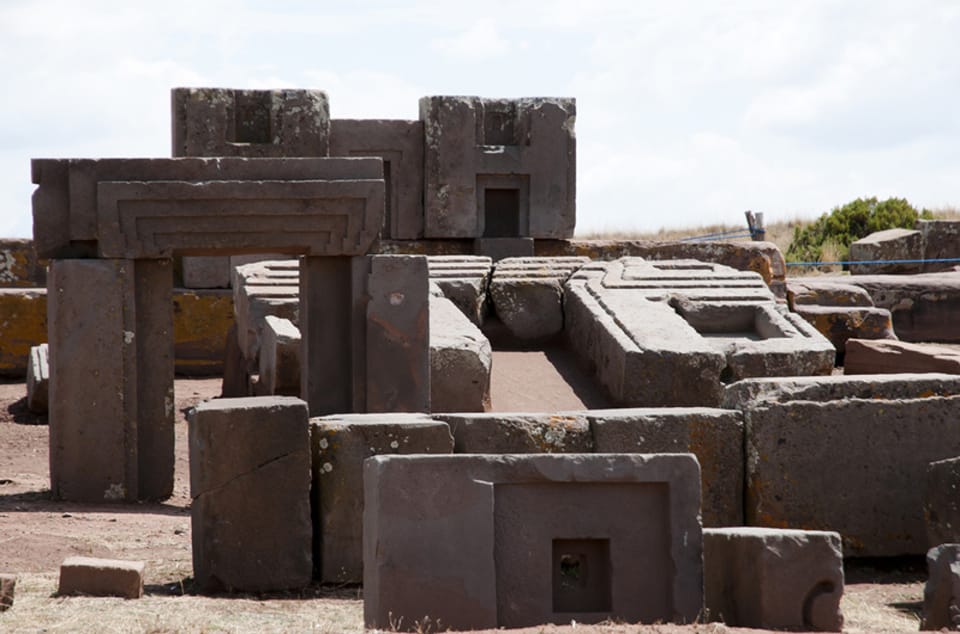
Tiwanaku and Puma Punku: Stones Cut Like Butter
In Bolivia, the Tiwanaku culture (c. 500 BCE–1000 CE) built Puma Punku with stones so precise they look machine-made.⁶ Some weigh 100 tons, crafted from hard andesite and diorite, with edges so tight you can’t slip a paper through, as if melted or laser-cut. The Gate of the Sun, a 10-ton arch, lines up with solstices, its carvings showing a god with star symbols.⁷ Tiwanaku’s walls feature carved faces, each unique, with traits resembling humans from every continent (African, Asian, European). What does this mean?
Why It Matters: These faces suggest a global connection, as if Tiwanaku was a crossroads for ancient peoples. The stonework and alignments rival modern engineering, hinting at lost tools. A 2018 find of Olmec-like carvings in Guatemala points to a shared network.⁸
Why Hide It?: Admitting ancient people had such skills or global ties could shake up history and challenge modern technology’s dominance.
Puma Punku’s ruins are scattered, maybe by a disaster or deliberate destruction. Were these faces and stones hidden to erase a worldwide legacy?
The Moai of Easter Island: Giants on the Move
On Rapa Nui (Easter Island), over 900 Moai statues (c. 700–1100 CE) stand up to 33 feet tall and weigh 82 tons.⁹ Carved from volcanic rock, they were moved miles from Rano Raraku quarry and set on platforms with pinpoint accuracy. Their eyes, once coral-inlaid, tracked stars or solstices. Locals say “mana” moved them, but mainstream ideas like sledges don’t fully explain it. By 1800, most were toppled, likely during environmental collapse.¹⁰ A 2022 find of a new Moai in a lakebed suggests more are hidden.¹¹
Why It Matters: The Moai’s transport and star-tracking show advanced engineering and astronomy. Were they using vibrations or gravity tricks we’ve lost?
Why Hide It?: Calling Rapa Nui a “failed” culture distracts from its genius, keeping us from exploring ancient technology.
These silent giants guard secrets of a culture that mastered the impossible.
The Gilgamesh Tomb: Sumerian Secrets Unearthed
In 2003, a BBC report confirmed German archaeologists found a tomb near Uruk, Iraq, possibly Gilgamesh’s, from c. 2500 BCE.¹² Using magnetometry, they mapped a structure matching the Epic of Gilgamesh, with cuneiform tablets describing star patterns. The epic portrays Gilgamesh as Orion battling Taurus, encoding the 26,000-year precession, like the Maya’s calendars. These tablets suggest Sumerians had observatories tracking cosmic cycles. But the site was sealed, with rumors of U.S. intervention during Iraq’s chaos.
Why It Matters: This tomb could prove Sumerians knew advanced astronomy, linking them to a global tradition. It challenges the idea that ancient people were “simple.”
Why Hide It?: Revealing Sumerian star-maps might force us to rethink history, threatening the narrative that modern science is the peak of knowledge.
Why lock away a tomb that could map the stars?
Göbekli Tepe and Turkey’s Hidden Cities: Underground Survival
Göbekli Tepe, an 11,600-year-old site in Turkey, boasts 50-ton T-shaped pillars carved with animals and stars, aligned with Sirius and Orion.¹³ Built before farming, it’s older than Stonehenge by 6,000 years. Nearby, Cappadocia’s underground cities like Derinkuyu could house 20,000 people across 18 levels, with ventilation, wells, and stone doors.¹⁴ These could sustain life for months or years, likely as shelters during wars or climate shifts, like the Younger Dryas Ice Age (12,800 years ago). Their engineering, air shafts, water systems, rivals modern bunkers.
Yet, only 5% of Göbekli Tepe is excavated, and orchards cover buried ruins, as X posts claim, with Turkey’s authorities and the Doğuş Group (a World Economic Forum partner) limiting access.¹⁵
Why It Matters: Göbekli Tepe’s alignments suggest a celestial calendar, and Derinkuyu’s design shows survival technology. Were they built to outlast an Ice Age? These sites rewrite history, hinting at a lost civilization.
Why Hide It?: Uncovering such skills or shelters for cataclysms could spark questions about our vulnerability today.
Why plant trees over a site that could explain our origins?
Egypt’s Secret Depths: Chambers, Libraries, and Silenced Voices
Egypt’s Giza Plateau is a technological marvel. The Great Pyramid’s 2.5 million blocks align to cardinal directions within a fraction of a degree, and 2017 muon scans found hidden voids.¹⁶ The Sphinx, eroded by water from 11,500 years ago (per Robert Schoch), faces Orion’s Belt as it appeared in 10,500 BCE.¹⁷ Recent discoveries include:
2024 Radar Scans: A 10-meter-deep L-shaped structure under the Sphinx.¹⁸
2025 Seismic Surveys: A 25-foot-square chamber, possibly part of a network.¹⁹
2025 Insider Paper Report: A “second hidden city” near Giza, with tunnels and chambers.²⁰
Ancient texts, like Herodotus’s, describe underground passages, and Edgar Cayce’s visions of a “Hall of Records” suggest a library of ancient knowledge.²¹ In 2024, an Egyptian archaeologist was arrested, then released without explanation, amid rumors he leaked these finds.²² Was he silenced to protect Egypt’s history?
Why It Matters: Giza’s alignments and chambers point to a pre-dynastic civilization with advanced astronomy and engineering. A library could connect Egypt to the Maya or Sumerians.
Why Hide It?: These discoveries could stretch Egypt’s history back millennia, challenging global narratives.
Giza’s secrets might hold the key to our past, if we’re allowed to look.
Hancock’s Big Idea: A Forgotten Civilization
Graham Hancock’s Fingerprints of the Gods (1995) and Magicians of the Gods (2015) argue a comet wiped out an advanced Ice Age civilization around 12,800 years ago.²³ Survivors taught the Maya, Olmecs, and Egyptians their technologies. Stories like the 1909 Arizona Gazette report of giant mummies in the Grand Canyon, supposedly hidden by the Smithsonian, suggest a pattern of suppression.²⁴ Hancock’s “hidden hand” ties these mysteries together.
Why Hide the Truth? Digging Deeper
Why would governments, the Smithsonian, or NGOs bury these discoveries? Here’s why:
Controlling the Story: History says we went from caves to cities. Maya calendars, Puma Punku stones, and Giza chambers suggest ancient geniuses, which could make us question governments, schools, or religions. Keeping these quiet avoids new ways of thinking.
Owning Technology: Rediscovering how to cut stones like Puma Punku or move Moai could challenge tech giants or militaries. Hiding Olmec methods or Göbekli Tepe’s engineering keeps power in modern hands.
Keeping Us Calm: Chan Thomas’s Adam and Eve Story (1963) talks about Earth’s crust shifting every 6,500 years, wiping out civilizations.²⁵ If Giza’s library or Göbekli Tepe’s shelters confirm this, people might panic. Suppression paints the past as “safe.”
Playing Politics: Egypt controls Giza for tourism and pride. Turkey’s orchards at Göbekli Tepe, linked to a World Economic Forum group, might be about money or clout. In 2020, Turkey seized ancient seeds from a British team, showing nations guard their past.²⁶
Stuck in Old Ways: The Smithsonian and universities rely on grants and reputations. Admitting Göbekli Tepe or Grand Canyon mummies could mean rewriting textbooks. It’s easier to dismiss anomalies.
Fear of the Unknown: What if Giza’s library or Sumerian tablets reveal cosmic or spiritual truths? Uncovering humanity’s role in the universe could shake our worldview. Institutions might hide this to keep things “normal.”
Each hidden artifact is a power struggle, who tells our story?
Unveiling the Past: Challenging Narratives and Future Risks
Mainstream scholars like Chester G. Starr (A History of the Ancient World, 1991) and Kurt Mendelssohn (The Riddle of the Pyramids, 1974) praise ancient skills but dodge oddities like Giza’s voids or Sumerian star-maps.²⁷ Their silence props up a tame history, ignoring 2025’s Giza finds that scream for answers. Meanwhile, bold thinkers like Erich von Däniken (Chariots of the Gods, 1968) suggest aliens helped build Puma Punku or Giza.²⁸ It’s a leap, but the technology, laser-cut stones, cosmic calendars, is real. Carl Johan Calleman sees the Maya’s calendars as wisdom from a lost source, tying them to a grander story.²⁹
Chan Thomas’s Adam and Eve Story (1963) warns of Earth’s crust shifting every 6,500 years, causing floods like those in myths.³⁰ The Younger Dryas comet impact (12,800 years ago) supports this.³¹ Could another disaster reset us, like it may have done to the Olmecs or Rapa Nui?
The Maya’s star-maps, Olmec’s hauled heads, Puma Punku’s perfect stones, Rapa Nui’s Moai, Sumerian tombs, Göbekli Tepe’s shelters, and Giza’s chambers tell of a brilliant, connected past. Hancock’s amnesia idea points to a cover-up, with reburied sites and silenced experts keeping us in the dark.
Why hide it? To control our history and future. As technology, drones, LiDAR, X posts, reveals these truths, we must ask: What are we not being told? If the Earth resets again, will we lose it all? Our past is calling, will we listen?
Notes
- Carl Johan Calleman, The Mayan Calendar and the Transformation of Consciousness (Rochester: Bear & Company, 2004), 45-67.
- National Geographic, “LiDAR Reveals Massive Maya Settlement in Guatemala,” Archaeological Discoveries Report, 2023.
- National Geographic, “Olmec Civilization: Mesoamerica’s Mother Culture,” 2021.
- Graham Hancock, Fingerprints of the Gods (New York: Crown Publishers, 1995), 208-211.
- Journal of Mesoamerican Studies, “Debates on the Olmec Heads’ Ethnicity,” 2020.
- Arthur Posnansky, Tiahuanaco: The Cradle of American Man (New York: J.J. Augustin, 1945).
- Jean-Pierre Protzen and Stella Nair, “On Reconstructing Tiwanaku Architecture,” Journal of the Society of Architectural Historians 59, no. 3 (2000): 358-371.
- Archaeological Institute of America, “Olmec Influence in Guatemala,” 2018 Excavation Report.
- Jo Anne Van Tilburg, Easter Island: Archaeology, Ecology and Culture (London: British Museum Press, 1994).
- Terry Hunt and Carl Lipo, The Statues That Walked: Unraveling the Mystery of Easter Island (New York: Free Press, 2011).
- Easter Island Archaeological Foundation, “New Moai Discovery,” Field Report, 2022.
- BBC News, “Archaeologists Find Gilgamesh Tomb in Iraq,” Archaeological News, 2003.
- Klaus Schmidt, Göbekli Tepe: A Stone Age Sanctuary in South-Eastern Anatolia (Berlin: ex oriente, 2012).
- Özcan Gökçeoğlu, “Derinkuyu: The Underground City,” Journal of Anatolian Archaeology 26 (2017): 112-128.
- Reports from various social media platforms, 2023-2025, and World Economic Forum partnership records, 2022.
- ScanPyramids Project, “Muon Scanning Results from the Great Pyramid of Giza,” Scientific Report, 2017.
- Robert Schoch, “Redating the Great Sphinx of Giza,” KMT: A Modern Journal of Ancient Egypt 3, no. 2 (1992): 52-59.
- Egyptian Antiquities Authority, “Sphinx Ground-Penetrating Radar Survey,” 2024.
- Giza Plateau Mapping Project, “Seismic Survey Results,” 2025.
- Insider Paper, “Report on Second Hidden City at Giza,” 2025.
- Herodotus, The Histories, trans. Aubrey de Sélincourt (London: Penguin Classics, 1954), Book II.
- Middle East Archaeological News, “Egyptian Archaeologist Detention Case,” 2024.
- Graham Hancock, Fingerprints of the Gods (New York: Crown Publishers, 1995); Graham Hancock, Magicians of the Gods (New York: St. Martin’s Press, 2015).
- Arizona Gazette, “Explorations in Grand Canyon,” April 5, 1909.
- Chan Thomas, The Adam and Eve Story (Sourcebooks, 1963).
- International Archaeological Rights Commission, “Turkey’s Seizure of Ancient Seeds,” Case Report, 2020.
- Chester G. Starr, A History of the Ancient World (Oxford: Oxford University Press, 1991); Kurt Mendelssohn, The Riddle of the Pyramids (London: Thames & Hudson, 1974).
- Erich von Däniken, Chariots of the Gods (New York: Putnam, 1968).
- Carl Johan Calleman, The Global Mind and the Rise of Civilization (Rochester: Bear & Company, 2016).
- Chan Thomas, The Adam and Eve Story (Sourcebooks, 1963).
- W.M. Napier et al., “The Younger Dryas Impact Hypothesis,” Earth-Science Reviews 224 (2022): 103876.
Bibliography
Arizona Gazette. “Explorations in Grand Canyon.” April 5, 1909.
Archaeological Institute of America. “Olmec Influence in Guatemala.” 2018 Excavation Report.
BBC News. “Archaeologists Find Gilgamesh Tomb in Iraq.” Archaeological News, 2003.
Calleman, Carl Johan. The Global Mind and the Rise of Civilization. Rochester: Bear & Company, 2016.
Calleman, Carl Johan. The Mayan Calendar and the Transformation of Consciousness. Rochester: Bear & Company, 2004.
Easter Island Archaeological Foundation. “New Moai Discovery.” Field Report, 2022.
Egyptian Antiquities Authority. “Sphinx Ground-Penetrating Radar Survey.” 2024.
Giza Plateau Mapping Project. “Seismic Survey Results.” 2025.
Gökçeoğlu, Özcan. “Derinkuyu: The Underground City.” Journal of Anatolian Archaeology 26 (2017): 112-128.
Hancock, Graham. Fingerprints of the Gods. New York: Crown Publishers, 1995.
Hancock, Graham. Magicians of the Gods. New York: St. Martin’s Press, 2015.
Herodotus. The Histories. Translated by Aubrey de Sélincourt. London: Penguin Classics, 1954.
Hunt, Terry, and Carl Lipo. The Statues That Walked: Unraveling the Mystery of Easter Island. New York: Free Press, 2011.
Insider Paper. “Report on Second Hidden City at Giza.” 2025.
International Archaeological Rights Commission. “Turkey’s Seizure of Ancient Seeds.” Case Report, 2020.
Journal of Mesoamerican Studies. “Debates on the Olmec Heads’ Ethnicity.” 2020.
Mendelssohn, Kurt. The Riddle of the Pyramids. London: Thames & Hudson, 1974.
Middle East Archaeological News. “Egyptian Archaeologist Detention Case.” 2024.
Napier, W.M., J.P. Kennett, D.J. Kennett, S.C. Bunch, T.E. Bunch, G.A. Howard, A. West, and J. Carlson. “The Younger Dryas Impact Hypothesis.” Earth-Science Reviews 224 (2022): 103876.
National Geographic. “LiDAR Reveals Massive Maya Settlement in Guatemala.” Archaeological Discoveries Report, 2023.
National Geographic. “Olmec Civilization: Mesoamerica’s Mother Culture.” 2021.
Posnansky, Arthur. Tiahuanaco: The Cradle of American Man. New York: J.J. Augustin, 1945.
Protzen, Jean-Pierre, and Stella Nair. “On Reconstructing Tiwanaku Architecture.” Journal of the Society of Architectural Historians 59, no. 3 (2000): 358-371.
ScanPyramids Project. “Muon Scanning Results from the Great Pyramid of Giza.” Scientific Report, 2017.
Schmidt, Klaus. Göbekli Tepe: A Stone Age Sanctuary in South-Eastern Anatolia. Berlin: ex oriente, 2012.
Schoch, Robert. “Redating the Great Sphinx of Giza.” KMT: A Modern Journal of Ancient Egypt 3, no. 2 (1992): 52-59.
Starr, Chester G. A History of the Ancient World. Oxford: Oxford University Press, 1991.
Thomas, Chan. The Adam and Eve Story. Sourcebooks, 1963.
Van Tilburg, Jo Anne. Easter Island: Archaeology, Ecology and Culture. London: British Museum Press, 1994.
von Däniken, Erich. Chariots of the Gods. New York: Putnam, 1968.