Hidden in Your DNA: The Jewish Roots of 152 Million People—and Why It Could Crush Antisemitism
For millennia, the Jewish people have lived in the diaspora. Scattered across the globe since the Babylonian Exile in the 6th century BCE. From the Iberian Peninsula to the Americas, from Southern Africa to the Middle East, we have faced persecution, expulsion, and the constant threat to our survival. To endure, many Jews became crypto-Jews hiding their identities. They adopted new names and blended into Christian, Muslim, or secular societies under the shadow of inquisitions, pogroms, and forced conversions. These hidden Jews, known as Conversos in Spain and Portugal or Anusim (the “forced ones” in Hebrew), carried their heritage in secret. Often losing it entirely over generations.
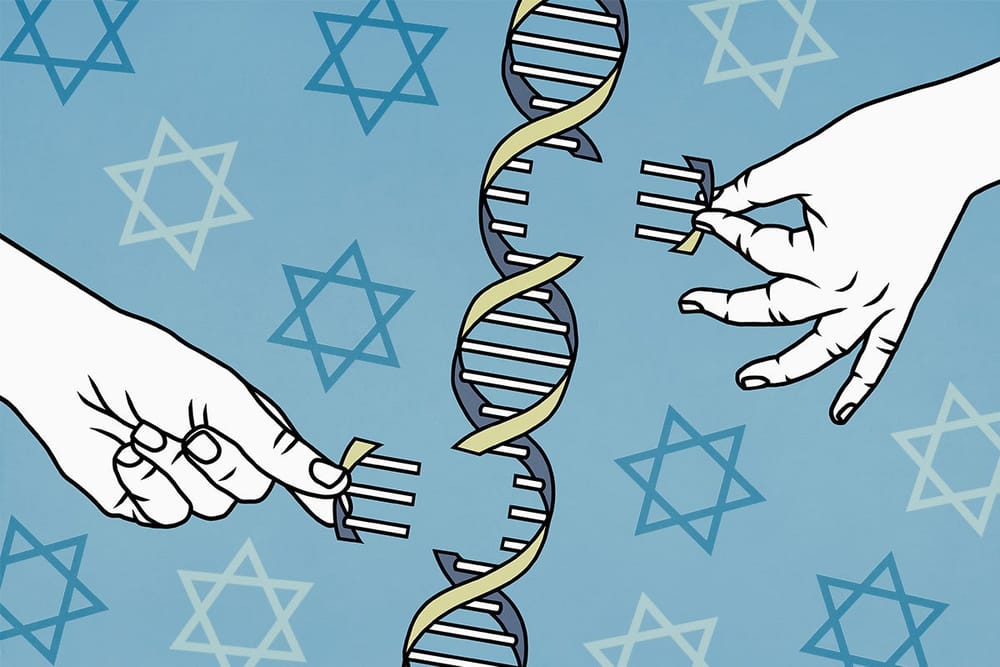
Today, a scientific revolution is unveiling these lost identities. Advances in genetic testing have revealed that millions worldwide perhaps as many as 152 million people, or 1.85% of the global population carry traces of Jewish ancestry in their DNA. In the United States alone, an estimated 15.8 million people, roughly 4.58% of the population, may have Jewish roots, often without knowing it. These discoveries raise profound questions. Would knowing their Jewish heritage change how people view themselves? If the world realized how many share this ancestry, would it foster understanding and reduce antisemitism? I believe it could. By embracing the truth of our shared histories, we might not only reconnect lost souls to their Jewish heritage but also challenge the hatred that has plagued our people for centuries.
The Hidden Legacy of the Diaspora
The Jewish diaspora is a story of resilience and survival. Since the Babylonian Exile (597–538 BCE), Jews have navigated a world that often rejected them. The destruction of the Second Temple in 70 CE, the Spanish Inquisition of 1492, and countless other expulsions forced Jews to adapt or perish. Many chose secrecy, becoming crypto-Jews who practiced their faith in hidden cellars or adopted Christian rituals publicly while whispering Hebrew prayers in private. In Spain and Portugal, Conversos faced scrutiny from the Inquisition, leading thousands to flee to the New World, where they hoped to escape persecution. Yet, even there, they often lived in fear. Their Jewish identity buried under layers of assimilation.
These hidden Jews left a genetic footprint. A 2018 study analyzed DNA from 6,589 individuals across five Latin American countries Brazil, Chile, Colombia, Mexico, and Peru. The results were staggering. Approximately 23% of those sampled had at least 5% Sephardic Jewish ancestry, averaging 1–4% across these nations. This translates to an estimated 136 million Latin Americans who may carry Jewish DNA, a legacy of Conversos who fled the Inquisition centuries ago. In the Iberian Peninsula itself, a 2008 study found that up to 20% of modern Spaniards and Portuguese roughly 12 million people have Sephardic ancestry, tied to historical conversions.
Beyond Iberia and Latin America, traces of Jewish ancestry appear in unexpected places. The Lemba tribe of South Africa and Zimbabwe carries Semitic Y-chromosome markers, with up to 50% of Lemba men and 53% of the Buba clan bearing the Cohanim Modal Haplotype a genetic signature linked to Jewish priestly lineages. This suggests that some 40,000 Lemba may descend from ancient Jewish or Semitic traders. Even in the United States, studies show that up to 38% of Hispanics in regions like New Mexico carry Sephardic or Cohanim markers, pointing to a crypto-Jewish legacy among an estimated 13 million Hispanic Americans.
These numbers are more than statistics. They are stories of survival, of ancestors who hid their menorahs, whispered Shema Yisrael in secret, and passed down fragments of identity that science is now rediscovering. Globally, an estimated 152 million people 1.85% of the world’s 8.2 billion may carry Jewish ancestry. In the US, 15.8 million 4.58% of 345 million share this heritage, often unknowingly. These “lost tribes” are woven into the fabric of humanity, their Jewish roots hidden until now.
Would They Want to Know?
Imagine discovering that your great-great-grandparent was a Converso, lighting Shabbat candles in a basement in 16th-century Mexico, or that your DNA traces back to a Jewish merchant who sailed to Southern Africa 2,000 years ago. For some, this revelation is a homecoming. Organizations like Reconectar and Bnai Anusim have emerged to help these individuals reconnect with their Jewish heritage. They offer resources to explore Judaism or even return to the faith.
But not everyone embraces this truth. For some, learning of Jewish ancestry might stir unease, especially in societies where antisemitism persists. Others may feel a sense of pride or curiosity, seeing their DNA as a bridge to a rich, resilient culture. The question is deeply personal. Would you want to know if part of your story was Jewish? For those who do, the discovery can be transformative. It offers a sense of belonging to a people who have endured and thrived against all odds.
Could Knowing Reduce Antisemitism?
Antisemitism has plagued humanity for centuries. It’s fueled by myths, stereotypes, and the scapegoating of Jews as “outsiders.” But what if the world knew that millions perhaps one in every 54 people globally carry Jewish ancestry? If 152 million people, from São Paulo to Seville, from Johannesburg to Albuquerque, share this heritage, the notion of Jews as “other” begins to crumble. DNA reveals that Jewishness is not just a religion or ethnicity but a thread woven into the human tapestry.
Consider the implications. If 15.8 million Americans nearly 1 in 20 have Jewish ancestry, antisemitism becomes a form of self-hatred for many. A 2019 survey found that 79% of Americans view antisemitism as a serious problem, yet incidents continue to rise, from vandalism to violent attacks. Could widespread knowledge of shared Jewish heritage shift this tide? I believe it could. When people see themselves in the “other,” empathy grows. Learning that your DNA carries a Jewish story might make you pause before tolerating hate or repeating stereotypes. It might inspire curiosity about Jewish culture its traditions, resilience, and contributions to science, art, and philosophy.
This isn’t just wishful thinking. Historical examples show that shared identity can bridge divides. In Spain, where Sephardic Jews were expelled in 1492, modern efforts to acknowledge Converso heritage have led to citizenship programs for descendants and a renewed interest in Jewish history. In Latin America, communities are rediscovering their roots, with some even reclaiming Jewish practices. These stories suggest that knowledge of shared ancestry can foster understanding, not division.
Real Stories of Rediscovery: From Hidden Roots to Embraced Heritage
The impact of these DNA revelations is vividly illustrated in real-life accounts. Take Bill Sanchez, a Roman Catholic priest in Albuquerque, New Mexico. In the early 2000s, Sanchez underwent a DNA test through Family Tree DNA, which revealed genetic markers on his Y-chromosome matching those found in about 30% of Jewish men. This included a signature associated with the Cohanim priesthood tracing back to biblical figures like Aaron, brother of Moses. This discovery prompted him to embrace his Jewish heritage publicly. He now wears a Star of David alongside his crucifix and displays a menorah in his office at St. Edwin Catholic Church.
Another compelling story is that of John Garcia, a former Catholic from El Paso, Texas. He learned at age 49 that his family had Sephardic Jewish roots. His father confided in him during his teenage years that they descended from Spanish Jews. It was a secret kept even from other family members who remained devout Catholics. Garcia’s brother later confirmed this through genealogical research, tracing their lineage to a Jewish congregation disbanded around 1596. Inspired by the Pope’s apology for the Inquisition, Garcia contacted Rabbi Stephen Leon after hearing about crypto-Judaism on a radio show. Over 15 years, he formally returned to Judaism. He learned Hebrew, read the Torah, and became an active leader in his congregation finding deep satisfaction and alignment with his ancestral faith.
These stories highlight how DNA and family history can unearth long-buried identities, leading individuals to reconnect with Judaism in meaningful ways. Perhaps you, too, have a similar hidden chapter in your ancestry waiting to be uncovered.
The Path Forward: Embracing Our Shared Humanity
The discovery of widespread Jewish ancestry is a call to action. For those with Jewish DNA, it’s an invitation to explore your heritage whether through genealogy, cultural study, or connecting with Jewish communities. For everyone else, it’s a reminder that our differences are often smaller than we think. If nearly 2% of the world and 5% of the US share Jewish roots, antisemitism isn’t just an attack on a minority it’s an attack on our collective history.
To combat antisemitism, we must educate. Share the science: 152 million people worldwide carry Jewish ancestry, from the Lemba’s ancient Semitic lineages to the Conversos of the New World. Encourage DNA testing to uncover personal stories. Support organizations that help crypto-Jewish descendants reconnect, like Shavei Israel or Bnai Zion. And most importantly, challenge hatred wherever it appears. Because when we know our shared roots, tolerance becomes not just a choice but a necessity.
A Call to Reflect
If you’ve ever considered a DNA test, now is the time. You might uncover a Jewish ancestor, a story of survival that ties you to a 3,000-year-old legacy. If you’re not ready to test, simply reflect. What if part of your heritage is Jewish? Would it change how you see yourself or others? And if you’re part of the Jewish community, reach out to those rediscovering their roots. Welcome them, share your traditions, and help them find their place.
The data is clear: Jewish ancestry is far more common than we once thought. In a world of 8.2 billion, 152 million of us carry this legacy. In the US, 15.8 million share it. These numbers aren’t just science they’re a testament to Jewish resilience and a challenge to antisemitism. By embracing our shared heritage, we can build a future where hate has no place, and where the lost souls of our tribe find their way home.
What are your thoughts? Have you discovered Jewish ancestry in your family, or do you know someone who has? Share your story in the comments, and let’s start a conversation about heritage, identity, and hope.
References:
Adams, S. M., E. Bosch, P. L. Balaresque, S. J. Ballereau, A. C. Lee, E. Arroyo, A. M. López-Parra, M. Aler, M. S. Grifo, M. Brion, A. Carracedo, J. Lavinha, B. Martínez-Jarreta, L. Quintana-Murci, A. Picornell, R. Montiel, M. Richards, O. Semino, D. A. Weiss, ... and M. A. Jobling. 2008. “The Genetic Legacy of Religious Diversity and Intolerance: Paternal Lineages of Christians, Jews, and Muslims in the Iberian Peninsula.” American Journal of Human Genetics 83(6): 725–736. https://doi.org/10.1016/j.ajhg.2008.11.007.
Bnai Zion. n.d. “Bnai Anusim.” Accessed August 22, 2025. https://www.bnaizion.org/bnai-anusim.
Chacón-Duque, J. C., K. Adhikari, M. Fuentes-Guajardo, J. Mendoza-Revilla, V. Acuña-Alonzo, J. M. Lozano, M. Quinto-Sánchez, J. Gómez-Valdés, P. Everardo-Martínez, H. Villamil-Ramírez, C. C. Silva de Cerqueira, A. Reséndez, G. Bedoya, F. Rothhammer, M. E. Resende de Morais, G. Bedoya, M. Polesel, A. Avendaño, ... and A. Ruiz-Linares. 2018. “Latin Americans Show Wide-Spread Converso Ancestry and Imprint of Local Native Ancestry on Physical Appearance.” Nature Communications 9(1): 5388. https://doi.org/10.1038/s41467-018-07748-z.
Government of Spain. 2015. “Law 12/2015, of 24 June, on the Granting of Spanish Nationality to Sephardic Jews Originating from Spain.” Accessed August 22, 2025. https://www.boe.es/buscar/act.php?id=BOE-A-2015-7045.
Hammer, M. F., D. M. Behar, T. M. Karafet, F. L. Mendez, B. Hallmark, T. Erez, L. A. Zhivotovsky, S. Rosset, and K. Skorecki. 2005. “Y-Chromosome Evidence for a Founder Effect in New Mexico Hispanics.” Unpublished data. Cited in Wade, N. 2000. “In DNA, New Clues to Jewish Roots.” The New York Times, December 5, 2000. https://www.nytimes.com/2000/12/05/science/in-dna-new-clues-to-jewish-roots.html.
Pew Research Center. 2019. “What Americans Know about the Holocaust.” Accessed August 22, 2025. https://www.pewresearch.org/religion/2019/10/17/american-jews-and-the-holocaust/.
Reconectar. n.d. “Helping Descendants of Sephardic Jews Reconnect with Their Heritage.” Accessed August 22, 2025. https://www.reconectar.org.
Shavei Israel. n.d. “Bnei Anusim: The Descendants of the Forced Converts.” Accessed August 22, 2025. https://www.shavei.org/communities/bnei-anusim/.
Spurdle, A. B., and T. Jenkins. 1996. “The Origins of the Lemba ‘Black Jews’ of Southern Africa: Evidence from p12F2 and Other Y-Chromosome Markers.” American Journal of Human Genetics 59(5): 1126–1133.
Thomas, M. G., T. Parfitt, D. A. Weiss, K. Skorecki, J. F. Wilson, M. le Roux, N. Bradman, and D. B. Goldstein. 2000. “Y Chromosomes Traveling South: The Cohen Modal Haplotype and the Origins of the Lemba the ‘Black Jews of Southern Africa.’” American Journal of Human Genetics 66(2): 674–686. https://doi.org/10.1086/302749.
Velez, C., J. A. Palacios, J. M. McCullough, and M. H. Crawford. 2012. “The Genetic Structure of a Hispanic Population in the United States and Ecuador: Implications for Genetic Association Studies.” Human Genetics 131(7): 1097–1109. https://doi.org/10.1007/s00439-011-1132-7.
Wade, N. 2000. “In DNA, New Clues to Jewish Roots.” The New York Times, December 5, 2000. https://www.nytimes.com/2000/12/05/science/in-dna-new-clues-to-jewish-roots.html.