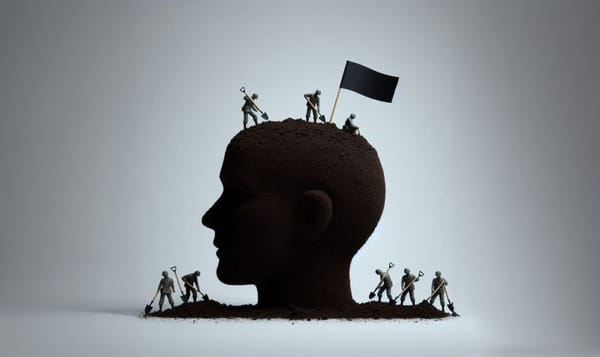
Silent Minds in a Digital Manipulation Trap
Silent Minds: A New Look at How People Think
What if the internal monologue you experience isn’t universal? While you might hear a voice narrating your thoughts, choosing your words, or rehearsing conversations, a substantial portion of people experience something fundamentally different. Their minds work through images, emotions, and abstract concepts rather than words. In an era dominated by visual platforms like TikTok and Instagram, understanding these cognitive differences matters more than ever.
The Diversity of Inner Experience
Most of us assume everyone thinks the way we do. That assumption breaks down when we examine the research. Morin and colleagues documented significant variation in how people experience inner speech, with some reporting constant verbal thoughts while others report very little.¹
The most rigorous evidence comes from Russell Hurlburt’s Descriptive Experience Sampling methodology. Rather than asking people to remember how they think, his team randomly prompts participants throughout their day to capture thoughts in real time. The findings challenge common assumptions: inner speech appears in only about 25% of sampled moments on average. More striking is the individual variation. Some people think verbally nearly all the time. Others almost never do.²,³,⁴
This isn’t about intelligence or capability. It reflects different cognitive architectures. A 2024 study by Nedergaard and Lupyan introduced the term “anendophasia” for individuals with minimal inner speech. Their research revealed specific trade-offs: people with low inner speech showed measurable deficits in verbal working memory tasks and struggled with rhyme judgments. However, they performed identically to high inner speech individuals on task-switching and perceptual challenges.⁵
Brain imaging confirmed these behavioral findings. People with minimal inner speech show distinct neural patterns, relying more heavily on visual and spatial processing regions.⁷,⁸ Their cognition operates through different channels, suggesting not a deficit but an alternative cognitive strategy.
Verbal Thought and Self-Regulation
The absence of inner speech has theoretical implications that extend beyond memory and rhyme detection. Lev Vygotsky argued that internalized speech serves as a cornerstone of self-regulation and higher-order thinking.¹⁰ Children develop this capacity gradually, and it becomes a tool for planning, evaluating, and controlling behavior.
Daniel Kahneman’s framework of dual-process cognition provides another lens. System 1 thinking operates quickly and intuitively, responding to immediate perceptual input and emotional cues. System 2 thinking is slower and more deliberate, requiring conscious effort to question assumptions and evaluate evidence.¹¹ Verbal reasoning appears central to engaging System 2 effectively.
Without robust inner speech, accessing deliberative reasoning may require different cognitive pathways. Jill Bolte Taylor’s memoir offers a compelling perspective. After a stroke temporarily disrupted her capacity for inner speech, she described losing the ability to guide and regulate her thoughts through language.¹² Her experience, though pathological in origin, mirrors what some individuals experience as their baseline cognition.
The philosophical concept of the mind as a blank slate, articulated by John Locke, takes on new relevance here.¹⁴ If experience writes on that slate, and inner speech serves as a tool for reflecting on and organizing those experiences, then minds without that tool might interact with incoming information differently. Nedergaard and Lupyan found that verbal memory patterns differ systematically in low inner speech individuals, which could shape how environmental information gets encoded and retrieved.¹⁵,²⁴
Vygotsky’s developmental research highlighted how children use inner speech to develop executive control.¹⁷ For individuals who don’t develop this capacity fully, alternative cognitive strategies emerge. Whether these strategies provide equivalent resources for critical evaluation remains an empirical question.
Visual Platforms and Cognitive Processing
Social media platforms have evolved into predominantly visual spaces. Instagram, TikTok, and YouTube prioritize images and videos over text. Billions of people spend hours daily in these environments. How different cognitive styles interact with this medium deserves scrutiny.
Robert Zajonc’s work on mere exposure provides relevant background. Repeated exposure to stimuli increases preference for them, often without conscious awareness of the process.²⁰,²² This happens to everyone, but the mechanism operates primarily through perceptual and affective channels rather than verbal reasoning.
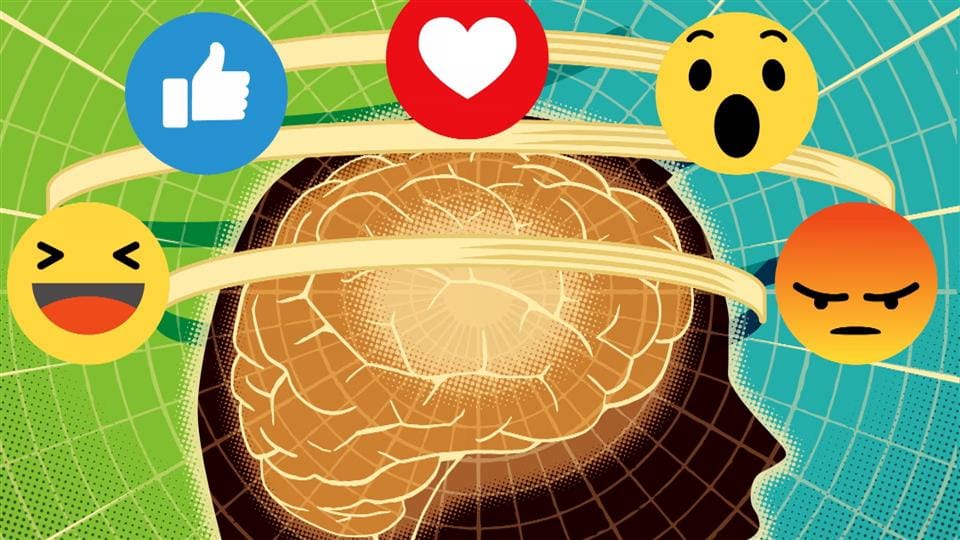
Marzouki and Oullier examined the neuroscience underlying social media engagement. Social approval signals like likes and shares activate reward-related brain regions, creating reinforcement loops that operate largely outside conscious deliberation.²¹ These mechanisms affect all users, but they may interact differently with different processing styles.
For someone who naturally processes information more visually than verbally, platforms built around images might feel particularly intuitive and engaging. The Nedergaard and Lupyan findings raise a question: do the verbal working memory differences they documented translate into differences in how people evaluate content on these platforms?⁵
Research on misinformation spread shows that emotional appeals play an outsized role, particularly during crises like the COVID-19 pandemic.²³ Emotional content bypasses analytical processing more easily than neutral information. However, we lack direct empirical evidence linking inner speech patterns to susceptibility to false information. While analytical thinking generally protects against misinformation, whether the specific verbal memory differences seen in low inner speech individuals affect real-world discernment remains unknown.
The proliferation of AI-generated video content adds complexity. As synthetic media becomes more sophisticated, all types of thinkers face new challenges in evaluation. How different cognitive styles handle this challenge demands investigation rather than assumption.
Open Questions and Future Directions
The evidence clearly establishes that inner speech varies dramatically across individuals. Hurlburt’s careful sampling work demonstrates this conclusively.² The 2024 Nedergaard and Lupyan study provides the strongest evidence yet for specific cognitive trade-offs associated with low inner speech, particularly in verbal working memory domains.⁵
What remains uncertain is how these laboratory findings translate to everyday behavior in digital environments. The theoretical connections are compelling. Kahneman’s distinction between intuitive and deliberative thinking,¹¹ Vygotsky’s emphasis on inner speech for self-regulation,¹⁰ and the visual nature of modern social platforms all suggest potential interactions. But theory isn’t data.
We need empirical research directly examining whether inner speech patterns predict different behaviors on social media. Do people with low inner speech engage differently with visual versus text-based content? Does their information evaluation process differ in ways that matter for distinguishing reliable from unreliable sources? How do they respond to emotionally charged versus neutral content?
Rather than assuming vulnerability, we should investigate systematically. Different cognitive styles likely bring different strengths and weaknesses to different contexts. Visual thinkers might excel at tasks where verbal thinkers struggle, and vice versa. Understanding these patterns could inform how we design information environments and educational interventions.
Cognitive diversity is a fact. The challenge lies in creating systems that serve all types of minds well. That requires moving beyond speculation to rigorous investigation of how different processing styles interact with the information environments we’ve created.
What do you think? How might cognitive diversity shape our collective experience of digital media? What research questions seem most urgent to address?
Notes
¹ Alain Morin, Bob Uttl, and Breanne Hamper, “Self-reported Frequency, Content, and Functions of Inner Speech,” Procedia - Social and Behavioral Sciences 30 (2011): 1714–1718. https://doi.org/10.1016/j.sbspro.2011.10.331. (Self-reports suggest frequent inner speech, often focused on self-evaluation.)
² Russell T. Hurlburt, Christopher L. Heavey, and Jason M. Kelsey, “Toward a Phenomenology of Inner Speaking,” Consciousness and Cognition 22, no. 4 (2013): 1477–1494. https://doi.org/10.1016/j.concog.2013.10.003; Christopher L. Heavey and Russell T. Hurlburt, “The Phenomena of Inner Experience,” Consciousness and Cognition 17, no. 3 (2008): 798–810. https://doi.org/10.1016/j.concog.2007.12.006. (Using Descriptive Experience Sampling, inner speech occurs in approximately 25% of random daily moments on average, with large individual differences.)
³ Hurlburt, Heavey, and Kelsey, “Toward a Phenomenology of Inner Speaking.”
⁴ Hurlburt, Heavey, and Kelsey, “Toward a Phenomenology of Inner Speaking.”
⁵ Johanne S. K. Nedergaard and Gary Lupyan, “Not Everybody Has an Inner Voice: Behavioral Consequences of Anendophasia,” Psychological Science 35, no. 7 (2024): 780–797. https://doi.org/10.1177/09567976241243004. (Low self-reported inner speech linked to deficits in verbal working memory and rhyme judgments; no differences in task-switching or perceptual tasks.)
⁷ Nedergaard and Lupyan, “Not Everybody Has an Inner Voice.”
⁸ Nedergaard and Lupyan, “Not Everybody Has an Inner Voice.”
¹⁰ L. S. Vygotsky, Mind in Society: The Development of Higher Psychological Processes, ed. M. Cole et al. (Harvard University Press, 1978).
¹¹ Daniel Kahneman, Thinking, Fast and Slow (Farrar, Straus and Giroux, 2011).
¹² Jill Bolte Taylor, My Stroke of Insight: A Brain Scientist’s Personal Journey (Viking, 2006).
¹³ Kahneman, Thinking, Fast and Slow; Vygotsky, Mind in Society.
¹⁴ John Locke, An Essay Concerning Human Understanding, ed. P. H. Nidditch (Oxford University Press, 1979).
¹⁵ Nedergaard and Lupyan, “Not Everybody Has an Inner Voice” (associates low inner speech with verbal memory differences).
¹⁷ Insights from Vygotsky on developmental role of inner speech.
²⁰ Robert B. Zajonc, “Attitudinal Effects of Mere Exposure,” Journal of Personality and Social Psychology 9, no. 2 (1968): 1–27. https://doi.org/10.1037/h0025848.
²¹ Y. Marzouki and O. Oullier, “The Neuroeconomics of Social Media,” Trends in Cognitive Sciences 16, no. 10 (2012): 487–488. https://doi.org/10.1016/j.tics.2012.08.006.
²² Zajonc, “Attitudinal Effects of Mere Exposure.”
²³ Studies on emotional appeals in misinformation (e.g., during COVID-19); no direct tie to inner speech.
²⁴ Nedergaard and Lupyan, “Not Everybody Has an Inner Voice.”
Bibliography
Heavey, Christopher L., and Russell T. Hurlburt. “The Phenomena of Inner Experience.” Consciousness and Cognition 17, no. 3 (2008): 798–810. https://doi.org/10.1016/j.concog.2007.12.006.
Hurlburt, Russell T., Christopher L. Heavey, and Jason M. Kelsey. “Toward a Phenomenology of Inner Speaking.” Consciousness and Cognition 22, no. 4 (2013): 1477–1494. https://doi.org/10.1016/j.concog.2013.10.003.
Kahneman, Daniel. Thinking, Fast and Slow. New York: Farrar, Straus and Giroux, 2011.
Locke, John. An Essay Concerning Human Understanding. Edited by P. H. Nidditch. Oxford: Oxford University Press, 1979.
Marzouki, Y., and O. Oullier. “The Neuroeconomics of Social Media.” Trends in Cognitive Sciences 16, no. 10 (2012): 487–488. https://doi.org/10.1016/j.tics.2012.08.006.
Morin, Alain, Bob Uttl, and Breanne Hamper. “Self-reported Frequency, Content, and Functions of Inner Speech.” Procedia - Social and Behavioral Sciences 30 (2011): 1714–1718. https://doi.org/10.1016/j.sbspro.2011.10.331.
Nedergaard, Johanne S. K., and Gary Lupyan. “Not Everybody Has an Inner Voice: Behavioral Consequences of Anendophasia.” Psychological Science 35, no. 7 (2024): 780–797. https://doi.org/10.1177/09567976241243004.
Taylor, Jill Bolte. My Stroke of Insight: A Brain Scientist’s Personal Journey. New York: Viking, 2006.
Vygotsky, L. S. Mind in Society: The Development of Higher Psychological Processes. Edited by M. Cole et al. Cambridge, MA: Harvard University Press, 1978.
Zajonc, Robert B. “Attitudinal Effects of Mere Exposure.” Journal of Personality and Social Psychology 9, no. 2 (1968): 1–27. https://doi.org/10.1037/h0025848.