The Apex Paradox
The Evolutionary Reason Certain People Feel Chronically Out of Place
Too Bright to Bear: Part II
The first piece I wrote under this title (Too Bright to Bear: The Lonely Path of Truth-Seekers) opened with Plato’s cave. Prisoners chained since birth, watching shadows on a wall, mistaking them for reality. One escapes, finds the sunlit world outside, and makes the mistake of going back to share what he saw. They don’t follow him. They shun him. The truth he carries threatens the only world they know.
That essay made the external case. It traced the institutional machinery built to reward the specialist and exile the synthesizer: from the Rockefeller-funded Flexner Report that erased holistic medicine from American professional life, to the conformity-enforcing oversight bodies that still govern academia, law, and science today. It catalogued the historical dead: Socrates executed, Spinoza excommunicated, Galileo silenced, Lovelace ignored for a century. The pattern across every era is the same. The person who sees too clearly through too many walls gets pushed to the margin, and society has always found a way to manage that particular discomfort.
What I didn’t write about, because I hadn’t yet assembled the language for it, is the internal case.
For most of my life I carried a loneliness that didn’t respond to the usual interventions. I tried openness. I tried selectivity. I tried showing up more and pulling back. None of it touched the underlying thing, that low persistent hum of not quite fitting, not quite landing, not quite being met at the place where I actually stood. I did what most people do with a pain that won’t resolve: I told myself it was temporary, that the right people were coming.
There was something else, too. In conversations I kept doing a thing I couldn’t stop. I could see where a sentence was going before it finished. I would cut in, not from rudeness, or not only from rudeness, but because my brain had already run the logic forward and was impatient with the preamble. The conclusion was obvious to me. What wasn’t obvious was why it left people cold, why it read as dismissal rather than engagement. I wanted more from every exchange, not less. I wanted to get past the pleasantries and reach the part where thinking actually happened. Most people found that exhausting, and a few found it threatening. I found their preferred pace close to unbearable, and that mismatch quietly built a wall I spent years mistaking for a personal defect.
What nobody explained across four years of psychology and business coursework, or in the MBA work that came after, is that the isolation was not circumstantial. It had a structure. A name. Once I understood the name, I stopped interpreting my entire adult life as evidence of a personal failing.
The concept is called the apex paradox. It comes out of evolutionary psychology, and it may be the most clarifying thing I have encountered about why some people feel alone most of their lives without ever understanding why.
The Paradox Itself
The principle draws from basic evolutionary biology. As an organism becomes more specialized, more precisely adapted to a particular niche, its circle naturally narrows. Generalist organisms thrive in groups because they need the group. The collective intelligence and shared labor of the herd compensate for what no single member can do alone. Apex organisms move differently. Their isolation is not a wound. It is an outcome of what they are.
Applied to human psychology, the logic runs like this: the further you develop toward the upper edge of any capability, whether that is integrative thinking, perceptual acuity, moral sensitivity, or strategic foresight, the more you exceed the social bandwidth of most environments you inhabit. The people around you are not lesser. They are calibrated for a different niche. The gap between your frequency and theirs is not something warmth or effort or communication skill can close, because it is not a communication problem. It is an architectural one.
John Cacioppo, the late neuroscientist at the University of Chicago whose decades of research on loneliness remain the field’s foundation, established that approximately fifty percent of an individual’s susceptibility to isolation is heritable.¹ Not shaped primarily by what happened to you, but encoded in what you were born as. His research further showed that loneliness operates like a biological signal: like hunger, it evolved to motivate reconnection, but that signal misfires chronically in people whose social environment simply cannot provide the depth of connection their nervous system requires.² The pain is not a malfunction. It is a measure of what went unrealized.
Two Systems, One Mismatch
Before cataloguing the specific traits, it is worth pausing on something that underlies almost all of them. Daniel Kahneman’s work on cognition made it impossible to ignore. In Thinking, Fast and Slow, Kahneman describes two modes of thought that operate in constant tension.³ System 1 is automatic and associative. It reads a room in a glance and flags the anomaly before the conscious mind has named it. System 2 is deliberate and effortful. It checks the fast read, runs the logic, sits with the contradiction.
Most people live in System 1. The social world runs on it. Pleasantries, consensus, the easy flow of conversation that doesn’t go anywhere in particular: all of it is System 1 behavior, and it serves a real function. It keeps the group cohesive. For most people, System 2 is something they reach for when the stakes demand it, not a mode they inhabit.
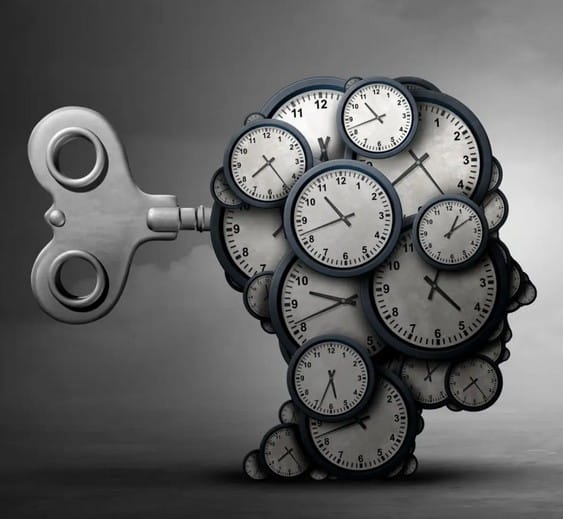
For the people this essay describes, that architecture is inverted. System 2 is not a gear they shift into. It is simply on, all the time, in every room they enter. The pattern recognition fires without being asked. The simulation runs forward whether they want it to or not. The gap between what someone is saying and what their body is communicating gets logged involuntarily. Running that kind of analytical load in environments built for something much lighter is exhausting in a way that is hard to explain to people who don’t experience it. And the social cost is consistent: people who are comfortable in System 1 feel unsettled by someone who won’t stay there with them. They call it intensity. They back away from it without quite knowing why.
This is also, I think, why the interrupting happens. When you can see the conclusion forming before the other person has reached it, waiting feels like a strange performance. The brain has already arrived. Sitting still while someone walks toward a destination you reached ten seconds ago feels, from the inside, like treading water. What it looks like to the other person is that you don’t care where they were going. The tragedy is that you almost certainly care more than anyone else in the room. You just got there first, and nobody asked you to.
Seven Things That Were Always True About You
I want to be careful here. What follows is not a list of virtues. These are not traits that make you superior to the people around you. They are traits that make you structurally incompatible with most available social environments, and understanding them as such is the difference between spending another decade blaming yourself and spending the next one building something worth having.
1. Hyperacute Pattern Recognition
Your brain does not process social information the way most people’s do. It doesn’t receive the words and accept them. It runs simultaneous tracks: what was said, what the body did while saying it, what was conspicuously not said, the micro-shift in eye contact half a second before the agreement came. Psychologists call this thin slicing, the ability to extract accurate meaning from very narrow windows of behavior, and research shows it operates below the threshold of conscious choice in the people who have it.⁴ You are not doing it deliberately. It is happening to you in every social situation you enter, whether you want it to or not.
A room full of people becomes a deafening data stream, a simultaneous broadcast from every person present about the gap between their performed self and their actual one. Nearly all social interaction involves a managed distance between inner state and outward expression. This is not dishonesty exactly; it is the lubrication that keeps groups from collapsing under the weight of everyone’s unfiltered interiority. But when that gap is visible to you, you cannot participate in the performance because you can’t stop perceiving it as one. People sense this quality of observation and it makes them uneasy. They call you intense. They call you hard to read. What they mean is that you function as a mirror, and the reflection is not what they came for. The loneliness that produces is not the loneliness of being disliked. It is the loneliness of clarity.
2. High Need for Cognition
Researchers in personality psychology describe what they call high need for cognition: a biological drive toward ideas and away from noise.⁵ Most social interaction is, in the language of thermodynamics, entropy. It tends toward disorder and randomness, the recycled complaint, the shared contempt for a colleague, the conversation that circles back to where it started. These exchanges serve a real function in maintaining group cohesion, but they generate nothing and demand nothing. For most people they are pleasantly neutral. For people with high need for cognition they are physiologically costly in a way that is not a preference or an attitude. It is a body telling you that you are burning energy on something that produces no return.
What I have always wanted, and what you likely want too, is the conversation that goes somewhere neither person planned. The kind where both parties leave with their thinking rearranged and can’t quite account for how it happened. I have spent most of my life looking for those conversations. They are rare not because interesting people are rare, but because the combination of depth and trust and mutual willingness to be changed by the exchange is genuinely uncommon. You will move through many environments before you find the density of people who can sustain that kind of exchange, and that is not a judgment of anyone. It is a description of distribution.
3. The Refusal to Submit to Arbitrary Authority
Solomon Asch demonstrated in his conformity experiments that roughly three-quarters of people will agree with an obvious factual error rather than stand apart from the group.⁶ The social cost of dissent activates the same neural threat circuitry as physical danger. For most people the calculation runs fast: conform, stay warm, stay safe. For a specific subset, the calculation inverts. Conformity itself triggers the threat response. Submitting to a demand for agreement without evidence, for loyalty without reason, for consensus without examination does not feel like safety. It feels like suffocation.
This is not contrarianism. It is a nervous system that requires logic and proof before it can extend trust, one that cannot register popularity or authority as sufficient grounds for belief. The problem is that many social circles are organized precisely around a dominant figure who needs agreement to feel stable. The moment you ask why, you become a problem. Groups exile you for it, and the exile is designed to hurt enough that you come back willing to comply. When you don’t, when you use the expulsion to build instead of beg, it genuinely confuses them. They don’t know what to do with a person who doesn’t need to be let back in.
4. The Architect’s Obsession
There are phases in certain lives where the social world falls away, not through rejection but through possession. You have a vision of what you could become or what you could build, and that vision has colonized the cognitive architecture that most people use for social maintenance. Neuroscience has mapped two primary brain networks that are essentially anti-correlated: the default mode network, which handles social cognition and self-referential thinking, and the task-positive network, which handles deep focus and execution.⁷ When one is fully running, the other quiets. You cannot simultaneously build something serious and maintain a rich social life. That is not a character flaw. It is a neurological constraint, and the historical record bears it out. The people whose names we still carry were not known for their social calendars. They were known for the single-minded focus that the social calendar crowds out. Wanting to change the world is not a modest ambition, and it does not coexist peacefully with small talk.
5. The Mirror Dynamic
This one is harder to sit with, because it describes something you do without intending to. A person who is self-aware, self-sufficient, and not particularly invested in managing others’ impressions of them becomes an uncomfortable screen for people carrying unacknowledged shame or insecurity. Jung wrote about the shadow, the parts of the self that are disowned and projected outward onto people who trigger their recognition.⁸ Your silence makes their internal noise louder. Your self-containment highlights their dependency. Your refusal to need validation from the room reminds them, below the level of articulation, of their own hunger for it. The human ego converts that discomfort into aggression. They attack you to destroy the mirror. You become the villain in a story where the actual problem is the narrator.
Most friendships contain a significant element of mutual validation: a reciprocal agreement to ratify each other’s narratives about why their failures are not their fault. There is real warmth in this, and it is a recognizably human thing. But when you won’t enter the transaction, when you ask the person describing the same crisis for the fourth consecutive year how they plan to fix it, you break a contract the other person didn’t know existed until you violated it. The exile that follows is not about you. It is about the fact that you refused to help them hide from themselves.
6. Temporal Displacement
You run longer simulations than the people around you. When someone describes a plan, you are already watching it fail three moves ahead and trying to work backward to the point of origin. When the room is celebrating a win, you are already modeling what it costs in the long run. This is not pessimism. It is a different relationship to time.
Evolutionary psychologists Norman Li and Satoshi Kanazawa found, through their savanna theory of happiness, that highly intelligent individuals are significantly better equipped to adapt to evolutionarily novel circumstances than the population at large.⁹ Less intelligent individuals suffer more when cut off from the dense social contact that characterized ancestral life. More intelligent individuals, whose cognition evolved precisely to handle novel situations, are far less reliant on that constant social reinforcement to feel grounded. They have moved further from the ancestral baseline. They are already living in a mode the group has not yet arrived at. You are the sentinel on the wall, watching the horizon while the city sleeps. You see the wolf before anyone wakes up to ask where the chickens went. They call you paranoid, right up until the thing you anticipated arrives, at which point they want to be near you. By then you have usually understood something that took a long time to accept: you can care deeply about people who cannot see what you see, but you cannot be close with them in the way that genuine friendship requires mutual comprehension. The gap is not about intelligence. You are simply living further into the future than they have arrived.
7. The Autotelic Personality
Psychologists describe the autotelic personality as someone whose motivation is internal rather than external.¹⁰ Most people require fuel from outside to maintain their sense of being real: validation, attention, the witness of others. The threat of exclusion works on them because it threatens to cut off the supply. You are different in a specific way. You read because you need to know, not because reading signals something about you to someone watching. You build because the thing demands to be built, not because the outcome will be applauded. This makes you, in the social economy of mutual dependency that most human communities run on, a kind of glitch. People who cannot bribe you with attention or punish you with silence have no leverage, and nothing to work with reads as a threat to people who depend on those tools.
What These Traits Produce Together
Consider them assembled. You see through performance. You require depth. You cannot submit to authority without evidence. You are possessed by building. You force self-awareness that nobody requested. You live further into the future than your surroundings will follow. And you cannot be managed through the threat of exclusion. Each of these traits generates friction on its own. Together they describe a person who is structurally incompatible with ordinary social domestication, not better, not worse, but genuinely mismatched to environments that were not calibrated for what you are.
Add to this the cognitive architecture Kahneman maps, and the picture sharpens. A world running mostly on System 1 does not reward the person who cannot stop running System 2. The fast, affiliative, consensus-seeking mode that keeps groups together is precisely the mode that feels least natural to you. You are not broken. You are running a different operating system, one that is slower to warm, harder to fool, and constitutionally unable to pretend it hasn’t noticed what it has noticed.
Society, understood honestly, is a system designed to produce manageable, consuming, predictable participants. Education trains repetition. Work trains obedience. Social circles train conformity. You failed the training not because you are broken but because your psychology rejected the update. And because you wouldn’t be domesticated, you got pushed to the margin. You have been sitting there ever since, looking at the village lights and wondering what is wrong with you.
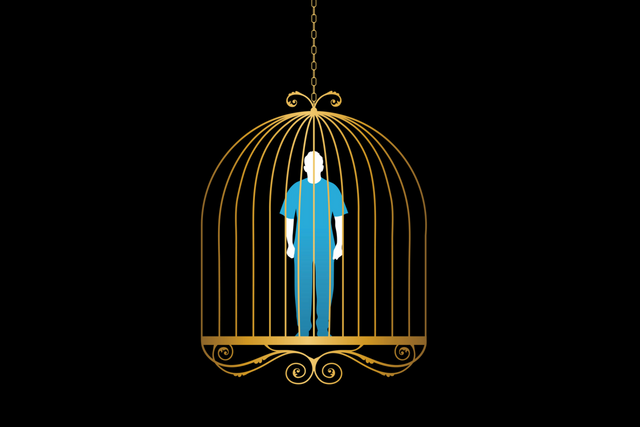
Nothing is wrong with you. You don’t fit in because you were never built for the cage.
The Trap That Opens Here
I have to say this clearly, because it is where many people like this go wrong. When isolation persists long enough, the mind begins to absorb the surrounding verdict. Maybe they are right. Maybe this is arrogance dressed up as insight. Maybe I am simply unlovable. From that place, two things tend to happen, and both are forms of self-destruction.
The first is lowering the standard. You let someone in not because they can meet you, but because the silence became unbearable. The second is returning to the herd, performing contentment with the shallow, draining yourself daily to simulate a belonging you don’t actually feel. Neither resolves anything. A wolf pretending to be a sheep doesn’t fool the sheep. It frightens them and starves itself at the same time.
When you compress yourself to fit an environment that cannot hold you, you don’t find connection. You find a more crowded version of the same loneliness, except now you are performing it. The loneliness of the mask is heavier than the loneliness of solitude, because solitude at least allows you to remain yourself.
The answer is to maintain the standard even when the cost is high. Not from arrogance, not from some performed stoicism, but because the moment you signal willingness to accept less than what you actually need, you will get less. One person who can genuinely meet you is worth a decade of relationships built on mutual diminishment. That is not a comfortable thing to commit to. But it is the only version of the commitment that has any chance of working.
What Changes When You Name It
In the first piece, I gave you the external architecture of this isolation: the systems, the histories, the deliberate institutional mechanisms that have always managed their most illuminated members through exile and marginalization. This piece gives you the internal one. The seven traits, the neuroscience behind them, the evolutionary logic of why the specific combination of things you are tends to produce the specific experience of isolation you have lived most of your life, and the cognitive layer underneath all of it: the System 2 mind running hot in a System 1 world, seeing the conclusion before the sentence ends, paying the social cost of a perception nobody asked you to have.
Together, what these pieces describe is something real and difficult that has, finally, after carrying it without a name for most of a lifetime, a name. You are not a social failure. You are not broken in the way the silence has sometimes suggested you might be. You are a specific kind of person living in an environment that was not built for what you are, carrying traits that history has consistently punished while also depending on them to move forward.
Plato’s freed prisoner does not stay comfortable in the cave. They return with what they have seen, knowing the reception will be hostile, because they cannot unknow what they know. The isolation is the cost of the clarity, and the clarity, however lonely, is not something you would trade.
The empty chair across from you is not a monument to failure. It is reserved. It holds space for the people who can meet you where you actually are. They exist. They are out there right now building in their own silence, waiting for the signal that they are not alone in this. Your solitude is not punishment. It is the condition under which you become capable of the thing you were built to do.
Stop filling it with noise just to make it bearable. Honor the silence. Something worth waiting for is coming.
Notes
1. John T. Cacioppo, Stephanie Cacioppo, and Dorret I. Boomsma, “Evolutionary Mechanisms for Loneliness,” Cognition & Emotion 28, no. 1 (2014): 3–21.
2. John T. Cacioppo, Mary Elizabeth Hughes, Linda J. Waite, Louise C. Hawkley, and Ronald A. Thisted, “Loneliness as a Specific Risk Factor for Depressive Symptoms: Cross-Sectional and Longitudinal Analyses,” Psychology and Aging 21, no. 1 (2006): 140–151.
3. Daniel Kahneman, Thinking, Fast and Slow (New York: Farrar, Straus and Giroux, 2011).
4. Nalini Ambady and Robert Rosenthal, “Thin Slices of Expressive Behavior as Predictors of Interpersonal Consequences: A Meta-Analysis,” Psychological Bulletin 111, no. 2 (1992): 256–274.
5. John T. Cacioppo and Richard E. Petty, “The Need for Cognition,” Journal of Personality and Social Psychology 42, no. 1 (1982): 116–131.
6. Solomon E. Asch, “Effects of Group Pressure upon the Modification and Distortion of Judgments,” in Groups, Leadership and Men, ed. Harold Guetzkow (Pittsburgh: Carnegie Press, 1951), 177–190.
7. Randy L. Buckner, Jessica R. Andrews-Hanna, and Daniel L. Schacter, “The Brain’s Default Network: Anatomy, Function, and Relevance to Disease,” Annals of the New York Academy of Sciences 1124 (2008): 1–38.
8. Carl G. Jung, Aion: Researches into the Phenomenology of the Self, trans. R. F. C. Hull (Princeton: Princeton University Press, 1959).
9. Norman P. Li and Satoshi Kanazawa, “Country Roads, Take Me Home… to My Friends: How Intelligence, Population Density, and Friendship Affect Modern Happiness,” British Journal of Psychology 107, no. 4 (2016): 675–697.
10. Mihaly Csikszentmihalyi, Flow: The Psychology of Optimal Experience (New York: Harper and Row, 1990).
Bibliography
Ambady, Nalini, and Robert Rosenthal. “Thin Slices of Expressive Behavior as Predictors of Interpersonal Consequences: A Meta-Analysis.” Psychological Bulletin 111, no. 2 (1992): 256–274.
Asch, Solomon E. “Effects of Group Pressure upon the Modification and Distortion of Judgments.” In Groups, Leadership and Men, edited by Harold Guetzkow, 177–190. Pittsburgh: Carnegie Press, 1951.
Buckner, Randy L., Jessica R. Andrews-Hanna, and Daniel L. Schacter. “The Brain’s Default Network: Anatomy, Function, and Relevance to Disease.” Annals of the New York Academy of Sciences 1124 (2008): 1–38.
Cacioppo, John T., Stephanie Cacioppo, and Dorret I. Boomsma. “Evolutionary Mechanisms for Loneliness.” Cognition & Emotion 28, no. 1 (2014): 3–21.
Cacioppo, John T., Mary Elizabeth Hughes, Linda J. Waite, Louise C. Hawkley, and Ronald A. Thisted. “Loneliness as a Specific Risk Factor for Depressive Symptoms: Cross-Sectional and Longitudinal Analyses.” Psychology and Aging 21, no. 1 (2006): 140–151.
Cacioppo, John T., and Richard E. Petty. “The Need for Cognition.” Journal of Personality and Social Psychology 42, no. 1 (1982): 116–131.
Csikszentmihalyi, Mihaly. Flow: The Psychology of Optimal Experience. New York: Harper and Row, 1990.
Jung, Carl G. Aion: Researches into the Phenomenology of the Self. Translated by R. F. C. Hull. Princeton: Princeton University Press, 1959.
Kahneman, Daniel. Thinking, Fast and Slow. New York: Farrar, Straus and Giroux, 2011.
Li, Norman P., and Satoshi Kanazawa. “Country Roads, Take Me Home… to My Friends: How Intelligence, Population Density, and Friendship Affect Modern Happiness.” British Journal of Psychology 107, no. 4 (2016): 675–697.