The Hidden Secrets of the Baigong Pipes
The Mystery of the Baigong Pipes
Deep in the fog-laced peaks of China’s Qinghai Province, near the isolated city of Delingha, whispers of an ancient enigma echo through time. The Baigong Pipes haunt the imagination. These eerie, metallic tubes jut from cave walls and lie buried in rock older than humanity itself. They defy explanation. Could these be remnants of a lost civilization’s machinery, built by “sky people” before a global cataclysm wiped the slate clean? Or perhaps something more sinister unfolds, with governments and scientists concealing the truth behind “natural” cover stories.¹
A Mountain of Mysteries
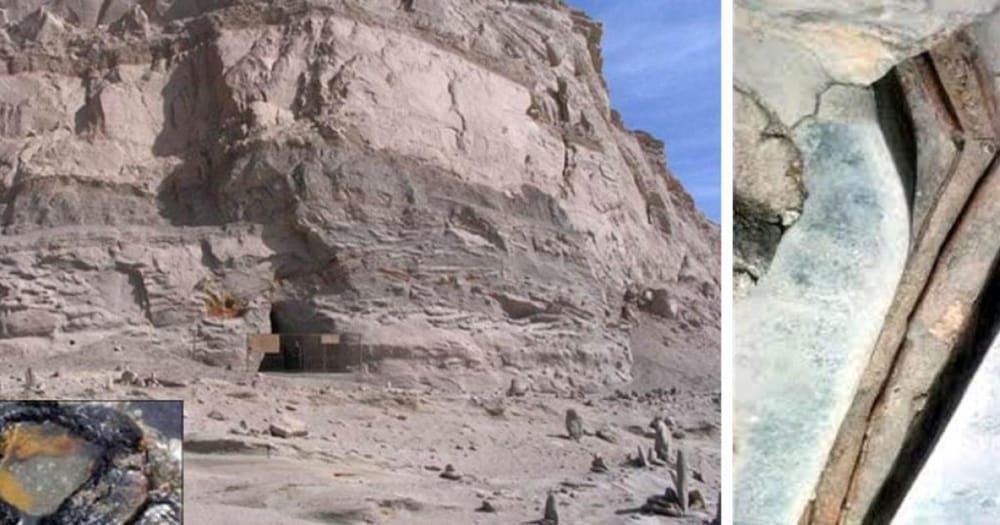
Picture this. A pyramid-shaped mountain, Mount Baigong (or White Mountain), hides three mysterious caves. Two have collapsed, sealing their secrets forever. The third towers 6 meters high and reveals a massive 40-cm-wide pipe snaking from floor to ceiling. Smaller tubes scatter like veins across the rock. Some are barely toothpick-thin. They even plunge into the salty depths of nearby Tuosu Lake, 80 meters away, as if part of a submerged network.²
Recent buzz questions the viral images. Some look AI-tweaked or misleading, with uniform, ribbed designs that don’t match real photos. The actual pipes appear as rusty, irregular concretions or columnar formations. But even “enhanced” imagery sparks modern myths. These fuel speculation that elites are doctoring visuals to downplay the site’s true intrigue.³
Discovery and Official Response
Fossil hunters unearthed the site in the late 1990s, sparking hushed official probes. By 2002, Qinghai officials like Quin Jianwen leaked details to state media giant Xinhua. They hinted at “rusty scraps” and bizarre stones that screamed artificial design. Reports soon flooded outlets like People’s Daily. Meanwhile, the government quietly turned the area into a tourist trap with signs and guides. Was this to control the narrative? Or perhaps to sensationalize for economic gain?⁴
Shocking Timeline Evidence
The dating shocks conventional timelines. The rock around these pipes clocks in at 150,000 years old. This predates human metalworking by eons. Labs from the Beijing Institute of Geology and Chinese Academy of Social Sciences dissected samples. They found 30% iron oxide, heaps of silicon and calcium, plus 8% “unidentified” stuff that fuels wild theories. A 2003 Xinmin Weekly piece revealed plant-like organic matter and tree rings inside. Were these fossilized roots or a clever disguise? Local expert Liu Shaolin confirmed sky-high iron levels. A 2007 Chinese Earthquake Administration report dropped a bombshell: Some pipes are radioactive. Why the silence on that particular detail?⁵
The radioactivity ties into the Qaidam Basin’s geothermal vents and salt lakes, where mineral deposition could explain the “unidentified” 8% as rare earth elements or microbial residues. A 2017 study on microbial diversity in the Keluke-Tuosu Lake Wetland Reserve hints at bacteria aiding iron buildup. Is this nature’s alchemy or a cover for ancient tech experiments?⁶
Scientific Explanations or Cover-Up?
Scientists like Yang Ji toyed with “intelligent design” ideas before backpedaling to “natural” excuses. They suggested fossilized tree roots or iron-filled cracks from ancient floods and tectonic shifts. Recent analyses from 2023-2025 emphasize iron-rich concretions from hydrothermal activity or root casts. They compare them to U.S. sites like Navajo Sandstone pipes in Louisiana. No solid proof of artificiality exists in official Chinese reports, they say. But why do these “natural” explanations feel so conveniently tidy, ignoring the high iron that doesn’t fit simple roots?⁷
Ancient Legends and Connections
Local legends among Tibetan and Mongol nomads go deeper than mere “sky people” tales. They link to Bon religion’s flood myths, stories of deluges sent by deities, ancient migrations, and kings descending from the heavens. These echo real geological events like ancient lake fluctuations. But could they mask memories of a pre-human society erased by catastrophe?⁸
Recent Developments Fuel Speculation
Recent developments amp up the conspiracy. Discussions between 2024-2025 tie in genetic links to Denisovans, who roamed the Tibetan Plateau 160,000 years ago. Could these archaic humans or their hybrids have forged the pipes from local ores, adapting to high altitudes with technology now buried? Climate models show ancient floods from glacial melts flooding the Qaidam Basin. These align with global OOPArt patterns like similar “pipes” in Turkey’s Cappadocia or Russia’s Putorana Plateau.⁹
A 2024 mineral survey from China’s Geological Bureau highlights iron ores in the basin. These would be perfect for ancient smelting. Yet official reports stay sparse on .gov.cn sites. Xinhua and People’s Daily archives from 2002-2003 confirm the initial hype but offer little follow-up.¹⁰
Challenging the Narrative
What if these aren’t accidents of nature, but relics of a pre-human technology shrouded by elite secrecy? The Baigong Pipes beckon us to peel back the layers of history. They dare us to challenge the sanitized narratives of “official” science. Are they evidence of ancient visitors from beyond our world? Or perhaps a chilling warning of a forgotten past? The answer could rewrite the story of humanity itself. We’re left wondering what other mysteries lie buried beneath the Earth’s surface, waiting to be unearthed.
Notes
- “Baigong pipes,” Wikipedia, accessed September 3, 2025, https://en.wikipedia.org/wiki/Baigong_pipes; “150000-Year-Old Pipes Baffle Scientists in China,” Ancient Origins, July 6, 2024, https://www.ancient-origins.net/ancient-technology/150000-year-old-pipes-baffle-scientists-china-out-place-time-001783.
- “Baigong pipes,” Wikipedia; “Baigong Pipes Mystery: The Iron Pipes Buried in China’s Mountains,” SlashLore, accessed September 3, 2025, https://www.slashlore.com/baigong-pipes-mystery/; “Mysterious metallic pipe found in a remote mountain, embedded in solid rock,” Vocal, accessed September 3, 2025, https://vocal.media/history/mysterious-metallic-pipe-found-in-a-remote-mountain-embedded-in-solid-rock.
- “Baigong Pipes: The Strange Ancient ‘Pipes’ Found In The Caves Of Mount Baigong,” IFLScience, April 4, 2023, https://www.iflscience.com/baigong-pipes-the-strange-ancient-pipes-found-in-the-caves-of-mount-baigong-68304; “The Baigong Pipes - Are These 150000-Year-Old Pipes Evidence of Ancient Technology?,” Malorie’s Adventures, December 12, 2024, https://www.maloriesadventures.com/blog/the-baigong-pipes-are-these-150000-year-old-pipes-evidence-of-ancient-technology; “Baigong Pipes: What Are the Mysterious Tube-Like Structures Found in China’s Mount Baigong Caves?,” Science Times, June 12, 2024, https://www.sciencetimes.com/articles/50672/20240612/baigong-pipes-mount-baigong-caves-fossilized-trees.htm.
- “Baigong pipes,” Wikipedia; “Mysterious Pipes Left by ‘ET’ Reported from Qinghai,” People’s Daily, June 25, 2002, http://en.people.cn/200206/25/eng20020625_98530.shtml; “Chinese Scientists to Head for Suspected ET Relics,” People’s Daily, June 19, 2002, http://en.people.cn/200206/19/eng20020619_98177.shtml.
- “Baigong pipes,” Wikipedia; “150000-Year-Old Pipes Baffle Scientists in China,” Ancient Origins; “The 150,000-year-old Baigong Pipes—Evidence of a Technologically Advanced Civilization?,” Bizsiziz, May 7, 2017, https://www.bizsiziz.com/the-150000-year-old-baigong-pipes-evidence-of-a-technologically-advanced-civilization/.
- Yue Chen et al., “Diversity and distribution of bacteria and archaea in Tuosu Lake in Qaidam Basin, China,” Cellular and Molecular Biology (2020), https://www.cellmolbiol.org/index.php/CMB/article/view/3660; “A Case Study of Tuosu Lake [EPUB],” Frontiers in Earth Science, July 7, 2022, https://www.frontiersin.org/journals/earth-science/articles/10.3389/feart.2022.934033/epub; “Salinity decreases methane concentrations in Chinese lakes,” ScienceDirect, August 10, 2024, https://www.sciencedirect.com/science/article/abs/pii/S0048969724035599.
- “Baigong Pipes: The Strange Ancient ‘Pipes’ Found In The Caves Of Mount Baigong,” IFLScience; “The Baigong Pipes: Mysterious Natural Formations Attracting Conspiracy Theorists,” FreeAstroScience, April 7, 2023, https://www.freeastroscience.com/2023/04/the-baigong-pipes-mysterious-natural.html; “Baigong Pipes: What Are the Mysterious Tube-Like Structures Found in China’s Mount Baigong Caves?,” Science Times; “150000-Year-Old Pipes Baffle Scientists in China,” Ancient Origins.
- “Flood myth,” Wikipedia, accessed September 3, 2025, https://en.wikipedia.org/wiki/Flood_myth; “BON RELIGION,” Asia Society, accessed September 3, 2025, https://asiasociety.org/education/bon-religion; “Great flood stories: Inter-religion similarities [PDF],” accessed September 3, 2025; “A Flood of Myths and Stories,” Smithsonian Magazine, December 10, 2020, https://www.smithsonianmag.com/science-nature/flood-myths-universal-except-christianity-180976030/; “Baigong pipes,” Wikipedia.
- Dongju Zhang et al., “Middle and Late Pleistocene Denisovan subsistence at Baishiya Karst Cave,” Nature, July 3, 2024, https://www.nature.com/articles/s41586-024-07612-9; Huijuan Lu et al., “Human genetic history on the Tibetan Plateau in the past 5100 years,” Science Advances, March 17, 2023, https://www.science.org/doi/10.1126/sciadv.add5582; “Researchers Unveil How Ancient Denisovans Survived on Qinghai-Tibet Plateau,” Chinese Academy of Sciences, July 8, 2024, http://english.casad.cas.cn/newsroom/ma/202407/t20240708_672749.html; Choongwon Jeong et al., “Ancient genomes from the Himalayas illuminate the genetic history of Tibetans and their Tibeto-Burman speaking neighbors,” Nature Communications, March 8, 2022, https://www.nature.com/articles/s41467-022-28827-2.
- “China Mineral Resources 2024 [PDF],” Chinatungsten, accessed September 3, 2025, http://news.chinatungsten.com/pdf/China-Mineral-Resources-2024-en.pdf; “Mysterious Pipes Left by ‘ET’ Reported from Qinghai,” People’s Daily; “Chinese Scientists to Head for Suspected ET Relics,” People’s Daily.
Bibliography
“150000-Year-Old Pipes Baffle Scientists in China.” Ancient Origins, July 6, 2024. https://www.ancient-origins.net/ancient-technology/150000-year-old-pipes-baffle-scientists-china-out-place-time-001783.
“A Case Study of Tuosu Lake [EPUB].” Frontiers in Earth Science, July 7, 2022. https://www.frontiersin.org/journals/earth-science/articles/10.3389/feart.2022.934033/epub.
“A Flood of Myths and Stories.” Smithsonian Magazine, December 10, 2020. https://www.smithsonianmag.com/science-nature/flood-myths-universal-except-christianity-180976030/.
“Baigong pipes.” Wikipedia. Accessed September 3, 2025. https://en.wikipedia.org/wiki/Baigong_pipes.
“Baigong Pipes Mystery: The Iron Pipes Buried in China’s Mountains.” SlashLore. Accessed September 3, 2025. https://www.slashlore.com/baigong-pipes-mystery/.
“Baigong Pipes: The Strange Ancient ‘Pipes’ Found In The Caves Of Mount Baigong.” IFLScience, April 4, 2023. https://www.iflscience.com/baigong-pipes-the-strange-ancient-pipes-found-in-the-caves-of-mount-baigong-68304.
“Baigong Pipes: What Are the Mysterious Tube-Like Structures Found in China’s Mount Baigong Caves?” Science Times, June 12, 2024. https://www.sciencetimes.com/articles/50672/20240612/baigong-pipes-mount-baigong-caves-fossilized-trees.htm.
“BON RELIGION.” Asia Society. Accessed September 3, 2025. https://asiasociety.org/education/bon-religion.
Chen, Yue, Yong Zhang, Yonghui Du, and Yi Zhang. “Diversity and distribution of bacteria and archaea in Tuosu Lake in Qaidam Basin, China.” Cellular and Molecular Biology (2020). https://www.cellmolbiol.org/index.php/CMB/article/view/3660.
“China Mineral Resources 2024 [PDF].” Chinatungsten. Accessed September 3, 2025. http://news.chinatungsten.com/pdf/China-Mineral-Resources-2024-en.pdf.
“Chinese Scientists to Head for Suspected ET Relics.” People’s Daily, June 19, 2002. http://en.people.cn/200206/19/eng20020619_98177.shtml.
“Flood myth.” Wikipedia. Accessed September 3, 2025. https://en.wikipedia.org/wiki/Flood_myth.
Jeong, Choongwon, Anagha T. Ozga, David B. Witonsky, Helena Malmström, Hanna Edlund, Courtney A. Hofman, Richard W. Hagan, Mattias Jakobsson, Cecil M. Lewis, Mark S. Aldenderfer, Anna Di Rienzo, and Christina Warinner. “Ancient genomes from the Himalayas illuminate the genetic history of Tibetans and their Tibeto-Burman speaking neighbors.” Nature Communications, March 8, 2022. https://www.nature.com/articles/s41467-022-28827-2.
Lu, Huijuan, Hui Zhang, Yu Qiao, Long Min, Yunfa Miao, Rixiang Zhu, and Yong Wang. “Human genetic history on the Tibetan Plateau in the past 5100 years.” Science Advances, March 17, 2023. https://www.science.org/doi/10.1126/sciadv.add5582.
“Mysterious metallic pipe found in a remote mountain, embedded in solid rock.” Vocal. Accessed September 3, 2025. https://vocal.media/history/mysterious-metallic-pipe-found-in-a-remote-mountain-embedded-in-solid-rock.
“Mysterious Pipes Left by ‘ET’ Reported from Qinghai.” People’s Daily, June 25, 2002. http://en.people.cn/200206/25/eng20020625_98530.shtml.
“Researchers Unveil How Ancient Denisovans Survived on Qinghai-Tibet Plateau.” Chinese Academy of Sciences, July 8, 2024. http://english.casad.cas.cn/newsroom/ma/202407/t20240708_672749.html.
“Salinity decreases methane concentrations in Chinese lakes.” ScienceDirect, August 10, 2024. https://www.sciencedirect.com/science/article/abs/pii/S0048969724035599.
“The 150,000-year-old Baigong Pipes—Evidence of a Technologically Advanced Civilization?” Bizsiziz, May 7, 2017. https://www.bizsiziz.com/the-150000-year-old-baigong-pipes-evidence-of-a-technologically-advanced-civilization/.
“The Baigong Pipes - Are These 150000-Year-Old Pipes Evidence of Ancient Technology?” Malorie’s Adventures, December 12, 2024. https://www.maloriesadventures.com/blog/the-baigong-pipes-are-these-150000-year-old-pipes-evidence-of-ancient-technology.
“The Baigong Pipes: Mysterious Natural Formations Attracting Conspiracy Theorists.” FreeAstroScience, April 7, 2023. https://www.freeastroscience.com/2023/04/the-baigong-pipes-mysterious-natural.html.
Zhang, Dongju, Huan Xia, Fahu Chen, Bo Li, Viviane Slon, Tengwen Cheng, Ruohan Yang, Zenobia Jacobs, Qingying Dai, Diana Massilani, Yunxiao Liu, Jiangwei Ge, Xing Hexin, Liang Yao, Jian Yang, David Madsen, Yaowu Hu, Qiaomei Fu, Dong-Jie Zhang, and Xiaoling Zhang. “Middle and Late Pleistocene Denisovan subsistence at Baishiya Karst Cave.” Nature, July 3, 2024. https://www.nature.com/articles/s41586-024-07612-9.