The Lost Map of the Ancients
Cosmic Structures: Alternative Perspectives on Giza’s Pyramids
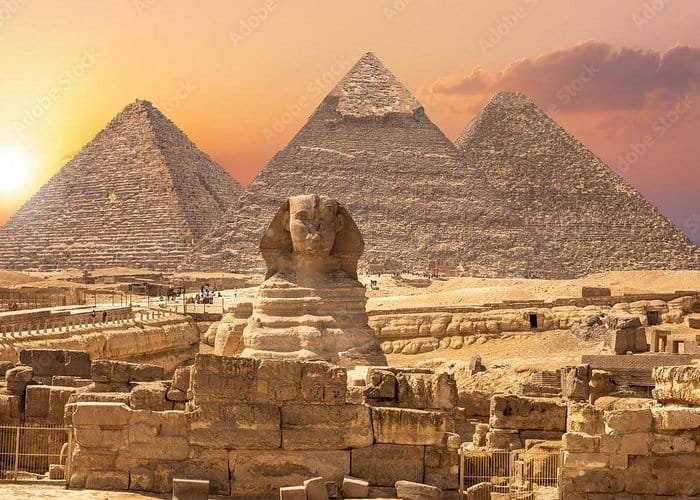
The pyramids of Giza stand as timeless sentinels over Egypt’s sands. Their star-aligned precision challenges the conventional narratives of history. Were they merely pharaohs’ tombs, as mainstream archaeology insists, despite their lack of hieroglyphs, unlike later Egyptian pyramids? Or are they part of a global network? This network could connect to the Maya’s temples, Stonehenge, Baalbek, and beyond, pulsing with the 26,000-year precession of the equinoxes.
The Sphinx’s weathered gaze hints at secrets. The Osiris Shaft’s sealed tunnels add to the mystery. Megaliths that defy modern engineering raise questions. Carbon dating’s inconsistencies, revealed through underground experiments, might challenge the 2600 BC timeline. Inspired by Graham Hancock, Edgar Cayce, and Robert Bauval, this exploration dives into the shadows of history. It presents alternative theories about a planetary grid of ancient wisdom.
Giza’s Starlit Precision: A Cosmic Map?
The pyramids of Giza align with true north to within a fraction of a degree. Without eyewitness accounts, the conventional 2600 BC Fourth Dynasty dating relies on evidence including the Inventory Stela (c. 670 BC), workers’ graffiti, and carbon-dated organic materials.
Graham Hancock’s Fingerprints of the Gods argues that the pyramids mirror Orion’s Belt as it appeared in 10,500 BC, suggesting a lost civilization.¹ Robert Bauval’s The Orion Mystery supports this view.² Edgar Cayce’s visions pointed to a “Hall of Records” hidden beneath the Sphinx.³
Some researchers note that the Great Pyramid’s latitude (29.9792°N) appears close to the speed of light in meters per second (299,792), though mainstream archaeologists consider this coincidental.⁴
Alternative researchers see a global pattern. Hugh Newman’s Earth Grids connects Chichen Itza’s El Castillo, which tracks equinoxes, to Giza.⁵ Online forums discuss theories linking Teotihuacan’s Pyramid of the Sun to Giza’s layout.⁶ Could these similarities suggest a shared architectural tradition, or are they coincidental?
The Silent Stones: The Hieroglyph Question
Unlike the Pyramid Texts etched into the Fifth and Sixth Dynasty pyramids, Giza’s monuments are largely devoid of hieroglyphs.⁷ Later pyramids contain sacred inscriptions. Why would Egypt’s grandest monuments omit the burial texts that defined later Egyptian tradition?
Some researchers argue their silence suggests a non-funerary role. Alternative theories propose that Giza predates the invention of hieroglyphs.⁸ The Inventory Stela, which states Khufu repaired the Sphinx, has been interpreted by some as evidence of older origins, though most Egyptologists date it to the 26th Dynasty, long after Khufu.⁹
Online forums sometimes suggest hieroglyphs were erased, though this seems improbable. Hatshepsut’s inscriptions at Deir el-Bahri were scratched out after her death, yet traces remain.¹⁰ Stone carvings typically leave evidence even when deliberately removed.
Napoleon’s Night in the Pyramid: Legend or History?
One enduring legend involves Napoleon Bonaparte. During his 1798 Egyptian campaign, it is said that Napoleon spent a night in the King’s Chamber of the Great Pyramid. When he emerged, he was reportedly pale and shaken, refusing to speak of his experience.
The King’s Chamber contains an empty granite sarcophagus devoid of hieroglyphs or mummies. It is known to have unusual acoustic properties.¹¹ Unlike later pyramids adorned with funerary texts, its silence has fueled speculation about alternative purposes.
Napoleon’s secretary, Bourrienne, denied the story, calling it a myth.¹² Whether the tale was fabricated to enhance Napoleon’s mystique or has some historical basis remains debated.
Dating Methods: Challenges and Limitations
The conventional 2600 BC date for Giza relies primarily on archaeological context and radiocarbon dating. While carbon dating has provided valuable insights, it does have limitations. Contamination can affect results, and calibration is complex.¹³
Some researchers cite studies of radiometric dating anomalies to question conventional chronologies. A study on Mt. Ngauruhoe’s recent lava flows found K-Ar “ages” much older than the known eruption dates due to excess argon-40 trapped in minerals.¹⁴ While such phenomena are well-understood by geologists who adjust their methodologies accordingly, they have been cited by alternative researchers to question dating techniques.
Research at Italy’s Gran Sasso Laboratory detected small seasonal variations in certain radioactive decay rates.¹⁵ Though these findings remain controversial within the scientific community and involve minute variations unlikely to significantly affect archaeological dating, they’ve been incorporated into alternative chronologies.
Questions and Perspectives
The pyramids of Giza continue to inspire wonder and speculation. While mainstream archaeology provides a framework based on excavations, hieroglyphic records, and scientific dating, alternative researchers offer different interpretations. These perspectives challenge us to question our assumptions about ancient capabilities and purposes.
Graham Hancock encourages us to consider multiple narratives of history. Are these pyramids solely tombs, or might they have served additional purposes? The sands of Giza and global archaeological sites continue to yield new discoveries, ensuring our understanding evolves with time.
Notes
- Graham Hancock, Fingerprints of the Gods: The Evidence of Earth’s Lost Civilization (New York: Crown Publishers, 1995).
- Robert Bauval, The Orion Mystery: Unlocking the Secrets of the Pyramids (New York: Crown Publishers, 1994).
- Edgar Cayce, “Visions of Atlantis,” Edgar Cayce Readings, accessed October 22, 2025, https://www.edgarcayce.org.
- This numerical similarity is discussed in various alternative archaeology forums but is considered coincidental by mainstream archaeologists.
- Hugh Newman, Earth Grids: The Secret Patterns of Gaia’s Sacred Sites (Glastonbury: Wooden Books, 2013).
- Various online forums discuss these theories, though they lack peer-reviewed archaeological support.
- While the main chambers of Giza’s pyramids contain few hieroglyphs, some inscriptions have been found, particularly in Khufu’s pyramid where workers’ markings were discovered in hidden chambers above the King’s Chamber.
- This theory contradicts archaeological evidence, as hieroglyphs predate the pyramids of Giza.
- Mainstream Egyptologists consider the Inventory Stela a much later creation that retrospectively attributes the Sphinx to Khufu.
- “Hatshepsut’s Inscriptions and Their Erasure,” History.com, accessed October 22, 2025, https://www.history.com.
- Various studies have examined the acoustic properties of the Great Pyramid’s chambers.
- “Napoleon’s Night in the Great Pyramid: Myth or Fact?,” Shannon Selin, accessed October 22, 2025, https://www.shannonselin.com.
- Radiocarbon dating has been refined significantly since its invention, with calibration curves and methods to detect contamination.
- Andrew A. Snelling published studies on this topic, though his work is primarily associated with young-Earth creationism rather than mainstream geology.
- J. H. Jenkins et al. published papers on seasonal variations in decay rates, though these findings remain controversial in the scientific community.
Bibliography
Bauval, Robert. The Orion Mystery: Unlocking the Secrets of the Pyramids. New York: Crown Publishers, 1994.
Cayce, Edgar. “Visions of Atlantis.” Edgar Cayce Readings. Accessed October 22, 2025. https://www.edgarcayce.org.
Hancock, Graham. Fingerprints of the Gods: The Evidence of Earth’s Lost Civilization. New York: Crown Publishers, 1995.
History.com. “Hatshepsut’s Inscriptions and Their Erasure.” Accessed October 22, 2025. https://www.history.com.
Newman, Hugh. Earth Grids: The Secret Patterns of Gaia’s Sacred Sites. Glastonbury: Wooden Books, 2013.
Shannon Selin. “Napoleon’s Night in the Great Pyramid: Myth or Fact?” Accessed October 22, 2025. https://www.shannonselin.com.