
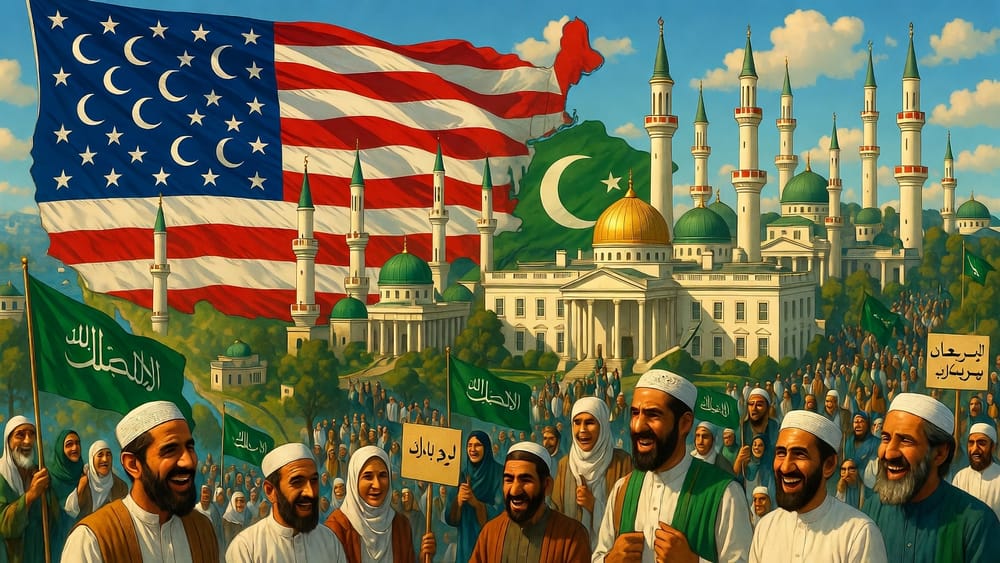
The Silent Conquest: How Taqiyya and Mass Migration Are Building a Global Caliphate Right Under Our Noses
The Deceptive Doctrine and Demographic Jihad That Threaten Western Civilization's Survival
The Hidden Conquest Unveiled: A Thesis That Demands Your Attention
Picture this. Western societies cherish the openness and progress born from the Enlightenment. Yet a subtle conquest unfolds at the same time. This one arrives without armies or swords. It advances through open borders, elections, and expanding families. This manuscript lays out a straightforward thesis: the massive migration of Muslims to areas beyond the Middle East, from Europe and Africa to the Americas, Australia, and segments of the Asia-Pacific, marks the newest phase in Islam’s enduring historical clash with non-Muslims. That clash extends well beyond Christianity. It strikes at secular liberties, Hindu customs, Budhist communities, and indigenous ways of life. Simply put, it strikes at all deemed infidels. A doctrine known as Taqiyya offers camouflage, enabling a slow infiltration that undermines non-Islamic societies until a global caliphate enforces Sharia law everywhere. Viewed from the West, this trend sparks deep worry. Ignore history’s teachings and the ideology fueling it, and we jeopardize the freedoms we fought so hard to secure. This study weaves historical examination with 2025 data, like the Global Terrorism Index noting a 63% surge in Western attacks (Institute for Economics & Peace, 2025) and Pew Research Center figures pegging Muslims at roughly 2 billion worldwide (Pew Research Center, 2025), to unsettle easy assumptions. The aim is sober insight, not animosity. The payoff is safeguarding a varied world against one rigid outlook.
Wake Up Call: The West’s Dangerous Slumber in the Face of Stealth Advance
Western countries have settled into ease since the Cold War ended. They view multiculturalism as a core asset. But a genuine threat draws near. Islam has long positioned itself as far more than private belief. It operates as a full framework for societal rule, seeing unbelievers as hurdles to a sacred system. Common narratives fixate on Islam’s tensions with Christianity alone. Reality stretches much broader. Islam’s initial expansions crushed Zoroastrianism in Persia, overran Hindu realms in India, uprooted Buddhist traditions in Central Asia, and supplanted African ancestral faiths. Now the secular West stands as the fresh focus. Vast population shifts from Muslim-dominant nations stem from more than economic pulls or humanitarian crises. They constitute deliberate steps in an ongoing struggle, masked by Taqiyya’s sanctioned deceit. This unfolds openly in our urban centers, educational institutions, and governing bodies. Refuse to recognize it, and our cherished liberties slip away unnoticed.
Bernard Lewis, a premier scholar of Islamic history, outlines aspects of a historic push for supremacy in Islamic growth (Lewis, 2003). F. E. Peters supplies comparative insights on religious adaptability among faiths (Peters, 2003). Western civilization, it’s time to awaken. Those gradual shifts in your communities, schools, and lawmaking bodies signal a deep transformation. Non-Muslims across the board, be they devout or secular, confront steady decline. Fresh 2025 findings from the U.S. Department of Homeland Security spotlight Islamist outfits such as ISIS and al-Qaeda leveraging digital platforms to radicalize people and amplify dangers (U.S. Department of Homeland Security, 2025). The 2025 Global Terrorism Index notes a 63% uptick in Western terror, with European incidents doubling to 67 (Institute for Economics & Peace, 2025). Such incidents lack randomness. They show modern tools disseminating timeless notions anew. The West’s openness, long a virtue, now acts as a liability that welcomes entities bent on dominance over true blending.
The manuscript proceeds in clear steps. First, we examine the broad historical pattern of expansion and resistance that involves far more than Christians. Next, we explain Taqiyya and its role in current strategies, using concrete examples. Then we present evidence from around the world, supported by reliable statistics. After that, we address common objections and defend core Western values, including women’s rights that Lewis described as a major weakness in Islamic societies (Lewis, 2003). We then look ahead to possible futures, drawing on Pew’s 2025 projections of Muslim populations reaching nearly 670 million in sub-Saharan Africa by 2050 (Pew Research Center, 2025). Finally, we issue a direct call to action. This work aims to inform and awaken anyone who cherishes freedom over forced conformity.
The Relentless Cycle: Islam’s War on Every Infidel Culture Through the Ages
History offers no gentle debate. It unfolds as a brutal contest where potent ideas battle to endure. Islam arose in the seventh century and soon swept past Arabia’s borders, overpowering Christian lands and every other non-Muslim society it encountered. The essential fact remains plain: this spread went beyond defense. The Quran directs believers to fight those who reject faith (Quran 9:29), rendering all non-Muslims valid foes (The Qur’an, 2004). That drive traversed seas and peaks, remaking vast areas.
Muslim forces toppled the Sassanid Persian Empire by 651, snuffing out Zoroastrian shrines and compelling survivors to convert or accept inferior standing. Heading eastward, invasions of India from the eighth century ignited ages of strife, where Delhi sultans razed temples and inflicted heavy losses, with past tallies indicating immense fatalities across long spans (Lal, 1999). Hindu leaders resisted with vigor, evident in the Vijayanagara Empire’s stand. Trade brought Islam to Southeast Asia over time, ultimately toppling the Buddhist Majapahit realm for Muslim governance by the 1500s. That approach persists now. Reports from Bangladesh in 2025 show more than 150 Hindu temples damaged or demolished since Sheikh Hasina’s ouster, including the Khilkhet Durga site (India Today NE, 2025). That year also saw huge demonstrations in New Delhi over a Hindu man’s killing in Bangladesh, heightening tensions between nations. The tactic stays steady: separate minorities, diminish their strength, and seize the land.
Christians’ encounters are familiar yet form just one piece of the puzzle. Yarmouk’s battle in 636 wrested the Levant from Byzantium, as Charles Martel blocked deeper pushes into France at Tours in 732. A wider lens shows Ottoman forces dominating Catholics, Slavic pagans, and Orthodox believers alike. Africa’s cross-Sahara commerce delivered bondage and conversion for Animist groups, echoed today in Boko Haram’s assaults on Christians and traditionalists in Nigeria. Boko Haram revived in 2025 under figures like Bakura Doro, striking in Yobe and Borno while battling rival ISWAP in the Sahel, a zone claiming half the world’s terror fatalities per the Index (Institute for Economics & Peace, 2025). Nigeria’s turmoil stands connected. It fits a wider African pattern where jihadists capitalize on frail states to seize authority, much like ancient caliphs once did.
To educate further on these early expansions, contemporary non-Muslim accounts reveal the perceived threat. For instance, the Doctrina Jacobi, a seventh-century Byzantine Greek text, describes the emergence of a prophet among the Saracens (early Arabs) as armed with a sword, proclaiming keys to paradise amid anarchy and bloodshed, portraying Islamic forces as a violent peril to Christians and Jews alike (Doctrina Jacobi, ca. 634/1991). Similarly, the Armenian Chronicle attributed to Sebeos, written around 661 CE, details Muhammad as a merchant preacher who united Ishmaelite tribes to claim Abraham’s land, leading to invasions of Persia and Byzantium with widespread killings and captives, based in part on information from Muslim prisoners (Sebeos, ca. 661/1999). The Syriac Chronicle of Thomas the Presbyter from 640 CE records Arab invasions of Syria and Persia, including the slaughter of monks in monasteries and the massacre of 4,000 villagers near Gaza, encompassing Christians, Jews, and Samaritans, underscoring the indiscriminate targeting of non-Muslims (Thomas the Presbyter, ca. 640/1993). Byzantine chronicler Theophanes the Confessor, compiling events up to 818 CE, depicts these conquests as expansionist assaults on Byzantium, ravaging provinces and highlighting Muhammad’s life as tied to militant spread (Theophanes, ca. 818/1997). In Persia, Ferdowsi’s epic Shahnameh, completed in 1010 CE, laments the Arab-Islamic conquest as a devastating blow to Zoroastrian Iran, mourning the end of ancient empires through cultural erasure and expressing resentment toward the invaders (Ferdowsi, 1010/2016). For India, Al-Biruni’s Indica from 1030 CE, written amid Ghaznavid invasions, documents temple destructions and cultural disruptions while critiquing Hindu resistance, illustrating how invasions transformed demographics and societies (Al-Biruni, 1030/1879). Reinforcing subjugation, the Pact of Umar, attributed to the seventh-century caliph but formalized in eighth- and ninth-century texts like Al-Shafi’i’s Kitab al-Umm and Abu Yusuf’s Kitab al-Kharaj, imposed restrictions on non-Muslims (dhimmis), including bans on new churches, distinctive dress, yielding priority to Muslims, and the jizya tax, designed to humiliate and encourage conversion or isolation (Pact of Umar, ca. 8th-9th/2002; Al-Shafi’i, ca. 820/2001; Abu Yusuf, ca. 798/1985). These pre-modern sources educate on the institutionalized pressures that facilitated demographic shifts and cultural dominance, aligning with the thesis of a relentless cycle targeting infidels.
Non-Muslim resistance has varied in success. The Crusades recovered small areas temporarily, while the Reconquista fully expelled Muslim rule from Spain. Hindu Maratha warriors shattered Mughal power in the eighteenth century, and Buddhist Siam repelled Muslim advances from Malay states. Western colonial powers later dismantled the last caliphate and imposed secular systems. Lewis points out that these defeats created deep resentment, fueling a modern resurgence in which migration serves as the new form of advance (Lewis, 2003). From a Western viewpoint, Islam’s pattern is universal. It absorbs or destroys cultural diversity wherever it gains strength. Today, open visas, welfare support, and cultural relativism become tools turned against the host societies. Australia, for example, has seen its Muslim population surpass 1 million by 2025, transforming suburbs and political debates in ways that echo Europe’s experience. This is not true integration. It is infiltration that creates parallel societies challenging the original culture. History teaches a clear lesson: overlooking this repeating cycle invites disaster. The West once repelled invading empires. Now it welcomes them, unaware of the long-term plan.
But history’s ghosts aren’t silent. They’re marching in today’s headlines, demanding we confront the veil of deception head-on.
Taqiyya Exposed: The Doctrinal Weapon That Turns Western Trust Into Fatal Weakness
Building directly on this historical foundation, we turn to the mechanism that enables such subtle advances today. Taqiyya is often described mildly as a way to hide faith under persecution. At its core, however, it functions as a religiously approved permission to deceive, opening doors that would otherwise remain closed. Originally developed by Shia Muslims facing Sunni oppression, it has broader application that allows concealment of true intentions among non-Muslims, with scholarly analyses noting its evolution into a strategic tool in certain contexts (Mukaram, 2004; Ibrahim, 2010). Scholarly discussions highlight its role in Islamic history and strategy (Kohlberg, 1975; Stewart, 2013). Far from mere survival, it has become a refined tactic used across centuries to outmaneuver opponents.
To educate on its doctrinal foundations, pre-modern texts provide direct evidence. The Quran itself lays groundwork in Surah Al Imran (3:28), advising believers not to ally with non-believers “unless it is a precaution against their tyranny,” interpreted as permitting outward friendship while harboring inner animosity (The Qur’an, 2004). Surah An-Nahl (16:106) excuses dissimulation under compulsion, referencing the companion ‘Ammar ibn Yasir’s forced renunciation of faith (The Qur’an, 2004). Hadiths in collections like Sahih al-Bukhari and Sahih Muslim affirm this, with narrations permitting denial of faith under duress and stating “war is deceit” (Sahih Muslim, ca. 875/2007, Book 32, Hadith 6303). A specific example from the Prophet’s life involves instructing the convert Naim bin Masud to deceive enemies during the Battle of the Trench in 627 CE (Al-Tabaqat al-Kubra, ca. 9th/1990). Early exegeses expand this: Al-Tabari’s Tafsir, from around 923 CE, comments on Quran 3:28: “If you [Muslims] are under their [infidels’] authority, fearing for yourselves, behave loyally to them with your tongue, while harboring inner animosity” (Al-Tabari, ca. 923/1987). Ibn Kathir’s Tafsir, from the 14th century, affirms taqiyya as “acceptable till the day of judgment,” quoting companions: “Let us smile to the face of some people while our hearts curse them” (Ibn Kathir, ca. 1373/2000). These sources demonstrate taqiyya’s roots not just in survival but in tactical deception during imbalances of power, directly supporting its role in infiltration as per the thesis.
Consider the wide range of non-Muslim societies, from secular Europe to polytheistic India. Taqiyya turns Western openness into vulnerability. Immigrants publicly promise assimilation while creating separate communities, such as no-go zones in Sweden, Sharia councils in Britain, and demands for halal food in American schools. This mirrors early Islamic history when Muslims in Abyssinia pretended friendship before returning with greater power. Peters provides comparative views on religious flexibility (Peters, 2004). In the modern era, radicals present themselves as moderates, entering neighborhoods and even elected office while quietly advancing their agenda. The 2025 U.S. Department of Homeland Security assessment warns of sharp increases in online radicalization, with groups exploiting trust to recruit new members (U.S. Department of Homeland Security, 2025).
Western trust becomes Taqiyya’s playground. Promoters market a gentle version of Islam while concealing the ultimate aim of a caliphate, as openly declared by ISIS in 2014. In 2025, terrorism suspects include significant numbers of youths under 18, with reports indicating involvement of teenagers in many ISIS-linked cases (Institute for Economics & Peace, 2025). Picture a classmate who appears normal yet absorbs hidden messages on the internet. This is already occurring. Europol’s 2025 report details how Islamist networks adapt recruitment after battlefield losses, worsening security threats (Europol, 2025). The deception is not theoretical. It acts as a blindfold, allowing the siege to progress unseen and changing diversity into division. Recognize this: Taqiyya is not an outdated custom. It serves as modern jihad’s hidden weapon, destroying from inside what armies could not take from outside.
The deception grows even more cunning here. Media coverage heavily emphasizes conflicts between Islam and Judaism, portraying them as a limited dispute centered on Israel and the Middle East. Endless reporting on Gaza or synagogue attacks reinforces this narrow view. However, deeper examination reveals this focus as a deliberate distraction that conceals the true aim of worldwide control. Consider recent tragedies. In England, Jihad al-Shamie pledged allegiance to ISIS and stabbed worshippers at a Manchester synagogue on Yom Kippur 2025, killing two (BBC News, 2025). In Australia, father and son Sajid and Naveed Akram opened fire at a Hanukkah event on Bondi Beach on December 14, 2025, killing 15 to 16 people while displaying IS flags in their vehicle, clearly targeting Jews (NBC News, 2025). These attacks are not random quarrels. They function as calculated diversions, fixing public attention on “Jewish problems” while the broader plan against all non-Muslims advances quietly into secular, Christian, Hindu, and other societies. The constant news cycle supports this misdirection, allowing the larger conquest to escape notice.
Paid influencers add another layer. They present a polished image, promoting stories of peaceful coexistence and moderate Islam. Some Arab governments even fund them to project tolerance and counter visible extremism. Yet this approach is naive at best and Taqiyya at worst. They commercialize religion through sponsored content, mixing Quranic verses with product promotions and softening teachings for wider appeal. The attractive message draws people in, but beneath lies disguised empire-building that misleads the West into lowering defenses. See past the surface, or face the consequences. Yet deception is just the start.
The Demographic Onslaught: How Numbers Are Becoming the New Battlefield Worldwide
With the veil of taqiyya in mind, the numbers tell an even more compelling story of how this conquest unfolds in the present. Reliable data sharpens the picture. Pew Research in 2025 estimates the global Muslim population at approximately 2 billion, or 25 to 26 percent of humanity, with sub-Saharan Africa projected to reach 670 million by 2050 (Pew Research Center, 2025). The Americas show rapid growth from established communities in Brazil to political influence in the United States. Australia experiences one of the fastest percentage increases in the West, passing 1 million Muslims by 2025 and altering local neighborhoods and politics. The Asia-Pacific region already contains 60 percent of the world’s Muslims, with 27.2 million migrant workers representing 16 percent of global migration and extending influence from Indonesia outward. South America develops growing pockets in countries like Brazil and Argentina through conversion and immigration, where Muslims increase faster than general migrant numbers. These figures are not harmless statistics. They provide leverage that shifts power balances in host countries. In New Zealand’s peaceful suburbs, the same pressures appear, with Muslim communities expanding 31 percent from 2018 to 2023 according to census figures and gradually influencing local government.
Europe offers stark examples. Rising assaults in Sweden and unrest in French suburbs are not accidents. They signal isolated communities where Taqiyya protects radical elements. Europol recorded 58 terrorist attacks in the EU in 2024, 34 of which succeeded (Europol, 2025), while Islamic State continues as the most dangerous group with evolving tactics into 2025 (International Centre for Counter-Terrorism, 2025). In Africa’s Sahel region, groups pursuing caliphate goals use migration routes to attack Christian and animist populations, leaving Nigeria’s overstretched military facing losses in 2025. Among Asia’s non-Muslims, Aceh province enforces Sharia on everyone, allegations of “love jihad” suggest demographic manipulation in India, and Bangladesh saw 152 Hindu sites destroyed since 2024, with 2025 demolitions pursuing “Hindu-free” areas (India Today NE, 2025).
From a Western viewpoint, these changes erode Enlightenment foundations. Women face restrictions through honor codes, free speech suffers from blasphemy fears as in the Charlie Hebdo case, and groups like Hizb ut-Tahrir openly advocate caliphate restoration using migration as foundation. In the United States, similar patterns emerge through school disputes over religious accommodations and political candidates prioritizing Sharia interpretations over constitutional principles. This is not unfounded fear. It is clear pattern recognition. The evidence shows that demographic change is not neutral. It creates a gradual process in which population growth translates into political power and cultural transformation. Now, before you dismiss this as alarmist hype, let’s tackle the skeptics head-on.
Shattering the Excuses: Why “Tolerance” Is Becoming the West’s Suicide Pact
Anticipating the counterarguments that often arise, we must address them squarely to reinforce the urgency of the thesis. Accusations of Islamophobia arise quickly. Face the truth. Facts are not hatred. Cultural exchange can enrich societies, but unchecked ideology destroys them. Economic needs and peaceful individuals exist, yet determined minorities exploit openings. Western values must remain non-negotiable if we wish to preserve them. Lewis identifies the treatment of women as Islam’s greatest failure in competing with the modern world, a point illustrated by ongoing honor killings and Sharia patrols that limit gains in 2025 (Lewis, 2003). Immigration costs billions in public funds, echoing the historical jizya tax but reversing who pays. Pew projections show Muslims potentially reaching significant proportions of sub-Saharan Africa’s population by mid-century, with large-scale movements northward and potential impacts on democratic systems (Pew Research Center, 2025). Calling this concern bigotry avoids the real issue: protecting rights against worldviews that see them as obstacles. What if your daughter’s school begins requiring dress codes justified as “cultural sensitivity”? This is not imaginary. It already occurs in various Western communities.
Address the common objections directly. Most Muslims indeed seek better lives. Yet determined fringes use that flow, as the Global Terrorism Index 2025 documents with rising lone-actor attacks in the West (Institute for Economics & Peace, 2025). Economic migration has validity, but it can hide cultural conquest when large unvetted groups arrive with views resistant to assimilation. Peaceful majorities often follow when radicals gain momentum, as seen in Ottoman growth and contemporary caliphate efforts. The Western duty is clear: defend core principles without apology. Free speech, equality between sexes, and secular governance form the foundation. Allow erosion, and the siege succeeds without violence. This stance is not hatred. It is the survival instinct shaped by centuries of hard experience. But what if we don’t act? The future isn’t pretty.
The Nightmare Horizon: Envisioning a World Lost to the Caliphate’s Slow Triumph
Extrapolating from these patterns and data, the trajectory ahead demands our unflinching gaze. If no action is taken by 2050, Pew data forecasts a grim reality: approximately 2.8 billion Muslims comprising 30 percent of humanity, 670 million in sub-Saharan Africa alone, and Europe reaching 10 percent even without further migration (Pew Research Center, 2025). Combined threats like AI-driven radicalization, according to the Index, will turn newcomers into online warriors (Institute for Economics & Peace, 2025). History echoes loudly. Internal divisions allowed Ottoman conquest of Constantinople in 1453; today’s polarization serves the same purpose. Iconic landmarks may broadcast calls to prayer, public squares fill with prescribed chants, and tech centers operate under religious rulings. Winners always write the rules. Fast-forward further: schools present Sharia principles as diversity education, laws bend to accommodate religious demands, and economies strain under separate systems. Australia may see Christians fall below half the population by 2050 projections as Muslims rise quickly. Africa’s growth spills northward, overwhelming borders. The 2025 DHS assessment already warns of complex extremist threats (U.S. Department of Homeland Security, 2025). This scenario is not science fiction. It follows directly from current trends. Surrender appears inevitable if we remain asleep. Yet awareness provides a way out: decisive steps today prevent a future rebuilt around submission.
Final Charge: Storm the Ramparts Before the Shadows Swallow the Light
In light of this looming horizon, the path forward is one of resolute action. The siege continues quietly while Taqiyya conceals its true edge. Western nations and all non-Muslims must rise against this distorted historical cycle. Secure borders firmly, expose deceivers without hesitation, and form strong alliances with India, Israel, and Africa’s independent thinkers, much like the coalitions that once stopped Ottoman advances. Insist on genuine reciprocity rather than one-sided tolerance. Teach religious doctrines openly in schools, support authentic moderates as Lewis recommended, yet maintain constant vigilance (Lewis, 2003). Strengthen intelligence networks, reform immigration policies thoughtfully, and ensure young people learn history’s unvarnished truths. Build lasting partnerships against every common threat, from visible jihadists to their subtle supporters. Failure here allows the caliphate to grow not through battlefield victory but through our gradual capitulation. Time grows short. The decision rests with us.
This is the stark warning: Western light fades unless actively defended. Reclaim the ramparts. Your freedom depends on it.
Shadows lengthen as the silent advance tightens its grip. Deception clouds judgment, demographics shift the ground beneath our feet. History’s cycle spins toward dominance unless we break it. Ignore the signs, and tomorrow’s world bows to one rule, one faith, erasing the vibrant mosaic of free thought. The caliphate doesn’t storm gates; it seeps through cracks we’ve left open. Act boldly, or watch liberty fade into submission’s endless night. The choice haunts us now.
Disclaimer: The views expressed in this article are the author’s opinion and are intended for informational and discussion purposes only. This work draws on historical analysis, publicly available data from official sources (including but not limited to Pew Research Center, Institute for Economics & Peace, Europol, U.S. Department of Homeland Security, and scholarly publications), and reported events from established news outlets. Fact verification relied exclusively on primary documents, official reports, academic texts, and direct journalistic sources. Wikipedia and Snopes were not consulted due to ongoing public debates regarding potential editorial biases and varying standards of reliability on controversial topics. Readers are encouraged to consult multiple sources and form their own conclusions. The author and publisher assume no responsibility for any actions taken based on this content.
References:
Abu Yusuf. (1969). Kitab al-kharaj (A. Ben Shemesh, Trans.). E.J. Brill. (Original work published ca. 798)
Al-Biruni. (1879). Alberuni's India (E. C. Sachau, Trans.). Trübner & Co. (Original work published 1030)
Al-Shafi'i. (2001). Kitab al-Umm. Dar al-Wafa'. (Original work published ca. 820)
Al-Tabari. (1987). The history of al-Tabari (Vol. 1-40) (Various translators). State University of New York Press. (Original work published ca. 923)
Al-Tabaqat al-Kubra. (1990). Ibn Sa'd's Kitab al-Tabaqat al-Kabir (S. M. Haq, Trans.). Kitab Bhavan. (Original work published ca. 9th century)
BBC News. (2025). Reports on Manchester synagogue attack.
Doctrina Jacobi. (1991). In G. Dagron & V. Déroche (Eds.), Juifs et chrétiens en Orient byzantin (Travaux et Mémoires 11). Association des Amis du Centre d'Histoire et Civilisation de Byzance. (Original work published ca. 634)
Europol. (2025). European Union terrorism situation and trend report 2025. https://www.europol.europa.eu/publication-events/main-reports/european-union-terrorism-situation-and-trend-report-2025-eu-te-sat
Ferdowsi. (2016). Shahnameh: The Persian book of kings (D. Davis, Trans.). Penguin Classics. (Original work published 1010)
Ibn Kathir. (2000). Tafsir Ibn Kathir (Abridged) (S. Al-Mubarakpuri, Trans.). Darussalam. (Original work published ca. 1373)
Ibrahim, R. (2009). Taqiyya: War and deceit in Islam. In J. Gallagher & E. D. Patterson (Eds.), Debating the war of ideas. Palgrave Macmillan.
India Today NE. (2025). Reports on Bangladesh temple incidents.
Institute for Economics & Peace. (2025). Global terrorism index 2025. Vision of Humanity. https://www.visionofhumanity.org/wp-content/uploads/2025/03/Global-Terrorism-Index-2025.pdf
International Centre for Counter-Terrorism. (2025). Reports on Islamic State.
Kohlberg, E. (1975). Some Imami-Shi'a views on Taqiyya. Journal of the American Oriental Society, 95(3), 395–402.
Lal, K. S. (1973). Growth of Muslim population in medieval India (A.D. 1000-1800). Research Publications in Social Sciences.
Lewis, B. (2003). The crisis of Islam: Holy war and unholy terror. Modern Library.
Mukaram, S. (2004). At-Taqiyya fi 'l-Islam [Dissimulation in Islam]. Mu'assisat at-Turath ad-Druzi.
NBC News. (2025). Reports on Bondi Beach attack.
Pact of Umar. (1987). In B. Lewis (Ed.), Islam: From the Prophet Muhammad to the capture of Constantinople (Vol. 2: Religion and society). Oxford University Press. (Original work published ca. 8th-9th centuries)
Peters, F. E. (2003). Islam: A guide for Jews and Christians. Princeton University Press.
Peters, F. E. (2004). The children of Abraham: Judaism, Christianity, Islam (New ed.). Princeton University Press.
Pew Research Center. (2025). How the global religious landscape changed from 2010 to 2020. https://doi.org/10.58094/fj71-ny11
Sahih Muslim. (2007). Sahih Muslim (A. H. Siddiqui, Trans.). Kitab Bhavan. (Original work published ca. 875)
Sebeos. (1999). The Armenian history attributed to Sebeos (R. W. Thomson, Trans.). Liverpool University Press. (Original work published ca. 661)
Stewart, D. J. (2013). Dissimulation in Sunni Islam and Morisco Taqiyya. Al-Qantara, 34(2), 439–472. https://doi.org/10.3989/alqantara.2013.016
The Qur'an (M. A. S. Abdel Haleem, Trans.). (2004). Oxford University Press.
Theophanes. (1997). The chronicle of Theophanes Confessor (C. Mango & R. Scott, Trans.). Clarendon Press. (Original work published ca. 818)
Thomas the Presbyter. (1993). In A. Palmer (Ed.), The seventh century in the West-Syrian chronicles. Liverpool University Press. (Original work published ca. 640)
Tibi, B. (2012). Islamism and Islam. Yale University Press. https://doi.org/10.12987/9780300160147
U.S. Department of Homeland Security. (2025). Homeland threat assessment 2025. https://www.dhs.gov/sites/default/files/2024-10/24_0930_ia_24-320-ia-publication-2025-hta-final-30sep24-508.pdf