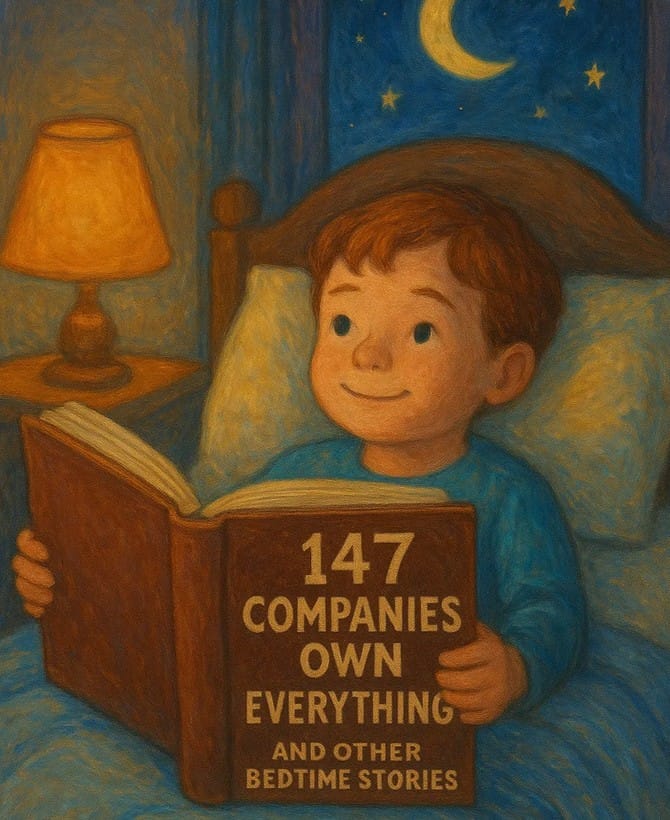
The Study They Don't Want You to Know About
In the summer of 2011, three systems theorists at the Swiss Federal Institute of Technology in Zurich published a paper that should have changed how we understand the world economy. It didn’t make the evening news. Most people have never heard of it.
What Stefania Vitali, James B. Glattfelder, and Stefano Battiston discovered confirmed something many had long suspected. A shockingly small number of corporations control an outsized portion of global wealth. And they proved it with math.
Their paper appeared in the peer-reviewed journal PLoS ONE. This wasn’t speculation or conspiracy theory. It was quantified network topology. The same mathematical tools used to map the internet, analyze disease spread, and understand neural networks. Applied to the global economy.
The results were stunning.
What They Actually Did
The researchers started with a database of 37 million economic entities worldwide. From this massive pool, they identified 43,060 transnational corporations and mapped the ownership relationships between them. Who owns shares in whom. How those ownership chains connect. Where control actually flows.
Think of it like mapping a family tree, except instead of tracking bloodlines, they tracked money and control. When Company A owns shares in Company B, which owns shares in Company C, which owns shares back in Company A, you get a web of recursive ownership. Control concentrates far beyond what simple shareholding percentages might suggest.
What emerged looked less like a free market of competing firms. More like a hierarchical pyramid.
The Numbers Nobody Talks About
Out of 43,060 transnational corporations, a core of just 1,318 companies formed the backbone of the global economy. These firms had interlocking ownership structures. They owned substantial stakes in each other.
But the real finding was inside that core.
Within those 1,318 companies sat what the researchers called a “super-entity.” A tightly interconnected group of just 147 firms that controlled 40 percent of the total wealth of all 43,060 transnational corporations in the study.
One hundred forty-seven companies. Forty percent of the wealth. Among over 43,000 corporations analyzed.
That’s not a typo. That’s the math.
Who Are These 147 Firms?
The list reads like a who’s who of global finance. Barclays. JPMorgan Chase. Goldman Sachs. Morgan Stanley. Bank of America. Similar entities across Europe and Asia filled out the ranks.
These weren’t manufacturing companies or tech startups. They were predominantly banks, investment firms, and financial service companies. The institutions that control the flow of capital itself.
The researchers noted this was significant. Financial institutions don’t just own assets. They control how money moves through the entire economy. They decide who gets loans, which companies get investment, which industries thrive or starve. Control the flow of capital and you control far more than your shareholding percentage would suggest.
Why This Matters
The ETH Zurich researchers weren’t making a political argument. They were making a systemic one.
This level of concentration creates what they called “systemic risk.” When ownership is this interconnected, the failure of any major node can cascade through the entire network. We watched exactly this dynamic play out in 2008. A few major institutions collapsed and nearly brought down the global economy with them.
There’s another implication the researchers touched on more carefully. This concentration raises serious questions about market competition and economic policy.
If 147 firms are interconnected through recursive ownership structures, are they really competing with each other? When the same institutional investors own significant stakes in companies that are supposedly rivals, what does “competition” actually mean?
And if economic power is this concentrated, what does that mean for political power?
The Study That Vanished
When this paper came out in October 2011, it received brief media attention. A few articles in business publications. Some academic discussion. Then it largely vanished from public discourse.
No sustained investigation. No congressional hearings. No mainstream documentary examining the implications. The study that mathematically demonstrated unprecedented concentration of global economic power became a footnote.
Maybe the findings were too abstract for popular consumption. Network topology doesn’t fit neatly into a news segment.
Or maybe the implications made people uncomfortable. We tell ourselves we live in a world of free markets and fair competition. This study suggested something different.
What the Researchers Concluded
The ETH Zurich team was careful. Concentration of ownership doesn’t automatically imply coordination or conspiracy. Companies can own shares in each other without actively colluding.
But they also noted that this structure creates the potential for coordinated action, whether explicit or implicit, that wouldn’t be possible in a more distributed economy. Tight control poses risks that extend far beyond what markets can self-correct.
The study raised questions. It didn’t claim to answer all of them.
But the questions it raised deserve far more attention than they’ve received. Who really controls the global economy? How is that control exercised? What does it mean for the rest of us?
Network analysis doesn’t lie. It doesn’t have an agenda. It simply maps what exists.
And what exists, according to one of the most rigorous studies ever conducted on global corporate ownership, is a world far more concentrated than most of us have been led to believe.
The data is there. The peer-reviewed paper is publicly available. The methodology has been scrutinized and validated.
The only question is whether we’re willing to look at what it shows us.
I explore the connections between ancient power structures and modern corporate control in my forthcoming book, The Hidden Hand: Wealth, Power, and Control from Pharaohs to Corporations (Trine Day, June 2026).
Pre-order now: https://www.barnesandnoble.com/w/the-hidden-hand-eric-daniel-buesing/1148336792