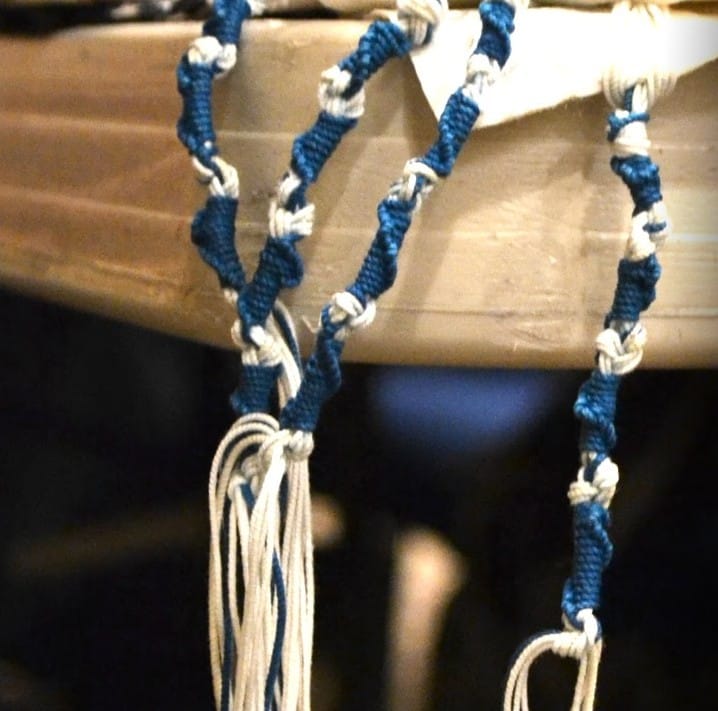
The Threads That Bind: Rediscovering the Daily Practice of Tzitzit
For the past three years, I’ve worn a tallit katan under my clothing every day. Mine is cotton. Perfectly kosher according to halacha. And honestly, it’s as comfortable as any undershirt I own. Some mornings I forget it’s even there until I reach down and feel the fringes. That moment, as I recite the blessing Baruch atah Adonai Eloheinu Melech ha’olam, asher kid’shanu b’mitzvotav v’tzivanu al mitzvat tzitzit (”Blessed are You, Lord our God, Ruler of the universe, who has sanctified us with His commandments and commanded us to wear tzitzit”), connects me to something ancient and enduring. Those soft threads against my skin throughout the day remind me of God’s presence and the covenant we carry.
I need to tell you something personal about these three years, because it matters to this story.
In 2002, a medical error during deployment with the U.S. Army changed everything. Severe migraines. Chronic pain that became my constant companion. For twenty-two years, I lived in that fog. The doctors gave me medications, lots of them, and I took them because what else could I do? But here’s the thing about living with that kind of pain: you survive, but you’re not really living. You’re watching life through an opaque filter.
I read. That’s what kept me going. Philosophy, theology, science, history. Book after book, year after year. My mind stayed active even when my body betrayed me. But it felt hollow somehow. I was gaining knowledge without being able to do anything with it. Just another book, another concept, another day in the fog.
Then three years ago, I started wearing tzitzit. I can’t tell you I expected what happened next.
Slowly, things began to shift. My health felt stronger. I started feeling healthier in ways I’d almost forgotten were possible. Over time, I’ve been able to stop taking most of those pain medications I’d relied on for over two decades. Not all at once. Gradually. Carefully. But the change has been real.
And my mind. My mind cleared. Like someone wiped away that opaque filter I’d been living behind. For the first time in twenty-two years, I could think clearly. Really think. The fog lifted.
I started writing. Manuscript after manuscript, pouring out everything that had been building up inside me during those years of reading. My brain, which had been muffled and dormant under all those medications, came back to life. Ideas that had been trapped suddenly had a way out.
I’m not saying tzitzit is a medical treatment. I’m not claiming miracles. But I am saying this: since I started wearing them, I’ve felt blessed in ways I couldn’t have imagined. The mitzvah has given me something back. Maybe it’s the daily reminder of God’s presence. Maybe it’s the connection to something larger than my pain. Maybe it’s both. I don’t fully understand it, but I’m grateful.
So when I ask why more people don’t wear tzitzit, it’s not academic for me. If wearing these threads helped give me my life back, helped clear away the fog and let me be fully present again, what might they offer others? I’ve spent time trying to understand this question. What I’ve learned isn’t a story about our generation failing somehow. It’s actually a fascinating (and sometimes heartbreaking) history of external forces that gradually pushed this biblical commandment to the edges of Jewish practice. Understanding what happened might help us think about what could be different today.
The Biblical Foundation: A Commandment for All Israel
The Torah speaks about tzitzit twice. In Numbers 15:37-41 and Deuteronomy 22:12. God tells Moses to instruct the Israelites to make tassels on the corners of their garments throughout their generations, putting a blue cord on each corner. “And it shall be a tassel for you to look at and remember all the commandments of the Lord.”
What strikes me about this commandment is how democratic it is. Scholar Jacob Milgrom points out that in the ancient Near East, elaborate corner decorations were typically reserved for nobility. They were status symbols. But the Torah commands every Israelite to wear tzitzit with tekhelet, that precious blue-violet dye usually reserved for royalty. Milgrom calls this “the democratic thrust within Judaism, which equalizes not by leveling but by elevating.”
Think about what that means. Every Jew is nobility. Every Jew is part of “a nation of priests.” These weren’t just decorative threads. They were (and are) a visible statement about who we are and what we’re called to be.
How the Practice Began to Fade: Understanding the Historical Forces
In biblical times, wearing tzitzit was straightforward. People wore rectangular garments. Shawls, tunics, cloaks. Things that naturally had four corners. Archaeological digs at Tel Shikmona found evidence of an advanced dye industry from around 1200 BCE using Murex snails. Ancient documents, like the Tell-el-Amarna tablets from 1500-1300 BCE, list tekhelet garments among the precious goods sent in royal dowries. This was valuable stuff.
But then history intervened in ways our ancestors couldn’t control.
The Loss of Tekhelet: External Pressures, Not Internal Neglect
Here’s what happened to that blue thread. And it wasn’t our fault.
Between 100 BCE and 68 CE, Caesar and Augustus restricted purple and blue dyes to the ruling classes. Then Nero took it further, claiming exclusive imperial right to wear these colors. By the time we get to Emperor Constantius (337-362 CE), the restrictions were brutally enforced. An edict in 383 CE turned the manufacture of high-quality purple and blue into a state monopoly.
These weren’t suggestions. They were imperial decrees backed by Roman power. The Jewish tekhelet industry went underground. The Talmud, compiled around 550 CE, mentions tekhelet being brought from Israel to Babylon in Rabbi Ahai’s time (506 CE). That’s the last time we hear about it being used. When the Arabs conquered Israel in 639 CE, the dyeing industry there collapsed entirely.
By 750 CE, the Midrash Tanhuma is mourning: “And now we have no tekhelet, only white.”
For over 1,300 years, Jews couldn’t fulfill this commandment the way it was originally given. Not because we stopped caring. Not because we chose to abandon it. But because empires made it impossible.
The Evolution of Clothing: A Second Challenge
There’s another piece to this story, and it unfolded more gradually. As Jewish communities scattered across the diaspora, we encountered different clothing styles. Those simple four-cornered garments? They fell out of fashion. People started wearing robes, jackets, trousers. Clothes that didn’t have four corners.
This created a real halachic puzzle. The commandment is to attach tzitzit to four-cornered garments. But what if nobody wears four-cornered garments anymore? Technically, if you’re not wearing such a garment, you’re not obligated. But you also can’t fulfill the mitzvah.
The Talmud wrestles with this through the story of Rabbi Kattina. The conclusion seems to be: yes, the obligation is on the garment, not the person. But there’s real value in creating opportunities to fulfill this commandment even when we’re not strictly required to.
The Medieval Solution: The Tallit Katan
By medieval Europe, four-cornered garments had completely disappeared from everyday dress. Our ancestors faced a choice: watch this biblical commandment fade away, or get creative.
They got creative.
The tallit katan (”small tallit” or arba kanfot, “four corners”) was their solution. A poncho-like vest or undergarment designed specifically with four corners, worn under regular clothing. Ingenious, really. The outer world could dress however it wanted, but underneath, Jews could still fulfill this mitzvah. By the time the Shulchan Aruch was written in the 16th century, these dedicated tzitzit garments were well-established.
Meanwhile, the larger tallit gadol became mostly associated with prayer rather than all-day wear. This shift happened over time as Jews adapted to local customs. In some communities (Yemenite Jews, for instance), people continued wearing a full tallit throughout the day well into the medieval period. Rabbi Petachia of Regensburg visited Baghdad in the 12th century and saw Jews there “wrapped up in a tallit of wool, with tzitzits” as they went about their business.
But in most places, the pattern became: tallit gadol for prayer, tallit katan for those who wore it daily. And increasingly, outside Orthodox communities, tzitzit became less visible in everyday Jewish life.
What We’ve Learned: Different Communities, Different Paths
Jewish communities have approached tzitzit in various ways, each with its own integrity. The Shulchan Aruch, following Sephardic tradition, preferred wool. It was the material most clearly required by biblical law. The Rema, speaking for Ashkenazic practice, said cotton also counts as a Torah-level requirement. Both are completely valid.
And here’s something I find encouraging: major halachic authorities throughout history wore cotton tallitot katan. The Vilna Gaon wore cotton. The Chazon Ish wore cotton. Rav Soloveitchik wore cotton. This isn’t some lesser option. It’s a fully legitimate tradition with great rabbis behind it.
The practical side matters too. Cotton breathes. It’s comfortable in different climates. You can wear it daily under regular clothes without even thinking about it. For those of us trying to make this mitzvah a sustainable part of modern life, that accessibility means everything.
Women’s relationship with tzitzit has varied as well. Since you can’t see tzitzit at night, it’s classified as a time-dependent commandment, which traditionally means women are exempt. But many medieval authorities (Rashi, Rabbeinu Tam, Maimonides) said women could wear tzitzit if they wanted to. Today you see different approaches: Conservative and Reform movements widely embrace women wearing tallitot, while Orthodox practice varies by community.
The point isn’t that one approach is more authentic than another. We’re all taking tradition seriously. The question is whether understanding this history might open up possibilities we hadn’t considered.
The Remarkable Rediscovery of Tekhelet
One of the most hopeful stories in recent Jewish history is the effort to recover that lost blue thread. It shows what’s possible when modern knowledge meets ancient wisdom.
In 1857, a French zoologist named Henri de Lacaze-Duthiers identified three dye-producing snails in the Mediterranean. A few years later, in 1864, archaeologists found massive mounds of Murex trunculus snails at Sidon. The shells were broken in exactly the right spot to extract the dye.
Then in 1888, the Radzyner Rebbe, Rabbi Gershon Henoch Leiner, launched his own quest for tekhelet. He identified a certain squid as the source and wrote three books that still inform our halachic discussions today. His conclusion turned out to be wrong. The dye’s color came from added chemicals, not the squid itself. But his passion inspired generations. He believed we should never stop trying to restore what was lost.
Rabbi Isaac Herzog (later Chief Rabbi of Israel) wrote his doctoral dissertation on this in 1913, identifying Murex trunculus as the best candidate. But he ran into a problem: he couldn’t consistently get blue dye from it. Sometimes it came out purple instead.
The breakthrough came in 1980. Professor Otto Elsner at Shenkar College discovered something simple but crucial: expose the dye to sunlight and it turns from purple to blue. That’s it. That’s what Rabbi Herzog had been missing. The ancient dye makers, working in bright Mediterranean sun, would have known this instinctively.
In 1985, Rabbi Eliyahu Tavger became the first person in over 1,300 years to dye tekhelet for tzitzit according to halacha. In 1993, the P’til Tekhelet organization formed to make it available to everyone who wanted it.
Today most Orthodox Jews still wear all-white tzitzit, honoring the tradition that sustained us through those centuries of loss. But a growing number across various communities have embraced the blue thread, reclaiming what was taken from us. Both approaches honor our past in meaningful ways.
An Invitation to Rediscover
Which brings me back to the tallit katan. The garment that kept this mitzvah alive through everything.
Four-cornered garments still aren’t standard fashion today, so the tallit katan remains exactly what it’s always been: an opportunity to fulfill this commandment throughout the day. Modern designs (like t-shirt style versions that stay in place better) make it even more practical than before.
Let me tell you about cotton specifically, since that’s what I wear. It’s lightweight, breathes well, works in any season. My cotton tallit katan honestly just feels like a normal undershirt. Some days I put it on and completely forget about it until I feel the fringes brushing against my leg or catch them when I’m getting dressed. That’s when the reminder comes. I’m carrying this piece of Torah with me. It’s become such a natural part of getting dressed that it requires no more thought than putting on socks.
For those of us who wear one, the tallit katan offers something quietly profound. It’s portable Jewish identity, carried under our clothes. At work, with family, running errands. Those fringes are there. Not announcing themselves, just present. Steady. The Rambam wrote that we should “always be heedful of the commandment to wear tzitzit, for the Torah equated and connected all other mitzvot with it.”
What I love about this mitzvah is how gentle it is. You don’t have to change your wardrobe or your routine. A cotton tallit katan fits seamlessly into daily life, invisible under your clothes. It just invites you to carry this commandment with you. To occasionally touch those threads and remember all of God’s instructions, your connection to Jews across time and space.
Moving Forward Together
Understanding how we got here (Roman edicts, lost knowledge, changing fashions) helps me see this isn’t about judging anyone. Our ancestors made choices that helped the Jewish people survive incredibly difficult circumstances. They did what they had to do.
But we live in different times. We can observe openly or discreetly hidden under a layer of our daily clothing. We’ve rediscovered tekhelet. We have comfortable, modern tallit katan designs. The barriers that once made this practice difficult have fallen away.
Maybe this is a moment to gently reconsider. Not because anyone’s failing if they don’t wear tzitzit daily (everyone’s Jewish journey is their own), but because we have something our ancestors would have treasured: the freedom and the knowledge to fulfill this commandment more fully.
If you’re curious, try wearing a tallit katan for a week. Cotton ones are easy to find and affordable. Notice what it feels like to carry this mitzvah through your day. See if those fringes become what they’ve become for me: a quiet source of strength and connection. Talk to your rabbi. Look into different customs and materials. Find what speaks to you.
I told you at the beginning about the fog I lived in for twenty-two years, and how wearing tzitzit helped lift it. I’m still amazed by that transformation. The clarity, the health, the ability to finally pour out everything I’d been holding inside. I don’t know if your experience will be like mine. Everyone’s journey is different. But I do know this: we never fully understand how a mitzvah will bless us until we embrace it.
The threads that connect us to our tradition proved remarkably strong. They survived emperors and exile, forced assimilation and scattered communities. They carried this commandment through centuries when it couldn’t be fully observed. Now we have the blessing of choice. The opportunity to bring this practice more fully back into Jewish life.
Whether you decide to embrace this mitzvah daily, occasionally, or just want to learn more about its history, you’re part of a conversation spanning three thousand years. And in that conversation, every voice adds something. Every question has value. Every step toward deeper connection makes us all stronger.