
What If Artemis II Is a Cover Story?
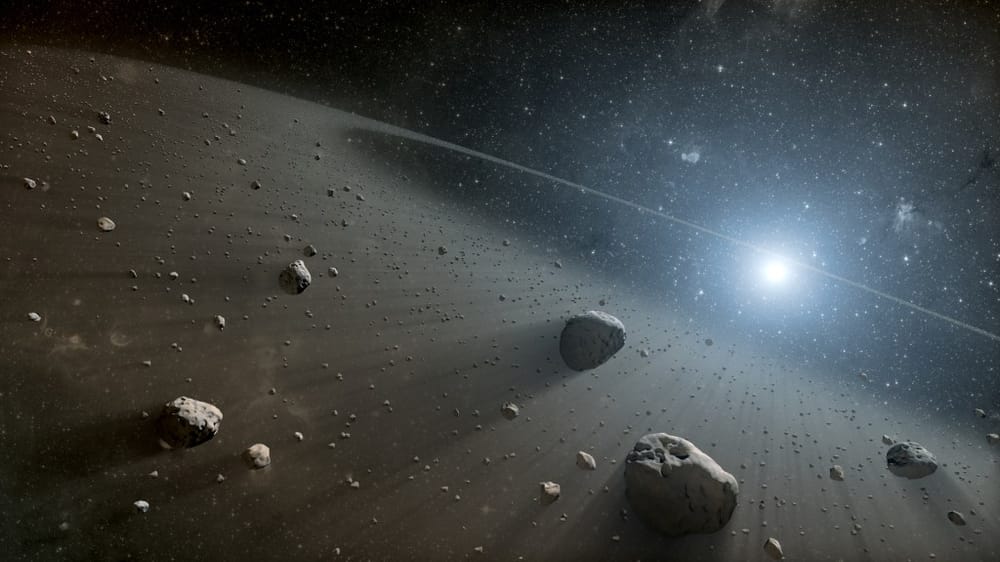
The Caves, the Ice, and the Asteroid Swarm Lighting Up Our Skies
Right now, four astronauts are strapped into Orion atop NASA's Space Launch System at Kennedy Space Center. Liftoff is tonight. NASA calls it Artemis II: a 10-day free-return flyby around the Moon. Test the spacecraft. Gather some data. Come home. No landing. No drama.
The script is reassuringly dull. But something in this picture does not add up.
We supposedly conquered the Moon more than half a century ago. Six successful Apollo landings. Flags planted, rovers driven across the dust, 842 pounds of lunar rock ferried back to Earth for study. All of it achieved with 1960s slide-rule computing and raw Cold War political will. Yet here we are in 2026, treating a crewed lunar flyby as a monumental milestone. So why the 53-year gap? Why scrap the old hardware, rebuild everything from scratch, absorb delays that stretched across decades, and then fly a cautious shakedown mission when we already did it?
Maybe because the public story has always been the cover.
Look closer at the crew NASA assembled for exactly this moment.
Jeremy Hansen is the first Canadian to head beyond low Earth orbit. Before being assigned to Artemis II, he completed ESA's CAVES program, spending six days sealed inside a Sardinian cave system: no sunlight, no easy escape, total darkness, life-or-death decisions made in zero visibility.1 He called it one of the most dangerous things he had ever done. He also trained inside the Mistastin crater in Labrador, a 28-kilometer-wide scar left by an asteroid impact 36 million years ago, which NASA and the CSA use as a direct analog for both lunar surfaces and impact-altered terrain.2 Planetary scientists describe the rocks there as among the closest things on Earth to what you would find on the Moon or on a rubble-pile asteroid.
Christina Koch spent nearly three and a half years working in Antarctica, including a full winter-over at the Amundsen-Scott South Pole Station.3 Temperatures dropped to minus 111 degrees Fahrenheit. Months of perpetual darkness. Complete isolation, with no resupply and no rescue possible. She served on the firefighting and glacier search-and-rescue teams. She has described the psychological demands in terms NASA now uses explicitly when studying long-duration deep-space isolation: going months without seeing the sun, with the same crew, and without shipments of mail or fresh food.4 NASA's own research programs identify Antarctic winter-overs as one of the most faithful analogs available for crewed deep-space missions.5
The full crew, Commander Reid Wiseman, Pilot Victor Glover, Koch, and Hansen, also completed intensive field geology training in Iceland's volcanic highlands, practicing identification and collection of basalt and breccia formations in simulated spacesuits.6 They navigated the terrain at night, in low-angle lighting deliberately chosen to replicate lunar conditions. In September 2023, Koch and Hansen spent a week at Mistastin itself, practicing what geologists describe as "traverse building and execution in lunar analogue terrain," learning to move efficiently through an impact-altered landscape when you cannot see what is underneath you.7
These are not random adventure credentials. They are highly specific, high-fidelity rehearsals for operating in confined darkness, extreme isolation, volatile cold, and impact-altered geology. That is the precise combination of conditions you would encounter on or inside a tumbling near-Earth asteroid or an outgassing comet nucleus.
So why select the only crew on Earth with this exact overlap, and then send them on what NASA says is a routine spacecraft test?
Now layer in what has been happening in our skies.
According to the American Meteor Society's Q1 2026 analysis, Earth has seen a documented surge in large fireball events: bright, long-duration meteors producing sonic booms and, in multiple confirmed cases, recoverable meteorites.8 The total number of fireballs in the first quarter of 2026 was the highest on record since AMS began tracking in 2005.9 But the really striking shift was not in raw volume. It was in scale. Events seen by 50 or more witnesses more than doubled compared to the five-year average. Events with over 100 witnesses doubled again.10 The distribution did not broaden. It shifted upward.
The surge does not appear to be a reporting artifact. AMS analyst Mike Hankey noted that the pattern cannot be explained by smartphone adoption or social media amplification, because smaller events remained statistically normal.11 Only the largest incoming objects saw the jump. Sonic boom rates tell a similar story. Nearly four in five of the high-witness events produced confirmed sonic booms, indicating deeper, denser atmospheric penetration by larger incoming objects.
March 2026 stood out the most. A slow-moving daytime bolide crossed France, Germany, Switzerland, Belgium, and the Netherlands on March 8, visible for roughly five and a half seconds across multiple countries, generating over 3,000 witness reports. Recovered specimens are suspected diogenites, a rare achondritic meteorite type from the HED group, linked to differentiated asteroids in the Vesta family.12 On March 17, a daytime fireball over Ohio and Pennsylvania, estimated at approximately seven tons and two meters in diameter, produced an energy release equivalent to roughly 250 tons of TNT. Meteorites recovered were identified as eucrites, again HED material from ancient asteroid crust.13 On March 21, a fireball over Houston dropped a fragment through a residential roof.14
The two major meteorite falls, the suspected German diogenite and the Ohio eucrites, both trace to the same broader family of parent bodies as Vesta, yet their orbital trajectories were separated by 98.2 degrees.15 They came from very different directions in the inner solar system. That rules out a single fragmentation event. Something more diffuse is happening.
AMS stated that the Q1 2026 surge "warrants serious investigation," noting it reflects a genuine shift in larger incoming events rather than mere reporting growth.16 The enhanced activity is concentrated around the Anthelion radiant, the region of sky directly opposite the Sun, at roughly double its historical density.17
Here is where the pieces start speaking to each other.
A lunar free-return trajectory offers an unmatched vantage point in cislunar space. Far enough for realistic deep-space sensor work and human observation, yet wrapped in a perfectly plausible engineering test profile. The far side of the Moon provides natural radio quiet for instrument calibration. The crew's cave expertise maps precisely onto navigating rubble-pile voids and enclosed structures common on asteroid interiors. Koch's Antarctic isolation training prepares her specifically for the psychological demands of extended operations near an outgassing or volatile-rich body. Their collective backgrounds in geology and systems engineering are exactly what you would want for quiet characterization of incoming threats, resource identification, or dual-use cislunar domain awareness.
What if tonight's boring flyby is the perfect low-profile dress rehearsal for crewed or teleoperated work in the small-body regime? Planetary defense. Resource prospecting. Cislunar threat assessment. All of it executable at exactly the moment Earth is receiving vivid, measurable, and scientifically anomalous reminders that large material from the asteroid belt is still arriving, and arriving in unusual concentration.
Is this proven? No. There are no leaks. There are no anomalies in the public data. The trajectory is transparent, the livestream will be spectacular, and every visible detail fits the official engineering test narrative.
But the half-century gap before returning. The hand-picked crew whose combined training profile has no parallel for a simple spacecraft test. The skies filling with Vesta-family meteorites right before launch. These dots connect in ways that are hard to dismiss as coincidence, even if coincidence is the most likely answer.
Tonight, as Orion rides fire into the dark, the most compelling space stories have rarely lived in the official press kit. They live in the training logs, the radiant scatter charts, and the fireball reports that suddenly refuse to stay quiet.
Watch the data this crew quietly brings back. In 1969, we went to beat the Soviets. In 2026, the question worth asking is what, exactly, we are racing against.
This is speculative analysis drawing solely from publicly available NASA, CSA, ESA, and American Meteor Society records. No classified information is referenced or implied.
Notes
1. Canadian Space Agency, "Biography: Jeremy Hansen," accessed March 31, 2026, https://www.asc-csa.gc.ca/eng/astronauts/canadian/active/bio-jeremy-hansen.asp; CNN, "Meet NASA's Artemis II Crew, Who Will Usher in a New Era of Deep-Space Exploration," March 27, 2026, https://www.cnn.com/2026/03/27/science/nasa-artemis-2-astronauts-crew.
2. Canadian Space Agency, "Training in Geology," accessed March 31, 2026, https://www.asc-csa.gc.ca/eng/astronauts/about-the-job/space-mission-simulations/training-in-geology.asp; Wikipedia, "Mistastin Crater," accessed March 31, 2026, https://en.wikipedia.org/wiki/Mistastin_crater.
3. NASA, "Christina Koch Biography," accessed March 31, 2026, https://www.nasa.gov/people/christina-koch/.
4. Wikipedia, "Christina Koch," accessed March 31, 2026, https://en.wikipedia.org/wiki/Christina_Koch.
5. NASA Analog Field Testing Blog, "Antarctica Provides ICE to Study Behavior Effects in Astronauts," December 19, 2016, https://blogs.nasa.gov/analogsfieldtesting/2016/12/19/antarctica-provides-ice-to-study-behavior-effects-in-astronauts/.
6. NASA Science, "NASA's Artemis II Crew Uses Iceland Terrain for Lunar Training," September 13, 2024, https://science.nasa.gov/missions/artemis/nasas-artemis-ii-crew-uses-iceland-terrain-for-lunar-training/.
7. Canadian Space Agency, "Artemis II Crew Refines Lunar Geology Skills in Iceland," August 22, 2024, https://www.asc-csa.gc.ca/eng/news/articles/2024/2024-08-22-artemis-ii-crew-refines-lunar-geology-skills-in-iceland.asp; Canadian Space Agency, "15 Photos of Lunar Geology Training in Canada," September 19, 2023, https://www.asc-csa.gc.ca/eng/blog/2023/09/19/15-photos-of-lunar-geology-training-in-canada.asp.
8. American Meteor Society, "Q1 2026: Has Something Changed in the Near-Earth Fireball Environment?" updated March 31, 2026, https://amsmeteors.org/ams-q1-2026-fireball-analysis.html.
9. EarthSky, "A Flurry of Fireballs! Is There a Reason for the Uptick?" March 2026, https://earthsky.org/space/flurry-of-fireballs-march-2026-reason-ams/.
10. American Meteor Society, "Has Something Changed in the Near-Earth Meteoroid Environment?" March 24, 2026, https://www.amsmeteors.org/2026/03/has-something-changed-in-the-near-earth-meteoroid-environment/.
11. Newsweek, "Mysterious Spike in Meteors 'Warrants Serious Investigation,'" March 2026, https://www.newsweek.com/mysterious-spike-in-meteors-warrants-serious-investigation-11755550.
12. American Meteor Society, "Q1 2026: Has Something Changed in the Near-Earth Fireball Environment?"
13. Discern Report, citing AMS, "Why Are So Many Meteors Suddenly Streaking Across America's Skies?" March 2026, https://discernreport.com/why-are-so-many-meteors-suddenly-streaking-across-americas-skies/; ZME Science, "Something Is Happening Around Earth: Inside 2026's Massive Fireball Surge," March 2026, https://www.zmescience.com/science/news-science/something-is-happening-around-earth-inside-2026s-massive-fireball-surge/.
14. Space.com, "Fireball Sightings Are Surging Across the US," March 2026, https://www.space.com/stargazing/meteor-showers/fireball-sightings-are-surging-across-the-us-heres-whats-really-going-on.
15. ZME Science, "Something Is Happening Around Earth: Inside 2026's Massive Fireball Surge."
16. American Meteor Society, "Has Something Changed in the Near-Earth Meteoroid Environment?"
17. Newsweek, "Mysterious Spike in Meteors 'Warrants Serious Investigation.'"
Bibliography
American Meteor Society. "Has Something Changed in the Near-Earth Meteoroid Environment?" March 24, 2026. https://www.amsmeteors.org/2026/03/has-something-changed-in-the-near-earth-meteoroid-environment/.
American Meteor Society. "Q1 2026: Has Something Changed in the Near-Earth Fireball Environment?" Updated March 31, 2026. https://amsmeteors.org/ams-q1-2026-fireball-analysis.html.
Canadian Space Agency. "Artemis II Crew Refines Lunar Geology Skills in Iceland." August 22, 2024. https://www.asc-csa.gc.ca/eng/news/articles/2024/2024-08-22-artemis-ii-crew-refines-lunar-geology-skills-in-iceland.asp.
Canadian Space Agency. "Biography: Jeremy Hansen." Accessed March 31, 2026. https://www.asc-csa.gc.ca/eng/astronauts/canadian/active/bio-jeremy-hansen.asp.
Canadian Space Agency. "15 Photos of Lunar Geology Training in Canada." September 19, 2023. https://www.asc-csa.gc.ca/eng/blog/2023/09/19/15-photos-of-lunar-geology-training-in-canada.asp.
Canadian Space Agency. "Training in Geology." Accessed March 31, 2026. https://www.asc-csa.gc.ca/eng/astronauts/about-the-job/space-mission-simulations/training-in-geology.asp.
CNN. "Meet NASA's Artemis II Crew, Who Will Usher in a New Era of Deep-Space Exploration." March 27, 2026. https://www.cnn.com/2026/03/27/science/nasa-artemis-2-astronauts-crew.
Discern Report. "Why Are So Many Meteors Suddenly Streaking Across America's Skies?" March 2026. https://discernreport.com/why-are-so-many-meteors-suddenly-streaking-across-americas-skies/.
EarthSky. "A Flurry of Fireballs! Is There a Reason for the Uptick?" March 2026. https://earthsky.org/space/flurry-of-fireballs-march-2026-reason-ams/.
NASA. "Christina Koch Biography." Accessed March 31, 2026. https://www.nasa.gov/people/christina-koch/.
NASA Analog Field Testing Blog. "Antarctica Provides ICE to Study Behavior Effects in Astronauts." December 19, 2016. https://blogs.nasa.gov/analogsfieldtesting/2016/12/19/antarctica-provides-ice-to-study-behavior-effects-in-astronauts/.
NASA Science. "NASA's Artemis II Crew Uses Iceland Terrain for Lunar Training." September 13, 2024. https://science.nasa.gov/missions/artemis/nasas-artemis-ii-crew-uses-iceland-terrain-for-lunar-training/.
Newsweek. "Mysterious Spike in Meteors 'Warrants Serious Investigation.'" March 2026. https://www.newsweek.com/mysterious-spike-in-meteors-warrants-serious-investigation-11755550.
Space.com. "Fireball Sightings Are Surging Across the US -- Here's What's Really Going On." March 2026. https://www.space.com/stargazing/meteor-showers/fireball-sightings-are-surging-across-the-us-heres-whats-really-going-on.
Wikipedia. "Christina Koch." Accessed March 31, 2026. https://en.wikipedia.org/wiki/Christina_Koch.
Wikipedia. "Mistastin Crater." Accessed March 31, 2026. https://en.wikipedia.org/wiki/Mistastin_crater.
ZME Science. "Something Is Happening Around Earth: Inside 2026's Massive Fireball Surge." March 2026. https://www.zmescience.com/science/news-science/something-is-happening-around-earth-inside-2026s-massive-fireball-surge/.