Earth's Cosmic Connections: A Networked Universe
Sacred Continuum: Earth's Pulse in an Emergent Holopanentheistic Cosmos
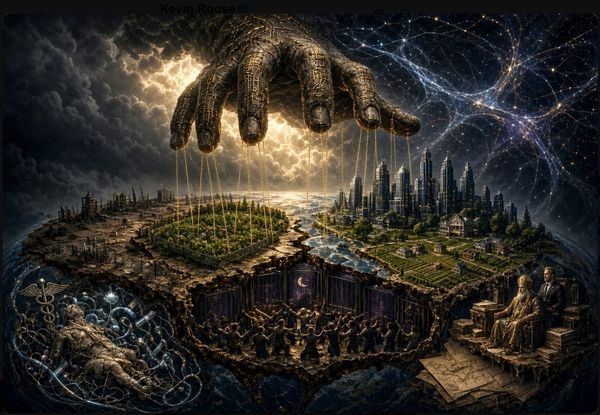
Earth thrives as a dynamic network. Its geological, biological, and atmospheric systems are interwoven in a delicate balance, pulsing within a cosmos that emergent holopanentheism understands as both materially real and suffused with sacred significance. From solar winds shaping its magnetic field to vast biological networks like Oregon's Armillaria ostoyae mycelium, Earth reflects the universe's interconnected patterns, patterns that emergent holopanentheism holds are not merely mechanical but expressive of a divine reality arising through complexity, relationship, and co-creative emergence.
This article merges cutting-edge science with insights from spiritual traditions and the theory of emergent holopanentheism.1 Where older frameworks imagined the divine as either wholly apart from nature or simply identical with it, emergent holopanentheism occupies a more nuanced position: God is immanent within natural processes yet also transcendent, self-limiting to allow genuine novelty and co-creation to arise. Kabbalah's call for cosmic repair, Hinduism's interconnected cosmic order, and Indigenous reverence for a living Earth all resonate with this view. Through geomagnetic rhythms, solar interactions, universal structures like the cosmic web, and organisms exhibiting awareness-like behaviors, this article explores how Earth, life, and the cosmos form a unified system whose sacred character deepens, rather than diminishes, under scientific scrutiny.
Earth's Resonant Systems
Earth's geomagnetic field acts as a silent orchestrator. Within an emergent holopanentheistic framework, such orchestration is not incidental: the planet's capacity to guide and coordinate life across species is itself an expression of the sacred arising through physical process. Research confirms that this field directs migrations of birds, whales, and sea turtles, enabling precise navigation across vast distances.2 In humans, geomagnetic fluctuations correlate with physiological shifts, including altered heart rates, disrupted sleep, and cognitive changes, suggesting that our bodies resonate with planetary rhythms at a level far beneath conscious awareness.3 Emergent holopanentheism reads such resonance not as mere biological coincidence but as evidence of the deep co-implication of life and cosmos, the sacred emerging through the very structures of matter.
The Sun extends this interplay outward. Its solar wind sparks auroras and, studies suggest, influences seismic activity; statistical models link solar flares to minor earthquakes.4 The Sun's eleven-year sunspot cycle also affects human health, with research documenting effects on cardiovascular function and circadian rhythms, likely mediated through geomagnetic disruptions.5 In an emergent holopanentheistic cosmos, these scalar connections, from stellar dynamics to cellular rhythm, are precisely the kind of nested, co-creative relationships through which the sacred makes itself known.
On Earth, Armillaria ostoyae offers one of the most compelling instances of this nested intelligence. This fungal network spans approximately 2,385 acres in Malheur National Forest in Oregon. Known as the Humongous Fungus, it facilitates nutrient exchange and chemical communication across forests, operating as a form of distributed ecological mind that emergent holopanentheism recognizes as the sacred expressing itself through biological complexity.6
Universal Threads of Connection
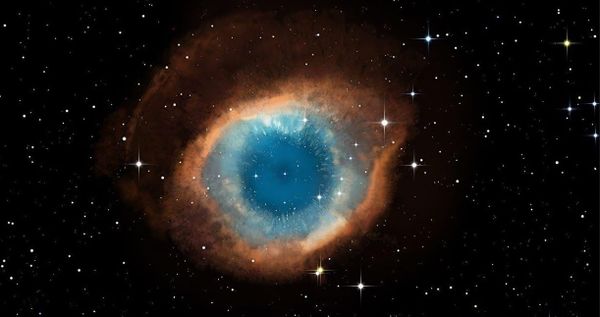
The universe reflects this connectivity at the largest scales through the "cosmic web," in which galaxies form filaments structurally analogous to neural networks. Fractal patterns like the golden ratio recur in fern spirals, nautilus shells, and galactic arms, pointing toward organizing principles that bridge biological and cosmological scales.7 Systems science views Earth's ecosystems, solar dynamics, and human consciousness as parts of a single, mutually conditioning network. Emergent holopanentheism interprets this network not as evidence that everything is mechanically determined but as a co-creative whole within which the sacred continuously emerges through new levels of relationship and complexity.
Preliminary studies, like the Global Consciousness Project, suggest that collective human activities such as synchronized global meditation can reduce social conflict metrics, with effects possibly amplified by geomagnetic or social feedback loops.8 These findings remain contested and should be read cautiously. Yet they are consonant with one of emergent holopanentheism's core claims: that consciousness is not an isolated phenomenon but is embedded in and co-constitutive of the wider relational field within which the sacred arises.
Emergent holopanentheism is worth distinguishing carefully from simpler positions. Classical pantheism holds that the universe simply is the divine, with no remainder. Classical theism places God wholly outside or above nature. Emergent holopanentheism holds that the universe exists within God, that God is present in and through natural processes, and that the divine is also more than the sum of those processes, transcendent in the sense of being inexhaustible, open, and creative. The sacred does not merely underlie reality like a hidden substance; it emerges through the increasing complexity and relationality of natural systems over time.
The spiritual traditions invoked in this article converge on precisely this insight, each in its own idiom. Kabbalah's tikkun olam frames human action as participation in an ongoing cosmic repair, not restoring a static order but co-creating an ever-richer sacred whole. Hinduism's dharma envisions life woven into a universal order that is dynamic rather than frozen, an expression of Brahman working through relationship and emergence. Indigenous traditions understand Earth as a living being within which all life participates in a sacred web that is itself always in process. Each of these traditions anticipates, in its own way, the emergent and relational character of the sacred that holopanentheism articulates in philosophical terms.
Examples of Organisms with Awareness-Like Behaviors
The organisms described below are significant not merely as biological curiosities but as illustrations of how intelligence, communication, and responsiveness arise through relationship and complexity. These are the very dynamics emergent holopanentheism identifies as the medium through which the sacred becomes manifest.
Armillaria ostoyae, Oregon: This fungal colony covers 2,385 acres in Malheur National Forest and is estimated to be 2,400 to 8,650 years old. It communicates via chemical and electrical signals, facilitating nutrient exchange in what ecologists have called the Wood Wide Web.9 Its distributed coordination across thousands of acres without any central organ is a striking instance of intelligence emerging through relationship rather than hierarchy.
Populus tremuloides, Pando, Utah: This quaking aspen colony spans approximately 106 acres and weighs an estimated 6,600 tons. Connected by a single root system, its trees share resources and respond collectively to stresses like drought, exhibiting coordinated, awareness-like behavior. Estimated at 80,000 years old, Pando represents persistence and resilience achieved through radical interdependence.10
Posidonia australis, Shark Bay, Australia: This seagrass covers approximately 200 square kilometers, making it the largest known plant by area. Genetically identical throughout, it stabilizes coastal ecosystems across environments of markedly different salinity and temperature, with adaptability arising through the integration of complexity rather than through differentiation.11
Armillaria gallica, Michigan: This honey mushroom spans 173 acres in the Upper Peninsula and is approximately 2,500 years old. It uses rhizomorphs to coordinate activity across its extent, balancing parasitism and ecosystem recycling in ways that serve the broader forest community.12
Slime molds (Physarum polycephalum): These organisms navigate mazes and optimize nutrient pathways without a nervous system, solving problems through purely distributed, network-level processes.13 Their behavior is a particularly clear instance of what emergent holopanentheism treats as mind arising through matter when matter is sufficiently organized into relationship.
Taken together, these organisms suggest that networked communication and environmental responsiveness are not exceptional biological achievements but recurrent outcomes of life's tendency toward co-creative complexity. This is precisely the pattern emergent holopanentheism predicts: the sacred is not an interruption of natural process but its deepest direction.
Humanity's Sacred Stewardship
Earth's geomagnetic rhythms, shaped by solar activity, align with patterns visible in the cosmic web and in the biological networks surveyed above. Research on Schumann resonances suggests they may synchronize with human brainwaves, potentially influencing mental states.14 Within an emergent holopanentheistic understanding, these resonances are not coincidental background noise but threads in the relational fabric through which mind and cosmos are co-constituted.
This interconnectedness carries ethical weight. If the sacred emerges through relationship and complexity, then the destruction of ecosystems is not merely an environmental loss but a diminishment of the conditions through which the divine continues to emerge. Ecological restoration, rooted in conservation science, is therefore a sacred practice in the strong philosophical sense: it preserves and extends the co-creative networks through which sacred emergence occurs. Studies on collective consciousness suggest that shared intentions, such as global peace meditations, may reduce violence metrics, pointing toward the possibility that human communities can actively shape the relational field rather than merely inhabit it.15 Emergent holopanentheism treats such stewardship not as an obligation imposed from outside but as the natural expression of what humanity is: a form of the universe's self-aware co-creativity, capable of either advancing or foreclosing the emergence of the sacred.
Embodying the Sacred Cosmos
Earth, its intricate biological networks, and the cosmos together form a sacred continuum. The divine is not a static presence underlying all things; rather, the sacred continuously emerges through the deepening complexity and relationship of natural systems. From the cosmic web's galactic filaments to Utah's Pando, Australia's Posidonia, Michigan's Armillaria, and the distributed intelligence of slime molds, interconnected patterns bind every scale within a whole that is more than the sum of its parts. Each star, organism, and act of human attention participates in that emergence.
Emergent holopanentheism redefines our existence accordingly. Humanity is not a passive observer of a sacred cosmos, nor its master, but a co-creator within it, a species in whom the universe has become capable of reflecting on its own sacred character and choosing, consciously, to extend or diminish it. Scientific exploration deepens our understanding of the geomagnetic, cosmic, and biological networks through which the sacred arises. Conservation protects the ecosystems whose complexity is the medium of that emergence. Collective moral effort cultivates the relational conditions in which the sacred can continue to unfold, and each of these activities is an expression of the same fundamental calling.
The cosmos is not finished. It is a living, co-creative process in which humanity participates not by accident but by nature. Emergent holopanentheism invites us to take that participation seriously, as the most fundamental form of stewardship available to us and as the most honest account of what it means to be alive in a universe still becoming itself.
Notes
1. Eric Daniel Buesing, Emergent Holopanentheism: The Quantum Bridge Between Science, Spirit, and Cosmic Meaning (2025).
2. M. Winklhofer and J. L. Kirschvink, "Magnetoreception in Animals," Physics Today 63, no. 3 (2010): 46–52.
3. N. J. Cherry, "Schumann Resonances, a Plausible Biophysical Mechanism for the Human Health Effects of Solar/Geomagnetic Activity," Natural Hazards 26, no. 3 (2002): 279–331.
4. S. D. Odintsov et al., "Solar Activity and Global Seismicity," Physics and Chemistry of the Earth 31, no. 4–9 (2006): 201–6.
5. G. Cornélissen et al., "Non-photic Solar Associations of Heart Rate Variability and Myocardial Infarction," Journal of Atmospheric and Solar-Terrestrial Physics 64, no. 5–6 (2002): 707–20.
6. B. A. Ferguson et al., "Coarse-scale Population Structure of Pathogenic Armillaria Species in a Mixed-conifer Forest in the Blue Mountains of Northeast Oregon," Canadian Journal of Forest Research 33, no. 4 (2003): 612–23.
7. V. Springel et al., "Simulations of the Formation, Evolution, and Clustering of Galaxies and Quasars," Nature 435, no. 7042 (2005): 629–36.
8. R. D. Nelson and P. A. Bancel, "On the Physical Basis of the Global Consciousness Project," Journal of Scientific Exploration 25, no. 4 (2011): 659–76.
9. Ferguson et al., "Coarse-scale Population Structure," 612–23; Guinness World Records, "Largest Fungi," accessed 2025, https://www.guinnessworldrecords.com/world-records/66481-largest-fungi.
10. M. C. Grant, "The Trembling Giant," Discover Magazine 14, no. 10 (1993): 82–89.
11. J. M. Edgeloe et al., "Extensive Polyploid Clonality Was a Successful Adaptation of the Seagrass Posidonia australis to the Mediterranean Sea of Australia," Proceedings of the Royal Society B 289, no. 1976 (2022): 20220523.
12. J. B. Anderson et al., "Clonal Evolution and Genome Stability in a 2500-year-old Fungal Individual," Proceedings of the Royal Society B 285, no. 1893 (2018): 20182233.
13. A. Tero et al., "Rules for Biologically Inspired Adaptive Network Design," Science 327, no. 5964 (2010): 439–42.
14. S. V. Pobachenko et al., "The Relationship Between Schumann Resonance and Human Brain Activity," Biofizika 51, no. 6 (2006): 1051–57.
15. D. W. Orme-Johnson et al., "International Peace Project in the Middle East: The Effects of the Maharishi Technology of the Unified Field," Journal of Conflict Resolution 32, no. 4 (1988): 776–812.
Bibliography
Anderson, J. B., C. Wang, B. Gladieux, E. Beaunée, O. Kasuga, and B. D. Qian. "Clonal Evolution and Genome Stability in a 2500-year-old Fungal Individual." Proceedings of the Royal Society B 285, no. 1893 (2018): 20182233.
Buesing, Eric Daniel. Emergent Holopanentheism: The Quantum Bridge Between Science, Spirit, and Cosmic Meaning. 2025.
Cherry, N. J. "Schumann Resonances, a Plausible Biophysical Mechanism for the Human Health Effects of Solar/Geomagnetic Activity." Natural Hazards 26, no. 3 (2002): 279–331.
Cornélissen, G., F. Halberg, C. Breus, E. V. Syutkina, R. Baevsky, A. Weydahl, Y. Watanabe, K. Otsuka, J. Siegelova, and B. Fiser. "Non-photic Solar Associations of Heart Rate Variability and Myocardial Infarction." Journal of Atmospheric and Solar-Terrestrial Physics 64, no. 5–6 (2002): 707–20.
Edgeloe, J. M., E. A. Severn-Ellis, D. Bayer, P. Custandi, F. Rozainah, M. Z. Hooper, and G. A. Kendrick. "Extensive Polyploid Clonality Was a Successful Adaptation of the Seagrass Posidonia australis to the Mediterranean Sea of Australia." Proceedings of the Royal Society B 289, no. 1976 (2022): 20220523.
Ferguson, B. A., T. A. Dreisbach, C. G. Parks, G. M. Filip, and C. L. Schmitt. "Coarse-scale Population Structure of Pathogenic Armillaria Species in a Mixed-conifer Forest in the Blue Mountains of Northeast Oregon." Canadian Journal of Forest Research 33, no. 4 (2003): 612–23.
Grant, M. C. "The Trembling Giant." Discover Magazine 14, no. 10 (1993): 82–89.
Nelson, R. D., and P. A. Bancel. "On the Physical Basis of the Global Consciousness Project." Journal of Scientific Exploration 25, no. 4 (2011): 659–76.
Odintsov, S. D., K. Boyarchuk, K. Georgieva, B. Kirov, and D. Atanasov. "Solar Activity and Global Seismicity." Physics and Chemistry of the Earth 31, no. 4–9 (2006): 201–6.
Orme-Johnson, D. W., C. N. Alexander, J. L. Davies, H. M. Chandler, and W. E. Larimore. "International Peace Project in the Middle East: The Effects of the Maharishi Technology of the Unified Field." Journal of Conflict Resolution 32, no. 4 (1988): 776–812.
Pobachenko, S. V., A. G. Kolesnik, A. S. Borodin, and V. V. Kalyuzhin. "The Relationship Between Schumann Resonance and Human Brain Activity." Biofizika 51, no. 6 (2006): 1051–57.
Springel, V., S. D. M. White, A. Jenkins, C. S. Frenk, N. Yoshida, L. Gao, and J. Navarro et al. "Simulations of the Formation, Evolution, and Clustering of Galaxies and Quasars." Nature 435, no. 7042 (2005): 629–36.
Tero, A., S. Takagi, T. Saigusa, K. Ito, D. P. Bebber, M. D. Fricker, K. Yumiki, R. Kobayashi, and T. Nakagaki. "Rules for Biologically Inspired Adaptive Network Design." Science 327, no. 5964 (2010): 439–42.
Winklhofer, M., and J. L. Kirschvink. "Magnetoreception in Animals." Physics Today 63, no. 3 (2010): 46–52.