Has the Pursuit of Happiness Made Americans Unhappy?
How America Traded Virtue for Screens and Lost Its Soul
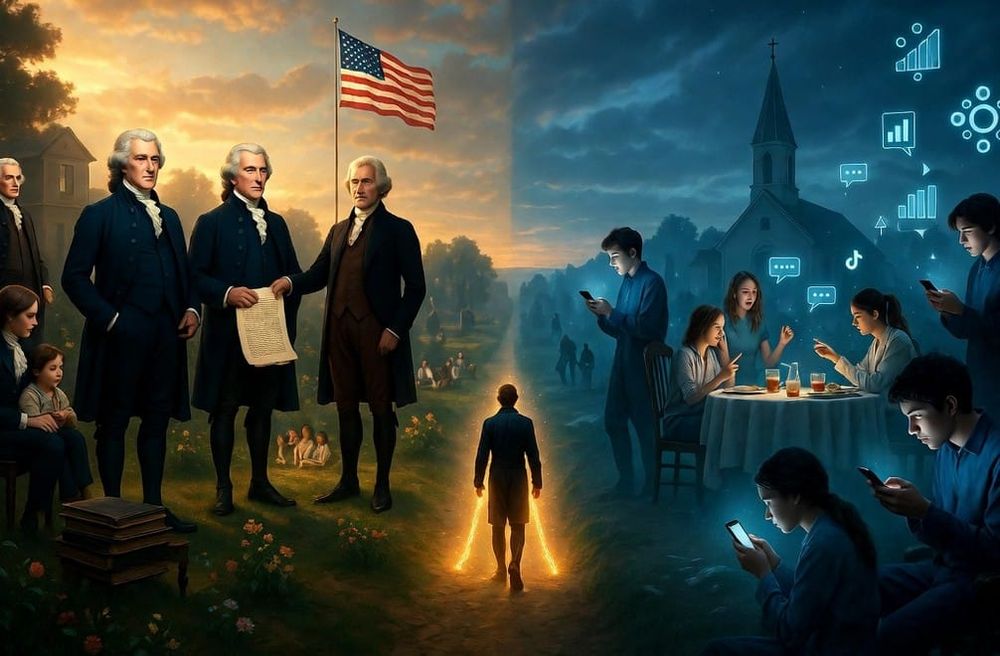
The Declaration of Independence enshrined the "pursuit of happiness" as an unalienable right alongside life and liberty. Jefferson and the Founders weren't talking about pleasure or consumption. They meant the active quest for a virtuous life grounded in reason, faith, property, and self-governance. Ordered liberty that produces genuine flourishing.
Today, Americans report record levels of anxiety, depression, loneliness, and discontent. Something has gone profoundly wrong.
Cultural engineers have always known how to manipulate human response. Babylonian court musicians synchronized rhythms to heartbeats, bypassing conscious thought entirely. TikTok's algorithm does the same thing with surgical precision. Modern platforms create dependency through infinite scrolls, variable rewards borrowed straight from casino design, engineered FOMO. Studies show heavy social media use correlating with heightened anxiety, depression, materialistic values. Especially among adolescents. We chase likes and status updates, then wonder why we feel empty. The average American now spends over two hours daily on social media. Time that used to build actual communities, movements, family bonds.
Foreign adversaries have funneled billions into American universities over the past few decades. Seeding programs that export anti-Western frameworks directly into K-12 curricula and teacher training pipelines. Students learn America is fundamentally oppressive before they learn what the founding principles actually say. They encounter "settler-colonial" theory before they read the Federalist Papers, are taught Lincoln was a colonizer before they read his actual words. Families fracture over Thanksgiving dinner. Adult children lecture their parents about privilege and systemic oppression. This isn't accidental curriculum development.
The educational system itself destroys intrinsic motivation. Basic operant conditioning. Grades reward compliance, detention punishes deviation. Edward Deci's research demonstrates how external controls crush the internal drive to learn and create. Children who once asked "why" learn instead to ask "will this be on the test?" School violence goes unaddressed while algorithms amplify every division and DEI bureaucracies punish dissent. What comes out the other end? Compliant, anxious, ideologically rigid adults who cannot distinguish propaganda from truth. Credentials without the tools for genuine sovereignty.
Networks of foundations, corporations, foreign powers have spent over a century refining these techniques. Edward Bernays' propaganda methods from the 1920s evolved into what we see now. Netflix's neuroscientist-tuned content streams. Silicon Valley's entire attention economy. Churches sit empty while Discord servers overflow. Neighborhood connections vanish while comment section battles rage. We've replaced real human connection with a digital substitute and can't figure out why loneliness has reached epidemic levels.
Look at the generational data. Gaps in patriotism, family stability, mental health track directly with exposure to these systems. Older Americans who grew up before the machine fully matured still retain higher rates of contentment and civic attachment. They remember when boredom was normal. When waiting didn't feel like punishment. When your attention wasn't being auctioned off every second of the day. Younger cohorts? Steeper declines across every measure you can track. The Founders warned repeatedly that liberty requires virtue. We replaced virtue with behavioral variables and called it progress.
But some people are walking away from all of this. Parents pulling children out of factory-model schools are seeing intrinsic motivation return. Stronger family bonds. Families turning off the screens are rediscovering what actual conversation feels like. Independent media operations challenging the narrative monopolies. Local economies pushing back against corporate homogenization. Faith communities offering genuine belonging that doesn't require a login.
People who step outside this system report something you won't hear in mainstream coverage. Lower stress. Clearer purpose. Actual peace once they get past the initial withdrawal period. They're reading books again, planting gardens, learning trades. Raising children who know their neighbors by name instead of their follower counts.
The pursuit of happiness was never supposed to be passive consumption delivered through a screen. It required effort and sacrifice. The willingness to build something that outlasts you. A family, a business, a community you can actually touch.
Americans aren't inherently unhappy. We've been systematically steered into pursuits that cannot satisfy. The cure isn't new legislation or better algorithms from the same people who created the problem. Wake up. Reclaim control over your own mind and your family. Reject what's being sold to you as happiness. Return to what actually produces flourishing instead of just the simulation of it.
The pursuit of happiness can still mean what the Founders intended. Not guaranteed pleasure, but earned meaning through struggle and sacrifice. The choice is ours if we're awake enough to see what's been done and brave enough to walk away from it.
Declaration of Generative AI Use
I use generative AI solely to research diverse topics, organize thoughts, correct language, improve clarity, and format citations in CMOS style. Every idea, argument, and conclusion in this work is my own. I have reviewed the piece carefully before submitting and take full responsibility for its content. It is also worth noting that the topics I typically write on are ones generative AI would refuse to engage with fully anyway.
A word on AI detection tools: they are not reliable. These tools routinely flag polished, well-structured, or academic writing as machine-generated, regardless of who actually wrote it. A high score on an AI detector is not evidence of AI authorship. It is, just as often, evidence of clarity.