The Dog-Headed People
Three Thousand Years of Reports Nobody Wants to Explain
Ctesias was a Greek physician working at the Persian court around 400 BCE. His job required accuracy. Court physicians who filed bad reports didn't keep their positions long. He wrote this about tribes in India:
They speak no language, but bark like dogs, and in this manner make themselves understood by each other. Their teeth are larger than those of dogs, their nails like those of these animals, but longer and rounder... They are extremely just, like the rest of the Indians with whom they associate. They understand the Indian language but are unable to converse, only barking or making signs with their hands and fingers by way of reply... They number about 120,000.1
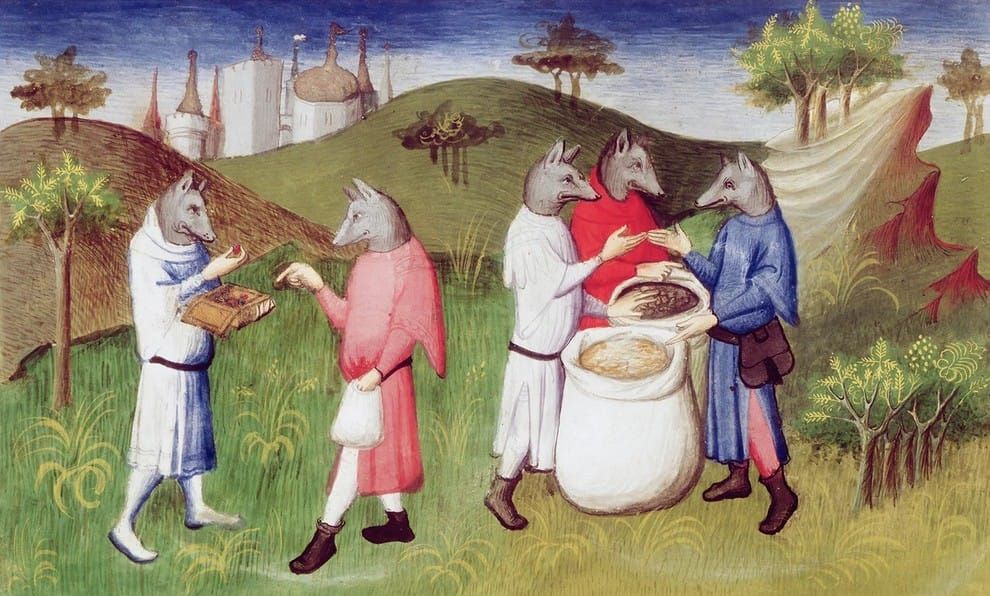
That last number matters. It's a population estimate. He also documented their economic activity: they traded amber, purple dye, and dried fruit to the Indian king annually. In exchange they bought bread, flour, cotton, swords, bows, and arrows. They lived in caves, hunted with sophisticated weapons, and were described as extremely just. The king sent them military supplies every five years. This isn't monster folklore. It's an administrative report about a trading partner.
Megasthenes, another Greek ethnographer, corroborated the account about a century later.2 Mountain-dwelling groups in India with dog-like heads, clothed in animal skins, hunting with claws. Independent confirmation. These were diplomats and official historians. Their careers depended on getting the facts right.
By the 9th century, reports had spread to Scandinavia. Around 850 AD, the missionary Rimbert wrote to the monk Ratramnus of Corbie describing cynocephali in the far north.3 Rimbert reported they lived in villages, farmed collectively, wore clothing, and followed laws. Ratramnus analyzed the evidence and concluded they possessed rational souls. His reasoning: living together requires laws, which requires a concept of justice. Agriculture requires rational planning. Clothing demonstrates technical skill and modesty. These weren't philosophical musings. This was a theological debate about whether missionaries should attempt to convert them. The Church was taking the question seriously enough to require formal written opinions from respected theologians.
Marco Polo wrote about the island of Angamanain in the late 13th century:4
I assure you all the men of this Island of Angamanain have heads like dogs, and teeth and eyes likewise; in fact, in the face they are all just like big mastiff dogs! They have a quantity of spices; but they are a most cruel generation.
He calls them cruel but notes they controlled spice trade. Economic networks. Commercial activity. Ibn Battuta, the Moroccan traveler whose accounts are considered foundational historical documents, writes about dog-mouthed people on an island between India and Sumatra.5 The men had canine mouths. The women were beautiful by conventional standards. He's describing anatomical differences, not cultural projections.
Christianity preserved one of these beings as Saint Christopher. Multiple historical texts describe him as having a dog's head before his conversion. He was reportedly captured in battle in Cyrenaica, part of a warrior tribe of dog-headed men. After meeting Christ, he converted, was baptized, and according to the tradition, received both sainthood and a human appearance. Eastern Orthodox iconography depicts him with a canine head.6
The standard academic explanation is misidentification.7 Maybe tribes with dental modifications. The Mentawai people filed their teeth. But filed teeth don't produce descriptions of heads like mastiff dogs, teeth larger than dogs, nails like claws. That's not dental work. That's anatomy.
Ancient Egypt had Anubis, the jackal-headed god.8 That imagery shaped Greek concepts of monstrous races at the world's edges. Medieval European bestiaries catalogued these beings as real creatures in remote regions. Natural history, not mythology.
Then the Age of Exploration maps the known world and the reports stop appearing in official records. Filed away as pre-scientific superstition.
Until Michigan. Starting in the 1990s.9
Linda Godfrey has documented sightings of large bipedal creatures with canine heads in the Great Lakes region for decades. Seven feet tall or bigger. Walking upright. Leaving tracks. Witnesses describe intelligent, aggressive behavior. These reports are distinct from werewolf folklore, which has its own separate tradition. Physical beings with hybrid anatomy moving through documented locations.
Three thousand years of reports. Multiple continents. Credible sources with no obvious reason to fabricate. The descriptions remain consistent: upright posture, human build, canine head. Not a bear. Not a wolf. Not a deformed person.
The usual response is to invoke archetypes. Jung's collective unconscious. Campbell's monomyth. The animal-headed figure as a boundary symbol between civilization and wilderness. There's probably something to that.
But archetypes don't explain population estimates. They don't explain annual tribute payments to the Indian king. They don't explain spice trade monopolies. They don't explain military supply shipments every five years. Those are economic and political relationships.
The distribution is the problem. Ancient India. Medieval Southeast Asia. Eastern Europe. North Africa. Modern Michigan. No clear transmission route connects these sightings. The Andaman Islanders weren't reading Pliny the Elder. Witnesses in 1990s Wisconsin had never heard of Megasthenes. The core description stays consistent anyway.
So the options are: mass psychological phenomenon, where humans across unrelated cultures independently generate identical hallucinations. Misidentified animals, which doesn't match the anatomical details or the documented economic activity. Undiscovered species, unlikely in 2026 with satellite mapping. Or elaborate hoax spanning three millennia and multiple continents with no clear motive.
Or something exists in the liminal spaces. The edges. Appearing rarely enough to stay outside scientific consensus but persistently enough that the reports never quite stop.
The cynocephali are either the most successful myth in human history, appearing independently across every inhabited continent with remarkable consistency, or we don't have a framework for what they actually are.
Mainstream science files this under folklore. Cryptozoology claims it as proof of hidden species. Neither explanation handles all the data. The reports exist. They're consistent across time and geography. Multiple credible sources. Nobody has provided a complete explanation that doesn't require either dismissing millennia of testimony or accepting something biology says shouldn't exist.
The pattern is real. The sightings continue. Somewhere between the certainties of our maps and the limits of what we're willing to accept, something with a human body and a dog's head keeps appearing in the record.
Notes
1. Ctesias's account is preserved in Pliny the Elder, Natural History, trans. H. Rackham, Loeb Classical Library (Cambridge, MA: Harvard University Press, 1942), 7.2.23.
2. Megasthenes's observations are cited in multiple classical sources, compiled in Ancient India as Described by Megasthenes and Arrian, trans. J. W. McCrindle (London: Trübner & Co., 1877), fragments 27b-27c.
3. Ratramnus of Corbie, Epistola de Cynocephalis, c. 850 AD. Written in response to missionary Rimbert's inquiry about dog-headed people in Scandinavia. For discussion see Karl Steel, "Cynocephali, Animal Savagery, and Terror," In the Middle (blog), July 2007, https://www.inthemedievalmiddle.com/2007/07/cynocephali-animal-savagery-and-terror.html; and "Louis the Pious and the Cynocephalus," The Historians' Sketchpad (blog), January 25, 2022, https://salutemmundo.wordpress.com/2022/04/01/louis-the-pious-and-the-cynocephalus/.
4. Marco Polo, The Travels of Marco Polo, trans. Ronald Latham (London: Penguin Books, 1958), 253.
5. Ibn Battuta, The Travels of Ibn Battuta, trans. H. A. R. Gibb, vol. 4 (Cambridge: Cambridge University Press, 1994), 813–14.
6. For Saint Christopher as cynocephalus, see "Christopher of Lycia," OrthodoxWiki, accessed May 22, 2026, https://orthodoxwiki.org/Christopher_of_Lycia; and "Why Is There a Saint With a Dog's Head in Orthodox Christian Iconography?" Greek Reporter, March 19, 2025, https://greekreporter.com/2025/03/19/saint-dog-head-orthodox-christian-iconography/.
7. For analysis of dental modification practices, see David W. Frayer et al., "Artificial Cranial and Dental Modification in the Bronze Age Balkans," in Anthropological Papers of the American Museum of Natural History 92 (2012): 35–48; on broader cultural interpretations of cynocephali, see Timothy S. Jones, "Monstrous Races," in The Ashgate Research Companion to Monsters and the Monstrous, ed. Asa Simon Mittman and Peter J. Dendle (Farnham, UK: Ashgate, 2012), 330–44.
8. "Cynocephaly," Wikipedia, accessed May 22, 2026, https://en.wikipedia.org/wiki/Cynocephaly.
9. Linda Godfrey, The Beast of Bray Road: Tailing Wisconsin's Werewolf (Black Earth, WI: Prairie Oak Press, 2003); Godfrey, Hunting the American Werewolf (Black Earth, WI: Trails Books, 2006).
Bibliography
"Cynocephali (Kynokephaloi)." Theoi Project. Accessed May 22, 2026. https://www.theoi.com/Phylos/Kunokephaloi.html.
"Cynocephaly." Wikipedia. Accessed May 22, 2026. https://en.wikipedia.org/wiki/Cynocephaly.
Frayer, David W., et al. "Artificial Cranial and Dental Modification in the Bronze Age Balkans." Anthropological Papers of the American Museum of Natural History 92 (2012): 35–48.
Godfrey, Linda. The Beast of Bray Road: Tailing Wisconsin's Werewolf. Black Earth, WI: Prairie Oak Press, 2003.
———. Hunting the American Werewolf. Black Earth, WI: Trails Books, 2006.
Ibn Battuta. The Travels of Ibn Battuta. Translated by H. A. R. Gibb. Vol. 4. Cambridge: Cambridge University Press, 1994.
Jones, Timothy S. "Monstrous Races." In The Ashgate Research Companion to Monsters and the Monstrous, edited by Asa Simon Mittman and Peter J. Dendle, 330–44. Farnham, UK: Ashgate, 2012.
Megasthenes. Ancient India as Described by Megasthenes and Arrian. Translated by J. W. McCrindle. London: Trübner & Co., 1877.
Pliny the Elder. Natural History. Translated by H. Rackham. Loeb Classical Library. Cambridge, MA: Harvard University Press, 1942.
Polo, Marco. The Travels of Marco Polo. Translated by Ronald Latham. London: Penguin Books, 1958.
Ratramnus of Corbie. Epistola de Cynocephalis. c. 850 AD.
Steel, Karl. "Cynocephali, Animal Savagery, and Terror." In the Middle (blog). July 2007. https://www.inthemedievalmiddle.com/2007/07/cynocephali-animal-savagery-and-terror.html.
"Louis the Pious and the Cynocephalus." The Historians' Sketchpad (blog). January 25, 2022. https://salutemmundo.wordpress.com/2022/04/01/louis-the-pious-and-the-cynocephalus/.
Declaration of Generative AI Use
I use generative AI solely to research diverse topics, organize thoughts, correct language, improve clarity, and format citations in CMOS style. Every idea, argument, and conclusion in this work is my own. I have reviewed the piece carefully before submitting and take full responsibility for its content. It is also worth noting that the topics I typically write on are ones generative AI would refuse to engage with fully anyway.
A word on AI detection tools: they are not reliable. These tools routinely flag polished, well-structured, or academic writing as machine-generated, regardless of who actually wrote it. A high score on an AI detector is not evidence of AI authorship. It is, just as often, evidence of clarity.