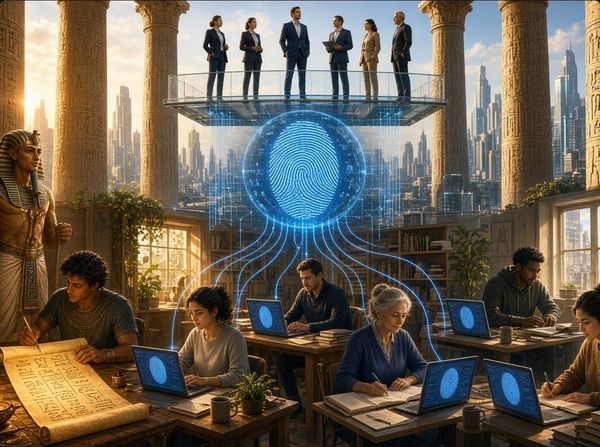
The Stolen Inheritance: Land, Faith, and the Five-Thousand-Year Cage
What appears as progress and faith is the continuous engineering of consent so that the Earth, the body, and the mind remain instruments of elite continuity rather than organic human flourishing.
I am an American, true to the red, white, and blue, shaped by the same soil, the same experiments in ordered liberty that still hold promise when not hollowed out from within. Yet age has taught me to read between the lines. Capitalism, for all its generative power in unleashing human ingenuity, carries deep structural flaws that concentrate advantage while manufacturing scarcity amid abundance.1 Starvation persists not from lack of food but from systems that prioritize extraction over distribution.2 Suffering endures in a medical establishment forged in the post-Flexner era under Rockefeller influence, one that treats the body as a lifelong revenue stream rather than a system capable of healing.3 These are not abstract critiques. They are lived patterns.
I reject the easy labels, socialism, communism, fascism, that function as tools of division.4 They are products of the same conditioning that pits neighbor against neighbor so that the architecture of control remains unexamined. We are all human. We want the same things for our families and for the future of humanity: safety, health, meaning, the chance for our children to grow without invisible strings directing their story. Division weakens us. Social conditioning trains us to remain divisive.5 The remedy is not another ideology handed down from new masters. It is the recovery of organic development, humanity unfolding through relationship, complexity, and conscious participation rather than through engineered crisis and managed consent.6
The Architecture of Control
For five thousand years a relatively small set of elites, priests, landowners, financiers, institutional heads, has maintained outsized influence through four interlocking mechanisms: coercion, alignment, amnesia, and conflict.7 Coercion controls the necessities of survival, once grain stores and temple debts, today credit, digital identity, and programmable money.8 Alignment makes the population want what the system requires; ancient kings did this through myth and divine kingship, modern ones through schooling, media, and the quiet consensus that good citizenship equals compliant consumption.9 Amnesia erases memory of alternatives, debt jubilees, communal land practices, healing traditions not subordinated to profit, so each crisis appears unprecedented.10 Conflict turns pressure sideways, exhausting people in manufactured culture wars while ownership and policy remain untouched above the fray.11
These mechanisms did not arise by accident. They form the hidden hand that runs from Sumerian temple administrators recording debts on clay tablets, through Roman patronage and medieval networks, colonial extraction, industrial monopolies, and into today’s surveillance capitalism and technocratic agendas.12 The same pattern appears in the conquest of private space and private thought: the systematic occupation of attention, the conversion of the unconscious into a lever of rule, the scientific architecture of manufactured belief.13 Edward Bernays named it plainly, the conscious manipulation of the organized habits and opinions of the masses by an invisible government that pulls the wires.14 The television was never neutral entertainment; it was programming designed to fill the vacancy left by distracted or absent parents, to install a template of reality before the slate could be claimed by the individual.15
Culture itself becomes Maya, the creative power that makes the constructed world appear solid, permanent, and obvious.16 Family, school, community, and media write the story so thoroughly that most never notice the writing.17 The template feels like common sense. That is the illusion at work: the conviction that there is no illusion. Once a population mistakes its shared Maya for objective reality, managing it becomes efficient. You need not control every mind. You shape the shared illusion underneath them all.18
Nowhere is this clearer than in the medical system. The Flexner Report of 1910, backed by Carnegie and Rockefeller resources, closed most of the diverse medical schools that once existed and standardized a model centered on pharmaceutical intervention, laboratory science, and professional monopoly.19 Genuine advances occurred. Yet the trajectory favored treatments that manage symptoms indefinitely over approaches that restore the body’s capacity to heal.20 Profit entered the most basic human need, health, and turned it into an industry. Chronic conditions become revenue. Prevention and root-cause inquiry are marginalized when they threaten the model.21 The same logic of scarcity amid abundance appears in food systems engineered for dependence rather than resilience, and in economic arrangements that generate vast wealth while leaving millions without the means to thrive.22
The result is a civilization that feels rigged because, in its deepest operating logic, it is. The elite system does not require cartoon villains. It requires only the continuous production of minds that accept the template as reality, and the continuous deployment of the four mechanisms whenever that acceptance threatens to crack.23
Religion has served as one of the most enduring instruments of division across this entire epoch. From the earliest temple complexes that fused spiritual authority with control of grain and debt, through the medieval Church’s accumulation of land and sale of indulgences, to the confessional wars that fractured Europe and the colonial missions that accompanied land seizures, doctrinal boundaries have been drawn and redrawn to separate human beings into camps of the saved and the damned, the pure and the impure.24 Competing cosmologies were not merely debated; they were systematically displaced, their sacred sites overwritten, their practitioners marginalized or eliminated.25 The result is a population trained to see fellow humans through the lens of inherited creed rather than shared origin and shared need. This religious fracturing operates as a specialized form of the conflict mechanism: energy that might otherwise question concentrated power is instead spent defending or attacking particular interpretations of the divine.26 Amnesia follows, as the earlier traditions of common land, communal care, and direct experience of the sacred are forgotten or dismissed as primitive.27 Alignment is achieved when obedience to institutional hierarchy is presented as fidelity to the divine itself. Coercion appears when dissent is punished as heresy or apostasy.28 Across five millennia the pattern holds: the same networks that control material resources have repeatedly used the language of ultimate meaning to keep humanity divided against itself.29
The Divine That Grows
Beneath this manufactured surface lies a deeper reality. Emergent Holopanentheism names it.30 Divinity is not a static, pre-existent entity hovering outside the cosmos, nor is it simply identical with matter. It develops. It emerges from the complex interactions, relationships, and holographic connections that constitute reality at every scale.31 “Emergent” means higher-order properties, awareness, meaning, value, arise from interactions that cannot be reduced to their parts, the way music arises from notes in relationship or consciousness from neural networks.32 “Holo” draws from the holographic principle: every region encodes patterns of the whole; information is more fundamental than matter.33 “Panentheism,” reoriented, means the sacred unfolds through natural processes rather than by external intervention or pure identity with the physical.34
The universe functions as a cosmic seedbed, distributing the chemical precursors of life and the conditions for complexity.35 Quantum non-locality, biological networks that exhibit distributed intelligence, collective intention effects, and the capacity of consciousness to influence physical systems all point to a reality in which relationship is primary.36 Divinity grows through that relational creativity. Humans are not spectators. We are co-creators. Our choices, our attention, our capacity for coherent relationship participate in the unfolding.37 Suffering and scarcity are not cosmic necessities; they are distortions introduced when systems of coercion and amnesia interrupt the organic process of complexity and mutual flourishing.38
This is not abstract theology. It is the recognition that the same universe that produced us is still developing, and that our conscious participation is part of that development. When we allow elites to write the script of culture, consciousness, and perceived reality, we surrender our role as authors. When we reclaim it, the divine process advances through us rather than being throttled by us.39
If the Earth is part of a living, sacred story that every conscious being helps write, then the land itself is not private property in the ordinary sense. Nobody made the land. Nobody created the dirt under a city block, the river running past a farm, or the stretch of coastline with the best view. People showed up to a planet that was already finished.40 The land existed before anyone alive was born and it will still be here after we are gone. Henry George saw this with clarity more than a century ago. The rising value of a location is created by the community around it, by the subways, schools, businesses, and generations of shared effort that make a place desirable. Yet the legal owner pockets that unearned gain as if it were personal achievement.41 George called it economic rent, and he proposed a single tax on the bare value of the land itself, separate from any improvements built upon it. Tax wages and you punish work. Tax buildings and you punish construction that benefits everyone. Tax land value and you capture wealth no private owner created.42
The historical record makes the injustice sharper still. Most land in America was first taken from Native nations by chartered companies, the Virginia Company, the Dutch West India Company, the railroad corporations that received roughly ten percent of the continental United States through federal grants.43 Those seizures were followed by inheritance, trusts, and corporate succession that keep the same concentrated holdings moving from one generation of owners to the next.44 Today nearly eighty percent of rented farmland is owned by landlords who do not farm it; much of it passes through wills and trusts rather than open markets.45 Vacant lots sit idle in cities that need housing because speculation pays better than use.46 The same pattern appears in monopoly power, in financial fees extracted regardless of performance, and in the value AI systems draw from collective data and labor.47 The form changes. The question remains: who earns the rising value that an entire community builds together? The land was provided by the divine process for all of us. Its control by a few entrenched elites, generation after generation, serves primarily to perpetuate their position and to keep the rest of humanity in a state of artificial scarcity.48
The Path of Organic Development
The solution is not a new central plan or a new set of masters promising liberation through their control. History shows that violent overthrow or wholesale ideological replacement simply installs a new elite using the same four mechanisms.49 The world was never theirs to take. Their power is borrowed from our surrender.50 The work is to stop surrendering, incrementally, deliberately, in the direction of those we love and trust.51
Begin with private space and private thought. Guard the hours of attention that the illusion architects have colonized.52 Recover the capacity to sit with questions rather than consuming pre-packaged answers. Teach children to notice the template rather than absorb it uncritically.53 In health, reject the premise that profit must mediate every interaction with the body. Support practices and research that treat the organism as a self-organizing system capable of coherence, drawing on nutrition, movement, relationship, and the body’s own intelligence rather than lifelong pharmaceutical management alone.54 In economy, favor arrangements that reduce artificial scarcity: local production where possible, transparent credit outside the tightest nodes of concentrated ownership, the preservation of cash and peer-to-peer exchange against the coming programmable cage.55
At the cultural level, refuse the manufactured conflict. Refuse the labels that turn shared human needs into zero-sum identity wars, including the religious divisions that have long been weaponized to keep humanity from recognizing its common stake in the Earth and in one another.56 Practice the stubborn counter-current that outlives every regime: the quiet insistence on asking who benefits, what has been forgotten, and what alternatives once existed.57 Collective coherence, shared attention directed toward healing rather than division, has measurable effects. Small groups aligning intention and action create fields that influence the larger system.58 This is not mysticism detached from evidence; it is the practical implication of a holographic, relational cosmos.59
Organic development means allowing complexity and relationship to generate higher-order solutions rather than imposing them from above. It means recognizing that starvation in an abundant world is a design failure of coercive systems, not an inevitability of human nature.60 It means building health systems whose success is measured by the restoration of vitality rather than the volume of ongoing prescriptions. It means economic life oriented toward the flourishing of families and communities rather than the perpetual expansion of elite control, beginning with the recognition that the land itself belongs to all of us as an inheritance of the divine process, not as a private prize to be hoarded across generations.61 And it means a spiritual stance that treats every human as a participant in the divine process, not a resource to be managed.62
The entrenched elites have spent millennia refining the performance. They have made the strings invisible by making the stage feel like the only reality. Yet the strings remain visible to anyone willing to look.63 Once seen, they lose their automatic power. We do not need permission to reclaim authorship of our lives. We need only the stubborn refusal to accept easy answers, the courage to stay real and curious, and the daily practice of withdrawing consent from mechanisms that divide and diminish us.64
Humanity develops organically when we remember that we are the ones who pull the levers of our own minds, or allow others to do so.65 The future belongs to those who choose the former. The divine that grows awaits our participation.66
Notes
1. Eric Daniel Buesing, The Hidden Hand: Wealth, Power, and Control from Pharaohs to Corporations (Walterville, OR: TrineDay, 2026), chaps. 9–10, 15; Thomas Piketty, Capital in the Twenty-First Century, trans. Arthur Goldhammer (Cambridge, MA: Harvard University Press, 2014).
2. Amartya Sen, Poverty and Famines: An Essay on Entitlement and Deprivation (Oxford: Clarendon Press, 1981); FAO, IFAD, UNICEF, WFP, and WHO, The State of Food Security and Nutrition in the World 2026 (Rome: FAO, 2026), estimating that some 645 million people faced hunger in 2025 in a world producing sufficient calories for its population; Frances Moore Lappé and Joseph Collins, World Hunger: Ten Myths (New York: Grove Press, 2015).
3. Abraham Flexner, Medical Education in the United States and Canada: A Report to the Carnegie Foundation for the Advancement of Teaching, Bulletin No. 4 (New York: Carnegie Foundation for the Advancement of Teaching, 1910); Paul Starr, The Social Transformation of American Medicine (New York: Basic Books, 1982); E. Richard Brown, Rockefeller Medicine Men: Medicine and Capitalism in America (Berkeley: University of California Press, 1979).
4. Buesing, Hidden Hand, chap. 16; Eric Daniel Buesing, “Why the World Feels Rigged: The Four Mechanisms That Have Controlled Humanity for Five Thousand Years,” June 19, 2026, https://www.ericbuesing.com/why-the-world-feels-rigged-the-four-mechanisms-that-have-controlled-humanity-for-five-thousand-years/.
5. Eric Daniel Buesing, The Illusion Architects: How Elites Shape Culture, Consciousness, and Reality (Walterville, OR: TrineDay, forthcoming 2026), preface and chap. 1.
6. Eric Daniel Buesing, Emergent Holopanentheism: The Quantum Bridge Between Science, Spirit, and Cosmic Meaning (2025), https://library.biblioboard.com/viewer/755f8ffe-ce17-4831-98fc-0cae64ea9497 and https://www.ericbuesing.com/free-book-emergent-holopanentheism/; on manufactured consent, see Edward L. Bernays, Propaganda (New York: Horace Liveright, 1928), and Walter Lippmann, Public Opinion (New York: Harcourt, Brace, 1922).
7. Buesing, Hidden Hand, introduction, 5–7; Buesing, “Why the World Feels Rigged.”
8. Buesing, Hidden Hand, chaps. 1, 12; Eric Daniel Buesing, “The Coming Programmable Cage: Money as Control Eliminating Humanity’s Last Free Exchange,” July 27, 2026, https://www.ericbuesing.com/the-programmable-cage-money-as-control-eliminating-humanitys-last-free-exchange/.
9. Buesing, Hidden Hand, chaps. 1–2, 10; Buesing, Illusion Architects, chap. 6.
10. Buesing, Hidden Hand, chap. 15, esp. 116; Michael Hudson, …and forgive them their debts: Lending, Foreclosure and Redemption from Bronze Age Finance to the Jubilee Year (Dresden: ISLET-Verlag, 2018); David Graeber, Debt: The First 5,000 Years (Brooklyn, NY: Melville House, 2011).
11. Buesing, Hidden Hand, chaps. 11, 16; Buesing, Illusion Architects, chap. 11.
12. Buesing, Hidden Hand, chaps. 1, 3, 5, 8, 9, 12, 14; Samuel Noah Kramer, The Sumerians: Their History, Culture, and Character (Chicago: University of Chicago Press, 1963); Shoshana Zuboff, The Age of Surveillance Capitalism: The Fight for a Human Future at the New Frontier of Power (New York: PublicAffairs, 2019).
13. Buesing, Illusion Architects, chaps. 5, 6, 10.
14. Bernays, Propaganda, 9–10; Buesing, Illusion Architects, preface.
15. Buesing, Illusion Architects, preface; Neil Postman, Amusing Ourselves to Death: Public Discourse in the Age of Show Business (New York: Viking, 1985); Lynn Spigel, Make Room for TV: Television and the Family Ideal in Postwar America (Chicago: University of Chicago Press, 1992).
16. Buesing, Illusion Architects, preface; Heinrich Zimmer, Philosophies of India, ed. Joseph Campbell (New York: Pantheon Books, 1951).
17. Buesing, Illusion Architects, preface; John Locke, An Essay Concerning Human Understanding, ed. Peter H. Nidditch (Oxford: Clarendon Press, 1975), bk. 2, chap. 1. Originally published 1689.
18. Buesing, Illusion Architects, preface and chap. 13.
19. Flexner, Medical Education in the United States and Canada; Starr, Social Transformation of American Medicine; Kenneth M. Ludmerer, Learning to Heal: The Development of American Medical Education (New York: Basic Books, 1985). Flexner surveyed 155 schools in the United States and Canada; the number of American medical schools fell from roughly 155 in 1910 to 66 by the mid-1930s.
20. Brown, Rockefeller Medicine Men; Rockefeller Archive Center, “Early 20th Century Reforms of Medical Education Worldwide,” accessed August 15, 2026, https://resource.rockarch.org/story/early-20th-century-reforms-of-medical-education-worldwide/.
21. Buesing, Hidden Hand, prologue and chap. 9; Gabor Maté, When the Body Says No: Exploring the Stress-Disease Connection (Hoboken, NJ: John Wiley and Sons, 2003).
22. Marion Nestle, Food Politics: How the Food Industry Influences Nutrition and Health, rev. and expanded 10th anniversary ed. (Berkeley: University of California Press, 2013); Lappé and Collins, World Hunger; Piketty, Capital in the Twenty-First Century, pt. 3.
23. Buesing, “Why the World Feels Rigged”; Martin Gilens and Benjamin I. Page, “Testing Theories of American Politics: Elites, Interest Groups, and Average Citizens,” Perspectives on Politics 12, no. 3 (2014): 564–581.
24. Buesing, Hidden Hand, chap. 7; Diarmaid MacCulloch, The Reformation: A History (New York: Viking, 2004).
25. Buesing, Hidden Hand, chaps. 4, 7, 8; Pope Alexander VI, Inter caetera, papal bull, May 4, 1493; Robert J. Miller, Native America, Discovered and Conquered: Thomas Jefferson, Lewis and Clark, and Manifest Destiny (Westport, CT: Praeger, 2006).
26. Buesing, Hidden Hand, chap. 7; Buesing, Illusion Architects, chap. 9.
27. Buesing, Hidden Hand, chap. 15; Peter Linebaugh, The Magna Carta Manifesto: Liberties and Commons for All (Berkeley: University of California Press, 2008).
28. Buesing, Hidden Hand, chap. 4; Edward Peters, Inquisition (New York: Free Press, 1988).
29. Buesing, Hidden Hand, chaps. 4, 7; Buesing, “Why the World Feels Rigged.”
30. Buesing, Emergent Holopanentheism.
31. Eric Daniel Buesing, “God and the Growing Universe,” March 20, 2026, https://www.ericbuesing.com/god-and-the-growing-universe/; Philip Clayton, Adventures in the Spirit: God, World, and Divine Action (Minneapolis: Fortress Press, 2008).
32. Philip Clayton, Mind and Emergence: From Quantum to Consciousness (Oxford: Oxford University Press, 2004); Philip Clayton and Paul Davies, eds., The Re-Emergence of Emergence: The Emergentist Hypothesis from Science to Religion (Oxford: Oxford University Press, 2006).
33. David Bohm, Wholeness and the Implicate Order (London: Routledge, 1980); Jude Currivan, The Cosmic Hologram: In-Formation at the Center of Creation (Rochester, VT: Inner Traditions, 2017), 34; Niayesh Afshordi, Claudio Corianò, Luigi Delle Rose, Elizabeth Gould, and Kostas Skenderis, “From Planck Data to Planck Era: Observational Tests of Holographic Cosmology,” Physical Review Letters 118, no. 4 (2017): 041301.
34. Alfred North Whitehead, Process and Reality: An Essay in Cosmology (New York: Macmillan, 1929); Charles Hartshorne, The Divine Relativity: A Social Conception of God (New Haven: Yale University Press, 1948); Clayton, Adventures in the Spirit.
35. Eric Daniel Buesing, “The Cosmic Seedbed: Divine Seeds Across the Universe,” accessed August 15, 2026, https://www.ericbuesing.com/the-cosmic-seedbed-divine-seeds-across/; NASA OSIRIS-REx Mission Team, “OSIRIS-REx Sample Return,” 2023, https://www.nasa.gov/osiris-rex; The Meteoritical Society, “Murchison,” Meteoritical Bulletin Database, https://www.lpi.usra.edu/meteor/metbull.php.
36. Toshiyuki Nakagaki, Hiroyasu Yamada, and Ágota Tóth, “Maze-Solving by an Amoeboid Organism,” Nature 407 (2000): 470; Myron L. Smith, Johann N. Bruhn, and James B. Anderson, “The Fungus Armillaria bulbosa Is Among the Largest and Oldest Living Organisms,” Nature 356 (1992): 428–431; Jennifer DeWoody, Carol A. Rowe, Valerie D. Hipkins, and Karen E. Mock, “Pando Lives: Molecular Genetic Evidence of a Giant Aspen Clone in Central Utah,” Western North American Naturalist 68, no. 4 (2008): 493–497; Lynne McTaggart, The Intention Experiment: Using Your Thoughts to Change Your Life and the World (New York: Free Press, 2007); Roger Nelson, Connected: The Emergence of Global Consciousness (Princeton, NJ: ICRL Press, 2019). On the differing evidentiary weight carried by the collective-intention research relative to the physics and biology cited here, see Buesing, “God and the Growing Universe.”
37. Whitehead, Process and Reality, 346; Buesing, “God and the Growing Universe.”
38. David Ray Griffin, God, Power, and Evil: A Process Theodicy (Philadelphia: Westminster Press, 1976); Sen, Poverty and Famines.
39. Buesing, “God and the Growing Universe”; Buesing, Illusion Architects, conclusion.
40. Henry George, Progress and Poverty: An Inquiry into the Cause of Industrial Depressions and of Increase of Want with Increase of Wealth (New York: D. Appleton, 1879), bk. 7, chap. 1.
41. George, Progress and Poverty, bk. 3, chap. 2; John Stuart Mill, Principles of Political Economy, 7th ed. (London: Longmans, Green, 1871), bk. 5, chap. 2, on the unearned increment of land.
42. George, Progress and Poverty, bk. 8, chap. 2; Richard F. Dye and Richard W. England, eds., Land Value Taxation: Theory, Evidence, and Practice (Cambridge, MA: Lincoln Institute of Land Policy, 2009).
43. Robert S. Henry, “The Railroad Land Grant Legend in American History Texts,” Mississippi Valley Historical Review 32, no. 2 (1945): 171–194, establishing the figure of roughly 131 million acres of federal grants, about 9.5 percent of the continental United States, supplemented by some 49 million acres granted by the states; “The First Charter of Virginia,” April 10, 1606; “Charter of the Dutch West India Company,” June 3, 1621; Stuart Banner, How the Indians Lost Their Land: Law and Power on the Frontier (Cambridge, MA: Belknap Press of Harvard University Press, 2005).
44. Banner, How the Indians Lost Their Land; Johnson v. M’Intosh, 21 U.S. (8 Wheat.) 543 (1823).
45. US Department of Agriculture, National Agricultural Statistics Service, Farmland Ownership and Tenure: Results from the 2024 Tenure, Ownership, and Transition of Agricultural Land (TOTAL) Survey, ACH22-28 (Washington, DC: USDA NASS, March 2026), https://data.nass.usda.gov/Publications/Highlights/2026/TOTAL24.pdf. The survey reports that 79 percent of rented farmland acreage is held by non-operating landlords and that 54 percent of that land was acquired through inheritance, trusts, and gifts.
46. Dye and England, Land Value Taxation; George, Progress and Poverty, bk. 4, chap. 4, on the withholding of land from use in anticipation of higher prices.
47. Zuboff, Age of Surveillance Capitalism; Daron Acemoglu and Simon Johnson, Power and Progress: Our Thousand-Year Struggle over Technology and Prosperity (New York: PublicAffairs, 2023).
48. George, Progress and Poverty, bk. 7; Buesing, Hidden Hand, chap. 16; Marty Rowland, foreword to Buesing, Hidden Hand, xi–xii.
49. Buesing, Hidden Hand, chap. 16; Rowland, foreword, xii; Vilfredo Pareto, The Mind and Society, trans. Andrew Bongiorno and Arthur Livingston (New York: Harcourt, Brace, 1935), on the circulation of elites; Robert Michels, Political Parties: A Sociological Study of the Oligarchical Tendencies of Modern Democracy, trans. Eden Paul and Cedar Paul (New York: Hearst’s International Library, 1915).
50. Rowland, foreword, xii; Étienne de La Boétie, The Discourse of Voluntary Servitude, trans. Harry Kurz (Auburn, AL: Ludwig von Mises Institute, 1975).
51. Rowland, foreword, xii; Buesing, Hidden Hand, chap. 16.
52. Buesing, Illusion Architects, chap. 5; Tim Wu, The Attention Merchants: The Epic Scramble to Get Inside Our Heads (New York: Alfred A. Knopf, 2016).
53. Buesing, Illusion Architects, preface and conclusion.
54. Maté, When the Body Says No; T. Colin Campbell and Thomas M. Campbell II, The China Study: The Most Comprehensive Study of Nutrition Ever Conducted (Dallas: BenBella Books, 2005); Buesing, Hidden Hand, prologue.
55. Buesing, “The Coming Programmable Cage”; Buesing, Hidden Hand, chap. 12.
56. Buesing, Hidden Hand, chap. 7; Buesing, “Why the World Feels Rigged.”
57. Buesing, Illusion Architects, chap. 8.
58. McTaggart, Intention Experiment; Nelson, Connected; Buesing, “God and the Growing Universe,” where the author notes that this body of research sits at a lower level of evidential confidence than the physics and astrobiology cited alongside it.
59. Bohm, Wholeness and the Implicate Order; Currivan, Cosmic Hologram; Buesing, Emergent Holopanentheism.
60. Sen, Poverty and Famines; FAO et al., State of Food Security and Nutrition in the World 2026.
61. George, Progress and Poverty, bk. 7; USDA NASS, Farmland Ownership and Tenure.
62. Buesing, Emergent Holopanentheism; Buesing, “God and the Growing Universe.”
63. Buesing, Illusion Architects, introduction and conclusion.
64. Buesing, Illusion Architects, dedication and conclusion.
65. Bernays, Propaganda, 9–10; Buesing, Illusion Architects, conclusion.
66. Buesing, Emergent Holopanentheism; Buesing, “God and the Growing Universe.”
Bibliography
Acemoglu, Daron, and Simon Johnson. Power and Progress: Our Thousand-Year Struggle over Technology and Prosperity. New York: PublicAffairs, 2023.
Afshordi, Niayesh, Claudio Corianò, Luigi Delle Rose, Elizabeth Gould, and Kostas Skenderis. “From Planck Data to Planck Era: Observational Tests of Holographic Cosmology.” Physical Review Letters 118, no. 4 (2017): 041301.
Alexander VI, Pope. Inter caetera. Papal bull. May 4, 1493.
Banner, Stuart. How the Indians Lost Their Land: Law and Power on the Frontier. Cambridge, MA: Belknap Press of Harvard University Press, 2005.
Bernays, Edward L. Propaganda. New York: Horace Liveright, 1928.
Bohm, David. Wholeness and the Implicate Order. London: Routledge, 1980.
Brown, E. Richard. Rockefeller Medicine Men: Medicine and Capitalism in America. Berkeley: University of California Press, 1979.
Buesing, Eric Daniel. “The Coming Programmable Cage: Money as Control Eliminating Humanity’s Last Free Exchange.” July 27, 2026. https://www.ericbuesing.com/the-programmable-cage-money-as-control-eliminating-humanitys-last-free-exchange/.
Buesing, Eric Daniel. “The Cosmic Seedbed: Divine Seeds Across the Universe.” Accessed August 15, 2026. https://www.ericbuesing.com/the-cosmic-seedbed-divine-seeds-across/.
Buesing, Eric Daniel. Emergent Holopanentheism: The Quantum Bridge Between Science, Spirit, and Cosmic Meaning. 2025. https://library.biblioboard.com/viewer/755f8ffe-ce17-4831-98fc-0cae64ea9497; https://www.ericbuesing.com/free-book-emergent-holopanentheism/.
Buesing, Eric Daniel. “God and the Growing Universe.” March 20, 2026. https://www.ericbuesing.com/god-and-the-growing-universe/.
Buesing, Eric Daniel. The Hidden Hand: Wealth, Power, and Control from Pharaohs to Corporations. Walterville, OR: TrineDay, 2026.
Buesing, Eric Daniel. The Illusion Architects: How Elites Shape Culture, Consciousness, and Reality. Walterville, OR: TrineDay, forthcoming 2026.
Buesing, Eric Daniel. “Why the World Feels Rigged: The Four Mechanisms That Have Controlled Humanity for Five Thousand Years.” June 19, 2026. https://www.ericbuesing.com/why-the-world-feels-rigged-the-four-mechanisms-that-have-controlled-humanity-for-five-thousand-years/.
Campbell, T. Colin, and Thomas M. Campbell II. The China Study: The Most Comprehensive Study of Nutrition Ever Conducted. Dallas: BenBella Books, 2005.
“Charter of the Dutch West India Company.” June 3, 1621.
Clayton, Philip. Adventures in the Spirit: God, World, and Divine Action. Minneapolis: Fortress Press, 2008.
Clayton, Philip. Mind and Emergence: From Quantum to Consciousness. Oxford: Oxford University Press, 2004.
Clayton, Philip, and Paul Davies, eds. The Re-Emergence of Emergence: The Emergentist Hypothesis from Science to Religion. Oxford: Oxford University Press, 2006.
Currivan, Jude. The Cosmic Hologram: In-Formation at the Center of Creation. Rochester, VT: Inner Traditions, 2017.
DeWoody, Jennifer, Carol A. Rowe, Valerie D. Hipkins, and Karen E. Mock. “Pando Lives: Molecular Genetic Evidence of a Giant Aspen Clone in Central Utah.” Western North American Naturalist 68, no. 4 (2008): 493–497.
Dye, Richard F., and Richard W. England, eds. Land Value Taxation: Theory, Evidence, and Practice. Cambridge, MA: Lincoln Institute of Land Policy, 2009.
FAO, IFAD, UNICEF, WFP, and WHO. The State of Food Security and Nutrition in the World 2026. Rome: FAO, 2026.
“The First Charter of Virginia.” April 10, 1606.
Flexner, Abraham. Medical Education in the United States and Canada: A Report to the Carnegie Foundation for the Advancement of Teaching. Bulletin No. 4. New York: Carnegie Foundation for the Advancement of Teaching, 1910.
George, Henry. Progress and Poverty: An Inquiry into the Cause of Industrial Depressions and of Increase of Want with Increase of Wealth. New York: D. Appleton, 1879.
Gilens, Martin, and Benjamin I. Page. “Testing Theories of American Politics: Elites, Interest Groups, and Average Citizens.” Perspectives on Politics 12, no. 3 (2014): 564–581.
Graeber, David. Debt: The First 5,000 Years. Brooklyn, NY: Melville House, 2011.
Griffin, David Ray. God, Power, and Evil: A Process Theodicy. Philadelphia: Westminster Press, 1976.
Hartshorne, Charles. The Divine Relativity: A Social Conception of God. New Haven: Yale University Press, 1948.
Henry, Robert S. “The Railroad Land Grant Legend in American History Texts.” Mississippi Valley Historical Review 32, no. 2 (1945): 171–194.
Hudson, Michael. …and forgive them their debts: Lending, Foreclosure and Redemption from Bronze Age Finance to the Jubilee Year. Dresden: ISLET-Verlag, 2018.
Johnson v. M’Intosh, 21 U.S. (8 Wheat.) 543 (1823).
Kramer, Samuel Noah. The Sumerians: Their History, Culture, and Character. Chicago: University of Chicago Press, 1963.
La Boétie, Étienne de. The Discourse of Voluntary Servitude. Translated by Harry Kurz. Auburn, AL: Ludwig von Mises Institute, 1975.
Lappé, Frances Moore, and Joseph Collins. World Hunger: Ten Myths. New York: Grove Press, 2015.
Linebaugh, Peter. The Magna Carta Manifesto: Liberties and Commons for All. Berkeley: University of California Press, 2008.
Lippmann, Walter. Public Opinion. New York: Harcourt, Brace, 1922.
Locke, John. An Essay Concerning Human Understanding. Edited by Peter H. Nidditch. Oxford: Clarendon Press, 1975. Originally published 1689.
Ludmerer, Kenneth M. Learning to Heal: The Development of American Medical Education. New York: Basic Books, 1985.
MacCulloch, Diarmaid. The Reformation: A History. New York: Viking, 2004.
Maté, Gabor. When the Body Says No: Exploring the Stress-Disease Connection. Hoboken, NJ: John Wiley and Sons, 2003.
McTaggart, Lynne. The Intention Experiment: Using Your Thoughts to Change Your Life and the World. New York: Free Press, 2007.
Meteoritical Society, The. “Murchison.” Meteoritical Bulletin Database. https://www.lpi.usra.edu/meteor/metbull.php.
Michels, Robert. Political Parties: A Sociological Study of the Oligarchical Tendencies of Modern Democracy. Translated by Eden Paul and Cedar Paul. New York: Hearst’s International Library, 1915.
Mill, John Stuart. Principles of Political Economy. 7th ed. London: Longmans, Green, 1871.
Miller, Robert J. Native America, Discovered and Conquered: Thomas Jefferson, Lewis and Clark, and Manifest Destiny. Westport, CT: Praeger, 2006.
Nakagaki, Toshiyuki, Hiroyasu Yamada, and Ágota Tóth. “Maze-Solving by an Amoeboid Organism.” Nature 407 (2000): 470.
NASA OSIRIS-REx Mission Team. “OSIRIS-REx Sample Return.” NASA, 2023. https://www.nasa.gov/osiris-rex.
Nelson, Roger. Connected: The Emergence of Global Consciousness. Princeton, NJ: ICRL Press, 2019.
Nestle, Marion. Food Politics: How the Food Industry Influences Nutrition and Health. Rev. and expanded 10th anniversary ed. Berkeley: University of California Press, 2013.
Pareto, Vilfredo. The Mind and Society. Translated by Andrew Bongiorno and Arthur Livingston. New York: Harcourt, Brace, 1935.
Peters, Edward. Inquisition. New York: Free Press, 1988.
Piketty, Thomas. Capital in the Twenty-First Century. Translated by Arthur Goldhammer. Cambridge, MA: Harvard University Press, 2014.
Postman, Neil. Amusing Ourselves to Death: Public Discourse in the Age of Show Business. New York: Viking, 1985.
Rockefeller Archive Center. “Early 20th Century Reforms of Medical Education Worldwide.” Accessed August 15, 2026. https://resource.rockarch.org/story/early-20th-century-reforms-of-medical-education-worldwide/.
Rowland, Marty. Foreword to The Hidden Hand: Wealth, Power, and Control from Pharaohs to Corporations, by Eric Daniel Buesing, xi–xii. Walterville, OR: TrineDay, 2026.
Sen, Amartya. Poverty and Famines: An Essay on Entitlement and Deprivation. Oxford: Clarendon Press, 1981.
Smith, Myron L., Johann N. Bruhn, and James B. Anderson. “The Fungus Armillaria bulbosa Is Among the Largest and Oldest Living Organisms.” Nature 356 (1992): 428–431.
Spigel, Lynn. Make Room for TV: Television and the Family Ideal in Postwar America. Chicago: University of Chicago Press, 1992.
Starr, Paul. The Social Transformation of American Medicine. New York: Basic Books, 1982.
US Department of Agriculture, National Agricultural Statistics Service. Farmland Ownership and Tenure: Results from the 2024 Tenure, Ownership, and Transition of Agricultural Land (TOTAL) Survey. ACH22-28. Washington, DC: USDA NASS, March 2026. https://data.nass.usda.gov/Publications/Highlights/2026/TOTAL24.pdf.
Whitehead, Alfred North. Process and Reality: An Essay in Cosmology. New York: Macmillan, 1929.
Wu, Tim. The Attention Merchants: The Epic Scramble to Get Inside Our Heads. New York: Alfred A. Knopf, 2016.
Zimmer, Heinrich. Philosophies of India. Edited by Joseph Campbell. New York: Pantheon Books, 1951.
Zuboff, Shoshana. The Age of Surveillance Capitalism: The Fight for a Human Future at the New Frontier of Power. New York: PublicAffairs, 2019.
Declaration of Generative AI Use
I use generative AI solely to research diverse topics, organize thoughts, correct language, improve clarity, and format citations in CMOS style. Every idea, argument, and conclusion in this work is my own. I have reviewed the piece carefully before submitting and take full responsibility for its content. It is also worth noting that the topics I typically write on are ones generative AI would refuse to engage with fully anyway.
A word on AI detection tools: they are not reliable. These tools routinely flag polished, well-structured, or academic writing as machine-generated, regardless of who actually wrote it. A high score on an AI detector is not evidence of AI authorship. It is, just as often, evidence of clarity.