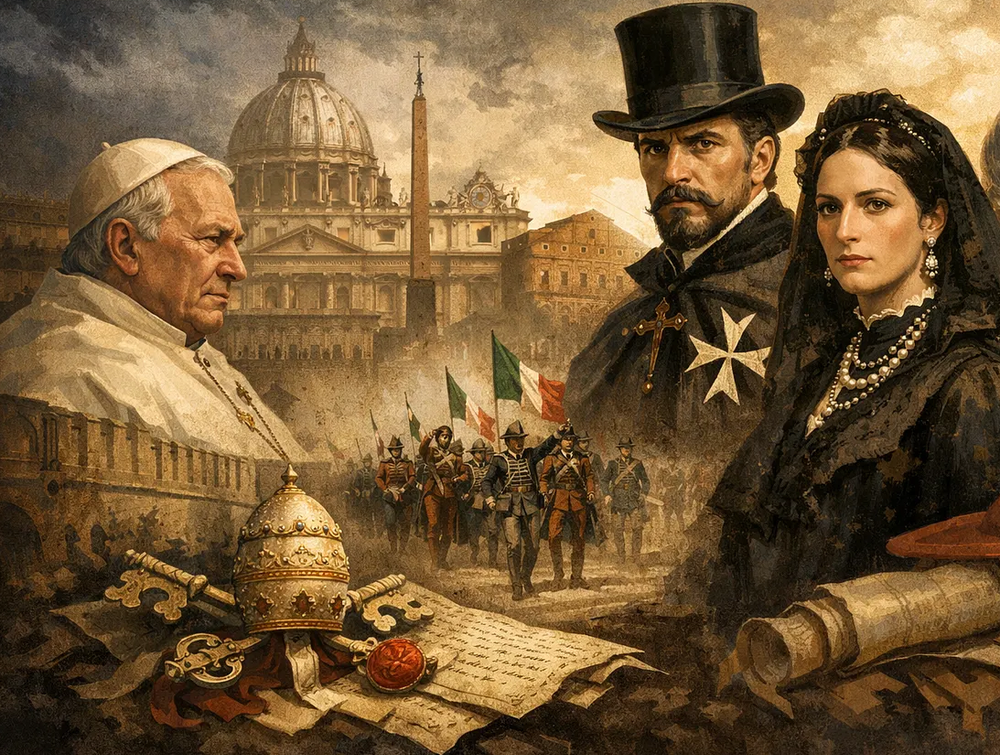
The Bloodlines Beneath the Vatican
The Black Nobility and the Ruling Class That Rome Never Lost
The Colonna and the Orsini, two of Rome's oldest families, have both claimed Julius Caesar as an ancestor. The Massimo say they descend from Quintus Fabius Maximus, the general who wore Hannibal down in the third century BCE.1 When Napoleon asked Prince Massimo if his family really came from Fabius, the prince answered that he couldn't prove it, but the story had been going around the family for twelve hundred years.2 What these families inherited from the Roman aristocracy was its playbook. They held land and married for advantage. They stayed close to the most powerful institution in the city, and they outlasted every government that tried to replace them. My argument is that the families known as the black nobility are extensions of the old Roman ruling class and that they still hold power today through banks, foundations, palaces, and the Order of Malta, the sovereign Catholic order that stands beside the papacy.
In my book The Hidden Hand: Wealth, Power, and Control from Pharaohs to Corporations, I argue that a handful of Roman patrician family lines, the same houses that ran the Republic's networks of patrons and clients, found a new and lasting home inside the Papal States during the Middle Ages. The families that survived did what the Church did after Rome fell. They stopped depending on any one office and wove themselves into the institutions around them.
Looking back, in the Roman Republic, a patron backed his clients in court and sometimes gave them their daily food. In return, they visited him every morning in a ritual called the salutatio, and he counted on their votes in the public assemblies. By the first century BCE, the bond was hereditary. In 123 BCE, the tribune Gaius Gracchus passed a law that sold grain to Roman citizens at a fixed low price. Cicero later wrote that the common people loved the law and the property owners opposed it. My reading is that cheap public grain threatened the private dependence that patronage ran on, since a client who could buy cheap bread had less reason to look up to one powerful man. The medieval barons ran the same scheme from their hilltop castles. The Colonna trace their line to the counts of Tusculum in the tenth century. Their recorded history starts around 1100 with Pietro, lord of Colonna. The 1911 Encyclopaedia Britannica's best guess is that he was a brother of Pope Benedict IX.3
In 1870, Rome's aristocracy lost its uniform but kept everything else. On the morning of September 20, 1870, Italian artillery blew a hole in the Aurelian Walls near the Porta Pia. Soldiers of the new Kingdom of Italy poured into the city, and a papal government that had ruled central Italy for about a thousand years came to an end. Pope Pius IX pulled back behind the Vatican walls. He refused to recognize the kingdom and called himself a prisoner.4
Rome's old families had to pick a side. Some went over to the new royal court, and the city called them the white nobility. Others shut their palace doors and dressed in black to mourn the pope's lost kingdom. Romans called them the nobiltà nera, the black nobility.5
How does a ruling class survive when the state that created it dies? My book names four mechanisms that elites have used for five thousand years to stay on top. Coercion is force or the threat of force. Alignment means separate institutions backing each other up without anyone giving orders. Amnesia wipes out the memory of how things used to be, so the present setup feels like the only one possible. Conflict keeps ordinary people fighting each other instead of looking up. The black nobility used all four.
The Barons: A Feud That Built a City
The heads of Rome's baronial families ruled their own subjects from hilltop castles and used their own troops to control the roads and borders around their lands. In the 1400s, King Ferdinand I of Naples complained that the barons of the countryside, the Orsini and Colonna among them, didn't recognize the pope's authority "in life or in death." They were, he said, "the true lords of the land."6 A family with a son on the papal throne could also make loyalty to itself look like loyalty to God.
The Orsini rose in the late 1100s, when Giacinto Orsini became Pope Celestine III in 1191. His gifts to his nephews started the family's land fortune. Over the next century, the Orsini led the Guelphs, the faction that backed the papacy. Their rivals, the Colonna, led the Ghibellines, who sided with the Holy Roman Emperor. The fight between the two houses ran Roman politics for generations.7
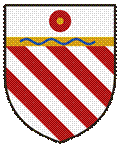
Arms of the Orsini family: a silver band with a red rose above red and silver diagonal stripes, separated by a gold stripe carrying a blue eel. Simplified drawing made for this essay.
In 1303, the Colonna took part in the armed seizure of Pope Boniface VIII at Anagni, an attack the family's own history calls the "Anagni Slap." A little over a century later, the family gave the Church Oddone Colonna, who became Pope Martin V in 1417. He ended the Great Western Schism and brought the papacy back to Rome in 1420. Once in power, he loaded his relatives with church and government offices and gave them estates such as Marino and Rocca di Papa.8 The Orsini answered with popes of their own, from Celestine III in the 1190s to Benedict XIII in 1724.9
The two houses made peace when Marcantonio II Colonna married Felice Orsini. In the 1580s, Pope Sixtus V tied them together again. He had adopted his grandnieces and given them his last name. In 1589, one of them, Flavia Peretti, married Virginio Orsini, Duke of Bracciano, and her sister Orsina married into the Colonna.10 From the sixteenth century on, the heads of both families held the hereditary title of Prince Assistant to the Papal Throne. The honor passed back and forth between them, and the holder stood beside the pope at the Church's biggest ceremonies.11 Families that had fought each other in the streets for centuries ended up shoulder to shoulder at the altar.
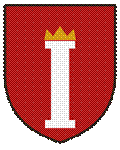
Arms of the Colonna family: a silver column with a gold crown on top, on a red shield. Simplified drawing made for this essay.
That's conflict used as a tool, and it works as long as both rivals stay useful. Each house needed the pope as a patron. He kept both of them close, where he could manage their quarrel. Ordinary Romans paid for the feud, and the families came out fine.
The Throne as a Factory of Princes
The papacy also built a second kind of nobility for itself. Every new pope arrived with relatives, and every reign was a chance to lift a family from the provinces to the top of Roman society. The Borghese came from Siena and rose when Camillo Borghese became Paul V in 1605. The Barberini rose with Urban VIII and the Pamphilj with Innocent X. The Chigi fortune started with the banker Agostino Chigi in the early 1500s. His family worked its way into the inner circle of Roman nobility, and one of its members took the throne as Alexander VII.12
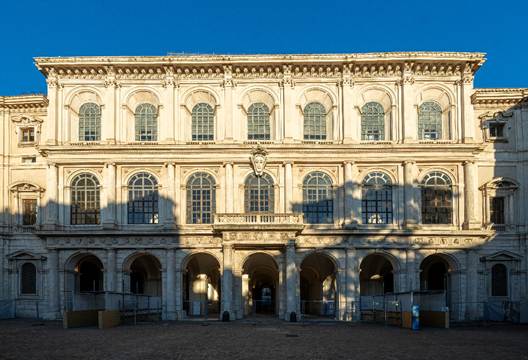
Palazzo Barberini in Rome, built for the family of Pope Urban VIII on land the Barberini bought in 1625. Carlo Maderno started the design, and Gian Lorenzo Bernini finished it in 1633. The Italian state bought the palace in 1949, and today it holds the National Gallery of Ancient Art. Photo via Wikimedia Commons.
The word for this is nepotism, from the Italian nipote, meaning nephew. It was the typical way the Papal States filled their top jobs. A pope's nephews got offices and estates, and they married into the oldest families. Historians Sandro Carocci and Anthony Majanlahti have traced the pattern family by family.13
The Palazzo Barberini was built to make new money look old. The Palazzo Chigi passed to Pope Alexander VII's brother and nephew in 1659, and it has been the seat of the Italian government since 1961.14 Romans walked past these huge buildings every day and learned, without anyone saying a word, that these names belonged at the top. Stone did the work of alignment and amnesia at once. Within a few generations, hardly anyone remembered where these families had started.
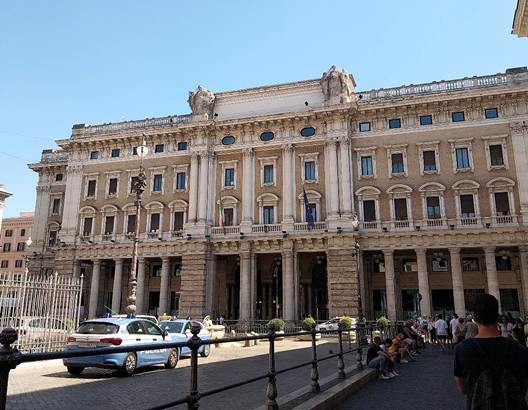
Palazzo Chigi on Piazza Colonna in Rome. Pope Alexander VII's brother and nephew bought the palace in 1659, and it has been the seat of the Italian government since 1961. Photo via Wikimedia Commons.
Accounts of the black nobility name about a dozen houses, including the Colonna, Orsini, Massimo, Borghese, Chigi, Barberini, Odescalchi, Ruspoli, Pallavicini, Sacchetti, and Theodoli.15 The black nobility was never one bloodline. It was many, tied together by marriage, and it kept taking in new money and new names as long as they came in through the papal throne.
59 Years Behind Closed Doors
The kingdom the white nobility rushed to join was new. It had been proclaimed on March 17, 1861, so in 1870 it was only nine years old, and Rome was the last piece it hadn't taken.16 The black families bet on something older.
The pope told Catholics what to do through a policy called the non expedit. Italian Catholics were to stay out of national politics, which meant no running for office and no voting. The policy was already weakening by the time of the Gentiloni Pact in 1913, and Benedict XV lifted it in 1919.17
Leopoldo Torlonia served as mayor of Rome from 1882 to 1887. Prospero Colonna, head of a house that had shut its doors for the pope, held the same job from 1899 to 1904 and again from 1914 to 1919,18 and his son Piero was Rome's governor under Mussolini from 1936 until he died in 1939.19
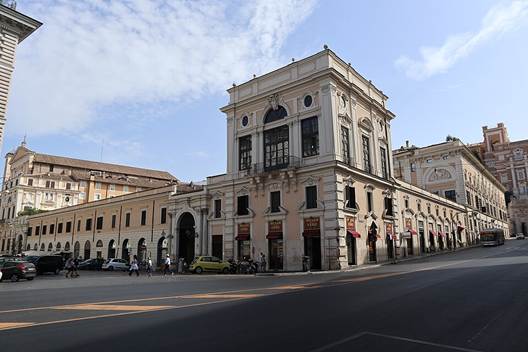
Palazzo Colonna on Piazza dei Santi Apostoli, at the foot of the Quirinal Hill in Rome. Cardinal Oddone Colonna lived here before he became Pope Martin V in 1417, and the palace has belonged to the Colonna family for more than twenty generations. Photo via Wikimedia Commons.
For 59 years, from 1870 to 1929, the black nobility lived as if the Papal States still existed. They refused to accept Italy's takeover of Rome and closed their salons in protest. They stayed away from receptions at the royal palace, and their wives even gave up the daily carriage ride along the Corso. Their black clothes followed the old Spanish fashion of the papal court, where they kept serving in ceremonial posts.20 Outsiders saw a sulking aristocracy that couldn’t let go of a dead world. They missed what the ceremonies were for. Every time these families took their places beside the pope, they showed one another who still ranked where, and a family that stopped showing up soon lost its place. Those ties to one another and to the papacy were the families’ real wealth. Behind their closed doors, the network waited out the years with no state to run, and in 1929 it was useful again.
The Reversal
On February 11, 1929, Mussolini's government and the Holy See signed the Lateran Treaty. The pope got Vatican City, a tiny independent state, and the long fight known as the Roman Question was over. In Article 42, Italy agreed to recognize noble titles granted by popes, including the ones handed out between 1870 and 1929.21 The black families had refused to bend to the kingdom, and now the kingdom approved the very titles their refusal had protected. Some accounts of the black nobility claim these families also got dual Italian and Vatican citizenship.22 But Article 9 ties Vatican citizenship to living or holding office inside Vatican City.23
Seventeen years later, the white nobility's side of the bet fell apart. On June 2, 1946, Italians voted to end the monarchy. King Umberto II had reigned for just 34 days. The House of Savoy went into exile, and its male heirs were barred from Italy until 2002. The royal palace where the white nobility had gone to stand beside the winner became a president's home. Italy's 1948 constitution stopped recognizing noble titles, but papal titles kept a narrow legal foothold under Article 42 for years afterward.24
The papacy, which looked finished in 1870, outlived the Italian monarchy. It was a network that reached into every Catholic country on earth, not just a piece of land. The families closest to it had tied themselves to the one institution in Italy that didn't depend on who won the next war.
From Office to Embedment
An elite that clings to the outward form of its power goes down with it. Elites that survive swap that form for something they can carry. These families moved from positional power, which depends on holding a particular office, to what I call institutional embedment. Embedment renews itself through marriage and through patient ties to whoever runs the institution of the moment. The Church made this move after the Western Empire fell, and the black nobility made it a second time.
After 1870, these families could no longer rule land, so they held on to what didn’t need land. Their standing at the papal court rested on birth, and birth carried over from one government to the next. Inside the Vatican, the Prince Assistant title survived the fall of the Papal States and later the end of the Italian monarchy, and the Noble Guard, a unit of aristocratic soldiers who protected the pope, lasted until Pope Paul VI disbanded it in a letter dated September 14, 1970.25 Beyond the Vatican, the Sovereign Military Order of Malta required its Grand Master and top knights to prove noble birth for centuries, which kept its highest offices within reach of families like these.26
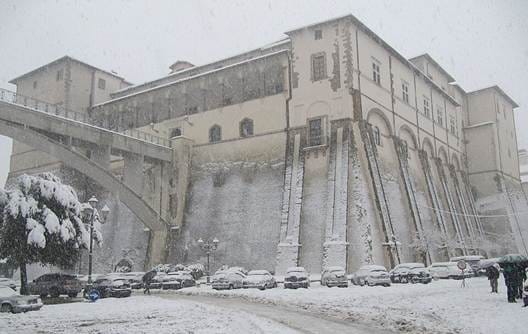
Castello Colonna at Genazzano, a Colonna stronghold from 1053 and the birthplace of Pope Martin V. The town of Genazzano bought it in 1979 after forty years of neglect. Photo via Wikimedia Commons.
Marriage carried these names far beyond Rome. Alessandro Torlonia, the fifth Prince of Civitella Cesi (1911 to 1986), married the Infanta Beatriz, a daughter of King Alfonso XIII of Spain, and one of their grandchildren is Princess Sibilla of Luxembourg. His sister Marina married the American tennis player Frank Shields and became the grandmother of the actress Brooke Shields.27 A family of Roman bankers who had been made nobles by the popes in the 1790s was now related to the royal house of Spain and the grand ducal house of Luxembourg.
The Church closed the last formal door itself. In 1958, Pope Pius XII took the Prince Assistant title away from Filippo Orsini after a public scandal. In 1962, Pope John XXIII gave it to the Torlonia family, naming Alessandro Torlonia. This was a different Alessandro, born in 1925, not the prince who married the Infanta.28 On March 28, 1968, Pope Paul VI issued Pontificalis Domus, which ended hereditary offices in the papal household. The two men who held the Prince Assistant title at the time, Aspreno Colonna and Alessandro Torlonia, were allowed to keep it for life.29 Colonna died in 1987. Torlonia died in 2017, at 92.30
The papal throne kept a black noble at its side for almost a century and a half after the Papal States fell. The influence these families carried into Europe ran through marriage and money, into royal houses and the banking world. It survived every change of government in the twentieth century because none of it looked enough like power to be worth abolishing.
The Order of Malta: Sovereign Without a Country
The Order of Malta, whose top offices these families held for centuries, has lost its territory more than once, and each time it came back with more standing.
It started in Jerusalem in the eleventh century as a hospital brotherhood that cared for sick pilgrims. Its members later became known as the Knights Hospitaller of St. John. After Jerusalem fell in 1187, the knights moved from one Mediterranean base to another until they settled on Rhodes. Along the way, the hospital brotherhood turned into a military and naval power with its own fleet and its own courts.31
The Knights Templar had built a network across Europe and had gone into banking and lending. King Philip IV of France was deep in debt, and in 1307 he had them arrested. In 1312, Pope Clement V dissolved the Templars with the bull Vox in excelso. On May 2 of that year, the bull Ad providam gave Templar property to the Hospitallers, minus some money set aside for pensions for the surviving Templars.32
Kings fought the handoff. The Hospitallers got nothing in Portugal, where King Denis moved the Templars' land and members into a new Order of Christ, approved in 1319. Valencia's Templar estates went to another new order, Montesa, and Castile gave the Hospitallers very little. They did take over the Templar holdings in Aragon, Catalonia, Navarre, and Majorca, and across much of the rest of Europe.33 So the Order of Malta inherited a big share of the Templar fortune through a papal decree that kings bargained down. A military order that had become a banking power was wiped out, and its land went to a rival order loyal to the same pope. That's alignment.
The Ottomans drove the knights out of Rhodes in 1522. In 1530, Emperor Charles V gave them Malta, and they ruled the island for 268 years, until Napoleon seized it in 1798. They used that time to build a state of their own. In 1574, they created the Sacra Infermeria in Valletta. The hospital had about 500 beds and could stretch to nearly 900 in a crisis, and it became one of the leading hospitals in Europe. The knights served the sick there on silver tableware.34 When Malta fell, the Order lost its fleet and its land, and with them any obvious reason to exist.
It moved its headquarters to Rome instead, where it still issues its own passports and is recognized as sovereign under international law, even though it governs no country. Its two Roman seats, the Magistral Palace on the Via dei Condotti and the Magistral Villa on the Aventine Hill, have been treated by Italy as outside its territory since 1869.35 Its diplomatic network grew from 42 countries in 1981 to 113 countries, plus the European Union, by 2024.36 On August 24, 1994, the UN General Assembly passed Resolution 48/265 without a vote and invited the Order to take part in its sessions as an observer.37 The Order keeps observer missions to the UN in New York, Geneva, Vienna, and Rome, and it's accredited to UNESCO in Paris.38 It describes all of this as humanitarian work, a way to move aid and protect its medical staff in war zones.
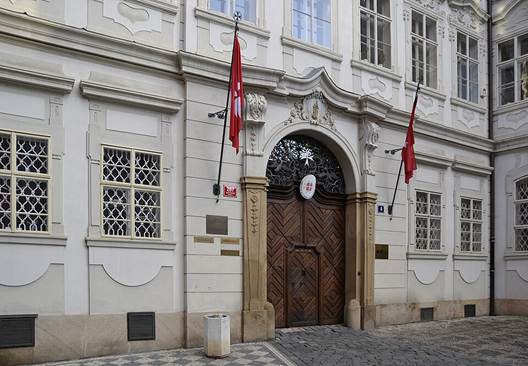
The Embassy of the Sovereign Military Order of Malta at Velkopřevorské náměstí 4 in Prague. The Order holds no territory of its own, but it keeps embassies abroad like a country does. The Czech Foreign Ministry lists its ambassador as Wenceslas de Lobkowicz, a member of one of Bohemia's oldest noble families. Photo via Wikimedia Commons.
Losing territory didn't mean losing power, as long as the network and its oaths survived. The black nobility and the Order of Malta made the same trade. Both gave up governing land and kept their rank and their access across borders.
Reporters started connecting the Order to American intelligence in the 1980s. Mother Jones in 1983 and The Washington Post in 1984 reported that William Casey, then the director of the CIA, was a member, and an earlier CIA director, John McCone, has been named too. In 1986, the magazine CovertAction ran a full exposé on the Order's ties to American intelligence. In 2011, the investigative journalist Seymour Hersh told an audience in Doha, Qatar, that top commanders in U.S. special operations were members or supporters of the Knights of Malta.39 A body with no territory and no voters holds a seat at the United Nations and has ambassadors in more than a hundred capitals. Standing like that has to be paid for.
Follow the Money
Marino Torlonia was a French merchant who settled in Rome in the middle of the 1700s and sold fine fabrics near the Spanish Steps. His son Giovanni Raimondo moved from cloth into banking. He lent money to the aristocrats who shopped with him and often took their land as security.40 Pope Pius VI made Giovanni Duke of Bracciano in 1794.41 When Napoleon's armies wrecked the old economy, Giovanni picked up estate after estate as his noble borrowers defaulted. In 1809, his name went into the Golden Book of the Roman nobility, and in 1814 the pope made him the first Prince of Civitella Cesi. He married his children into families that claimed descent from Julius Caesar.42
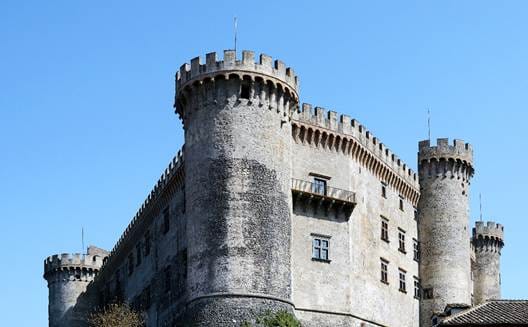
Castello Orsini-Odescalchi at Bracciano. Napoleone Orsini began the castle around 1470, and the Orsini sold it to the Odescalchi family in 1696. Photo via Wikimedia Commons.
His son Alessandro took over the bank in 1829 and turned it into a European business. Working with James de Rothschild of Paris, he became the pope's banker and managed loans for the Papal States.43 On July 16, 1840, he married Teresa Colonna, so the newest bank in Rome married into one of its oldest families.44 Then Alessandro did what the Medici had done in Florence centuries before. He bought art, whole collections of ancient sculpture at a time. In 1876 he opened the Torlonia Museum, but only to visitors listed in the Golden Book of the nobility.45 The marble made people forget that the family had started out in trade.
The papacy needed bankers more than ever after 1870, because it had lost the tax base of an entire state almost overnight. Ernesto Pacelli, a cousin of the future Pope Pius XII, filled that gap. He ran the Banco di Roma and advised several popes on money. While the Roman Question was still open, papal property and stock were held in his name, a legal workaround that kept them out of the Italian state's reach. By 1914, the Holy See owned about a quarter of the bank.46 John Pollard's Money and the Rise of the Modern Papacy follows this money from the lost income of the Papal States to the founding of the Vatican's modern financial institutions.47
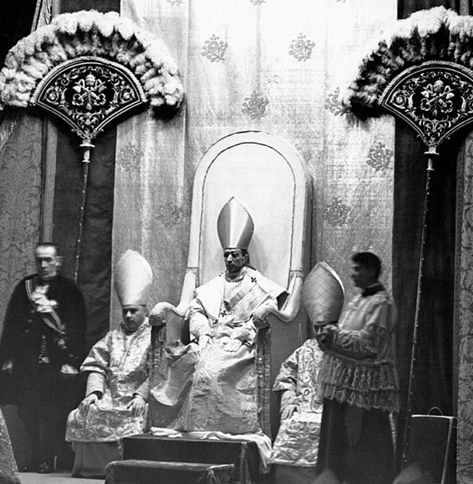
Pope Pius XII on the papal throne in St. Peter’s Basilica, 1939, with Prince Marcantonio VII Colonna, Prince Assistant to the Papal Throne. Photographer unknown, Keystone Paris. Public domain in Italy (Law no. 633 of 22 April 1941, Arts. 87 and 92) and in the United States (pre-1976 work out of copyright in its source country on 1 January 1996). Via Wikimedia Commons; original from Getty Images.
Two centuries of loans and favors built a closeness with the papacy that didn't depend on any office. The same few families and bankers who served the papal court also lent it money, and one of them held its property in his own name when the Italian state came looking. When the ceremonial offices were abolished, the financial ties survived, because they had never been offices.
Venice and the Three Hundred: The Making of a Legend
Online and in a few books, a bigger version of this story circulates. It says the black nobility is a secret bloodline that has ruled Europe, and now the world, from behind the scenes for a thousand years. These families never gave up power, and on that point the legend is correct. They didn’t need a secret government to keep it. They held it in plain sight, through palaces, banks, marriages, and a sovereign order with a seat at the United Nations. The legend’s wild claims do them a favor, because they make the real power easier to laugh off.
Part of the legend comes from Venice. In 1297, Venice passed a law called the Serrata, Italian for “closing.” It locked the city’s Great Council, the body that ran the government, to the families who already had seats in it. Those families’ names later went into an official register called the Golden Book, and only they could hold office or help choose the Doge, Venice’s elected ruler. After a few generations, people could hardly remember a time when Venice had been more open. This closed group ran the city for five hundred years. It ended on May 12, 1797, when Napoleon’s army was closing in and the Great Council voted to shut itself down, taking the Republic of Venice with it.48
Venice’s closed nobility and Rome’s black nobility were two different groups. They lived in different cities, and more than seventy years separate them. Venice’s ruling families gave up power in 1797, and Rome’s black nobility didn’t get its name until 1870. The legend glues them together into one “Venetian Black Nobility” and claims it never died.
We know who built this legend, because they put their names on it, and each writer added a new layer. In September 1981, Webster Tarpley, then writing for Lyndon LaRouche's political movement, published "The Venetian Conspiracy" in the movement's magazine, The Campaigner. LaRouche's publications spent years presenting a "Venetian oligarchy" as the hidden hand behind European history.49 About ten years later, John Coleman's Conspirators' Hierarchy: The Story of the Committee of 300 listed a "Venetian Black Nobility" among the branches of a single committee he said ran the world. In his foreword, Coleman says he was a career intelligence officer who saw top secret documents while serving in Angola.50 Fritz Springmeier's Bloodlines of the Illuminati pushed the story into satanic family lines.51 Internet writers took it from there. A post first published on the site Total Disclosure and reposted on Substack names a "Grey Pope," Pepe Orsini, as the hidden ruler above both the pope and the head of the Jesuits. The closest real office is the Prince Assistant title, a ceremonial role that stopped being hereditary in 1968 and whose last holder died in 2017.52
Coleman's number has a real source. Walther Rathenau was the heir to the fortune behind AEG, Germany's version of General Electric. He sat on dozens of corporate boards before he took over the company himself, so he saw up close how Europe's money moved. In a newspaper article on Christmas Day 1909, he wrote that about three hundred men, all of whom know one another, direct the economic destiny of Europe and choose their successors from among themselves. He was describing the boardrooms he sat in. He later became Germany's foreign minister and was assassinated in 1922.53 Carroll Quigley quoted the 1909 line in Tragedy and Hope.54 Coleman's "300" borrowed the number. Rathenau's description deserves to be taken seriously, and families like these, working through foundations and marrying into each era's ruling class, fit the network he described.
Today's Power Bases
The Torlonia fortune shows how much of the old machine is still running. In 1923, Giovanni Torlonia founded the Banca del Fucino. For nearly a century, it was a princely family's private bank and the oldest private bank in Rome.55 It took its name from the Fucine Lake, which Alessandro Torlonia had drained in the 1860s and 1870s.56 After the younger Prince Alessandro Torlonia, the last Prince Assistant, died in 2017, the family sold the bank to Igea Banca in 2019. The sale turned into a legal war among the heirs, and Roman prosecutors have investigated it.57 The bank was gone, but the fortune it had built stayed with the family. In the same family fight, a court put the Torlonia estate under seal. The estate is worth around 1.8 billion euros. It includes the Palazzo Torlonia on the Via della Conciliazione, along with the largest private collection of ancient sculpture in the world.58 The family that married into the Colonna in 1840 still sat on one of Italy's great private fortunes in the 2020s, a short walk from St. Peter's.
In December 2023, a Vatican court convicted Cardinal Angelo Becciu of embezzlement and aggravated fraud. Becciu is a priest from the small Sardinian town of Pattada, and he once held the No. 3 job in the Secretariat of State. The case grew out of a London property deal that cost the Holy See more than $200 million. Becciu said he was innocent and appealed.59 He was the first cardinal ever convicted by a Vatican court.60 Becciu isn't from a black noble family. The job of handling papal money out of public view, which once belonged to families like the Torlonia and bankers like Ernesto Pacelli, now falls to insiders like him. More than 150 years after the Papal States disappeared, papal money still moves through private middlemen, the same setup Pacelli ran when the pope's property had to be hidden under a banker's name.
In 2017, an internal dispute in the Order of Malta ended with the Grand Master, Fra' Matthew Festing, stepping down at Pope Francis's request. The pope then named the same Cardinal Becciu as his special delegate to the Order.61 In September 2022, Francis went further. He issued a new constitution and dissolved the Order's governing council. Future Grand Masters now need the pope's confirmation, and the new rules dropped the old requirement that the Grand Master and top knights prove noble birth.62 It was 1968 all over again, 54 years later, inside the last major institution where noble birth was still a formal requirement for command. The families lost their birthright claim, but the Order kept everything that makes it powerful. It still has its UN seat and its ties to 113 countries, and it now answers directly to the pope, the same institution these families tied themselves to in 1870.
The Colonna still own their palace at the foot of the Quirinal Hill, and its gallery opens to paying visitors on certain days of the week.63 The Massimo still own and live in the Palazzo Massimo alle Colonne. They open its private chapel to the public on only one day a year, March 16, the anniversary of a miracle credited to St. Philip Neri in 1583.64
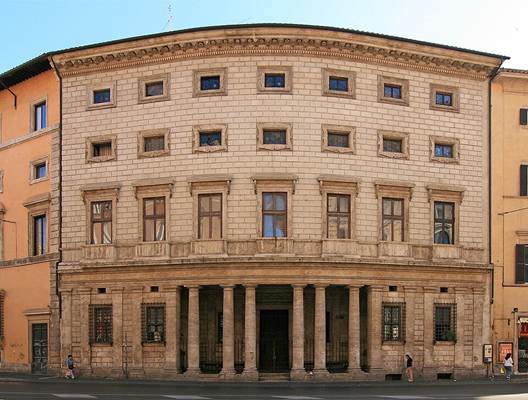
Palazzo Massimo alle Colonne on Corso Vittorio Emanuele II, designed by Baldassare Peruzzi in 1532 and still owned by the Massimo family. Photo via Wikimedia Commons.
In 2014, Prince Alessandro Torlonia set up the Fondazione Torlonia to manage the family's sculpture collection. In 2016, the foundation signed an agreement with Italy's Ministry of Culture to put the items on display, and the president of Italy himself was scheduled to open the 2020 exhibition at the Capitoline Museums. The prince's grandson, Alessandro Poma Murialdo, now runs the foundation. He's the same man who chaired the Banca del Fucino when the family sold it.65 One family, working through one foundation, got the Italian state to treat its private collection as a national event. A family foundation that pays for a university chair or hosts a diplomatic reception doesn't need a seat in the Senate to shape the room.
Old power now sits on bank boards and in religious orders that carry diplomatic passports, not in parliament. These families don't publish their guest lists.
The Hand That Never Left the Table
Most people meet the black nobility either as a caption under a portrait in a palace gallery or as a cartoon council of evil bloodlines on some online forum. Both versions skip the real history in between.
In that history, papal relatives and feudal barons lost their government in 1870 but kept their names and their money. Later reforms took away their inherited court titles in 1968 and their birthright claim on the Order of Malta's top offices in 2022. They still own palaces in the heart of Rome, and the Order of Malta they once commanded still has a seat at the United Nations. At least one of these families sits on a fortune of nearly two billion euros, and they've married into royal houses and run family foundations.
All four mechanisms are at work in this story. Coercion was the castle, and later the Torlonia bank. Alignment was a family pope making privilege look like God’s plan, and later the 1929 treaty that turned a protest into a legal title. Amnesia is what every new century does to that history. Conflict was the Colonna and Orsini feud, which cost the city plenty and cost the families nothing. All four served one goal: holding on to land and the rent it pays. The American economist Henry George explained why that matters in his book Progress and Poverty. He argued that land becomes valuable because of the city that grows around it, so the owner gets rich without doing any of the work. That’s exactly what happened in Rome. The city made the ground under these palaces worth a fortune, and the families who held the deeds kept collecting rent through every change of government.66
The Italian Republic turned 80 this year. The Colonna have owned their palace below the Quirinal for more than twenty generations, and the palace on the hill above them has gone from a king’s home to a president’s while they watched. These families have seen the Papal States and the Kingdom of Italy disappear, yet both times they kept what mattered. They’ve never needed to overthrow anything. They only need us to keep forgetting. Since 1870, Europe has redrawn its borders again and again and traded its old currencies for the euro. Its governments are no more permanent than Rome’s were. When the next one falls, there’ll be no siege and no announcement. The families who already know one another will be the ones left standing in the room when Europe’s fortunes are divided up again.
Endnotes
1. Ingrid D. Rowland, "Light in the Palazzo," New York Review of Books, May 13, 2021, https://www.nybooks.com/articles/2021/05/13/torlonia-marbles-light-palazzo/.
2. "Massimo Family," Wikipedia, accessed October 18, 2026, https://en.wikipedia.org/wiki/Massimo_family. The article traces the family's descent claim to Onofrio Panvinio's De gente Maxima (1556). Rowland, "Light in the Palazzo," calls the claim implausible but centuries old.
3. Encyclopaedia Britannica, "Clientship," accessed October 18, 2026, https://www.britannica.com/topic/clientship; Peter Garnsey and Dominic Rathbone, "The Background to the Grain Law of Gaius Gracchus," Journal of Roman Studies 75 (1985): 20–25, https://doi.org/10.2307/300649; Cicero, Pro Sestio 103; Encyclopaedia Britannica, "Colonna Family," accessed October 18, 2026, https://www.britannica.com/topic/Colonna-family; Encyclopaedia Britannica, 11th ed. (1911), s.v. "Colonna (family)," https://en.wikisource.org/wiki/1911_Encyclop%C3%A6dia_Britannica/Colonna_(family).
4. David I. Kertzer, Prisoner of the Vatican: The Popes' Secret Plot to Capture Rome from the New Italian State (Boston: Houghton Mifflin, 2004).
5. "Black Nobility," Wikipedia, accessed October 18, 2026, https://en.wikipedia.org/wiki/Black_nobility.
6. Ramie Targoff, Renaissance Woman: The Life of Vittoria Colonna (New York: Farrar, Straus and Giroux, 2018), chap. 1.
7. Encyclopaedia Britannica, "Orsini Family," accessed October 18, 2026, https://www.britannica.com/topic/Orsini-family.
8. Galleria Colonna, "The Colonna Family," accessed October 18, 2026, https://www.galleriacolonna.it/en/i-colonna/; Encyclopaedia Britannica, "Martin V," accessed October 18, 2026, https://www.britannica.com/biography/Martin-V; Catholic Encyclopedia (1913), s.v. "Pope Martin V," https://www.newadvent.org/cathen/09725a.htm; Encyclopaedia Britannica, 11th ed. (1911), s.v. "Colonna (family)."
9. Britannica, "Orsini Family"; Gran Enciclopèdia Catalana, s.v. "Orsini," accessed October 18, 2026, https://www.enciclopedia.cat/gran-enciclopedia-catalana/orsini.
10. Galleria Colonna, "Colonna Family"; Stefano Boero, "Peretti Damasceni, Flavia," in Dizionario Biografico degli Italiani, vol. 82 (Rome: Istituto della Enciclopedia Italiana, 2015), https://www.treccani.it/enciclopedia/flavia-peretti-damasceni_(Dizionario-Biografico); "Flavia Peretti," Wikipedia, accessed October 18, 2026, https://en.wikipedia.org/wiki/Flavia_Peretti.
11. John Paul Sonnen, "The Papal Court: Prince Assistants to the Papal Throne (Principe Assistente al Soglio Pontificio)," Liturgical Arts Journal, May 9, 2024, https://www.liturgicalartsjournal.com/2024/05/the-papal-court-prince-assistants-to.html; "Prince Assistant to the Papal Throne," Wikipedia, accessed October 18, 2026, https://en.wikipedia.org/wiki/Prince_assistant_to_the_papal_throne.
12. Anthony Majanlahti, The Families Who Made Rome: A History and a Guide (London: Chatto & Windus, 2005); Rowland, "Light in the Palazzo."
13. Sandro Carocci, Il nepotismo nel medioevo: Papi, cardinali e famiglie nobili (Rome: Viella, 1999); Majanlahti, Families Who Made Rome.
14. Turismo Roma, "Chigi Palace," accessed October 18, 2026, https://www.turismoroma.it/en/places/chigi-palace; Majanlahti, Families Who Made Rome.
15. "Black Nobility," Wikipedia; "Venti Settembre (Pasquino Remembers the Breach of Porta Pia)," L'Italo-Americano, September 24, 2013, https://italoamericano.org/porta-pia/.
16. Kertzer, Prisoner of the Vatican.
17. John F. Pollard, Catholicism in Modern Italy: Religion, Society and Politics since 1861 (London: Routledge, 2008).
18. "Prospero Colonna di Paliano," Wikipedia, accessed October 18, 2026, https://en.wikipedia.org/wiki/Prospero_Colonna_di_Paliano; "Torlonia," Wikipedia, accessed October 18, 2026, https://en.wikipedia.org/wiki/Torlonia.
19. "Piero Colonna," Wikipedia, accessed October 18, 2026, https://en.wikipedia.org/wiki/Piero_Colonna.
20. Plinio Corrêa de Oliveira, Nobility and Analogous Traditional Elites in the Allocutions of Pius XII (1993), chap. 2, https://www.pliniocorreadeoliveira.info/UKLN_0102_universal_scope_allocutions.htm; "Venti Settembre," L'Italo-Americano; Fernando Prado, "La nobleza negra de Roma o las familias que se negaron a reconocer el nuevo reino de Víctor Manuel II," El Debate, January 12, 2025, https://www.eldebate.com/historia/20250112/nobleza-negra-roma-familias-negaron-reconocer-nuevo-reino-victor-manuel-ii_259872_amp.html.
21. Treaty between the Holy See and Italy (Lateran Treaty), February 11, 1929, art. 42; "Papal Nobility," Wikipedia, accessed October 18, 2026, https://en.wikipedia.org/wiki/Papal_nobility.
22. "Black Nobility," Wikipedia.
23. Lateran Treaty, art. 9.
24. Constitution of the Italian Republic (1948), Transitional and Final Provisions XIII and XIV; "Umberto II of Italy," Wikipedia, accessed October 18, 2026, https://en.wikipedia.org/wiki/Umberto_II_of_Italy; "Festa della Repubblica," Italy On This Day, June 2, 2016, https://www.italyonthisday.com/2016/06/festa-della-repubblica.html; "Italian Nobility," Wikipedia, accessed October 18, 2026, https://en.wikipedia.org/wiki/Italian_nobility.
25. Paul VI, "Lettera al Cardinale Giovanni Villot per il servizio d'ordine e di vigilanza nella Città del Vaticano," September 14, 1970, https://www.vatican.va/content/paul-vi/it/letters/1970/documents/hf_p-vi_let_19700914_vigilanza-vaticano.html.
26. Reuters, "Pope Dissolves Knights of Malta Leadership, Issues New Constitution," Malay Mail, September 3, 2022, https://www.malaymail.com/news/world/2022/09/03/pope-dissolves-knights-of-malta-leadership-issues-new-constitution/26343.
27. "Torlonia," Wikipedia.
28. Sonnen, "Papal Court"; "Prince Assistant to the Papal Throne," Wikipedia.
29. Paul VI, Pontificalis Domus, apostolic letter motu proprio, March 28, 1968; "Prince Assistant to the Papal Throne," Wikipedia.
30. Sonnen, "Papal Court"; Rowland, "Light in the Palazzo."
31. Encyclopaedia Britannica, "Hospitallers," accessed October 18, 2026, https://www.britannica.com/topic/Hospitallers.
32. Malcolm Barber, The Trial of the Templars (Cambridge: Cambridge University Press, 1978); "Trials of the Knights Templar," Wikipedia, accessed October 18, 2026, https://en.wikipedia.org/wiki/Trials_of_the_Knights_Templar; "Ad providam," Wikipedia, accessed October 18, 2026, https://en.wikipedia.org/wiki/Ad_providam.
33. Carlos Barquero Goñi, "La Orden del Hospital y la recepción de los bienes templarios en la Península Ibérica," Hispania Sacra 51, no. 104 (1999): 531–56, https://hispaniasacra.revistas.csic.es/index.php/hispaniasacra/article/download/587/585/584; "Knights Templar in Portugal," Wikipedia, accessed October 18, 2026, https://en.wikipedia.org/wiki/Knights_Templar_in_Portugal.
34. Britannica, "Hospitallers"; Arpan Banerjee, "The Sacra Infermeria or Holy Infirmary of Malta," British Society for the History of Medicine, June 28, 2026, https://bshm.org.uk/?p=21280; Joseph Borg, "The Holy Infirmary of the Order of St. John," St. Luke's Hospital Gazette 8, no. 1 (1973): 50, https://www.um.edu.mt/library/oar/handle/123456789/15269.
35. Atlas Obscura, "Palazzo Malta," accessed October 18, 2026, https://www.atlasobscura.com/places/palazzo-malta; Turismo Roma, "The Villa Magistrale of the Sovereign Order of Malta on the Aventine," accessed October 18, 2026, https://www.turismoroma.it/en/places/villa-magistrale-sovereign-order-malta-aventine; "Palazzo Malta," Wikipedia, accessed October 18, 2026, https://en.wikipedia.org/wiki/Palazzo_Malta.
36. Marianna Balfour, "Celebrating 30 Years as Permanent Observer at the UN," UN Today, September 2, 2024, https://untoday.org/celebrating-30-years-as-permanent-observer-at-the-un/.
37. UN General Assembly, Resolution 48/265, "Observer Status for the Sovereign Military Order of Malta in the General Assembly," A/RES/48/265, August 24, 1994, https://digitallibrary.un.org/record/161740.
38. Sovereign Order of Malta, Permanent Observer Mission to the United Nations in Vienna, "Relations with the United Nations," accessed October 18, 2026, https://unmissionvienna.orderofmalta.int/relations-with-the-united-nations/.
39. Martin A. Lee, "Their Will Be Done," Mother Jones, July/August 1983, https://www.motherjones.com/politics/1983/07/their-will-be-done/; "$14 Million in Medical Aid Funneled to Central America," Washington Post, December 27, 1984, https://www.washingtonpost.com/archive/politics/1984/12/27/14-million-in-medical-aid-funneled-to-central-america/82671904-b9af-4f38-a52b-58464d87abde/; Françoise Hervet, "The Sovereign Military Order of Malta," CovertAction Information Bulletin, Winter 1986; Joshua E. Keating, "Who Are the Knights of Malta, and What Do They Want?," Foreign Policy, January 19, 2011, https://foreignpolicy.com/2011/01/19/who-are-the-knights-of-malta-and-what-do-they-want/; Matthew Phelan, "Seymour Hersh and the Men Who Want Him Committed," Salon, February 28, 2011, https://www.salon.com/2011/02/28/seymour_hersh_whowhatwhy/.
40. Rowland, "Light in the Palazzo."
41. "Torlonia," Wikipedia.
42. Rowland, "Light in the Palazzo."
43. Daniela Felisini, Alessandro Torlonia: The Pope's Banker (Cham, Switzerland: Palgrave Macmillan, 2016), 75–105.
44. "Alessandro Torlonia, 2nd Prince of Civitella-Cesi," Wikipedia, accessed October 18, 2026, https://en.wikipedia.org/wiki/Alessandro_Torlonia,_2nd_Prince_of_Civitella-Cesi.
45. Rowland, "Light in the Palazzo."
46. "Ernesto Pacelli," Wikipedia, accessed October 18, 2026, https://en.wikipedia.org/wiki/Ernesto_Pacelli; Maurizio Pegrari, "Pacelli, Ernesto," in Dizionario Biografico degli Italiani, vol. 80 (Rome: Istituto della Enciclopedia Italiana, 2014), https://www.treccani.it/enciclopedia/ernesto-pacelli_(Dizionario-Biografico)/.
47. John F. Pollard, Money and the Rise of the Modern Papacy: Financing the Vatican, 1850–1950 (Cambridge: Cambridge University Press, 2005).
48. Benjamin G. Kohl, "The Serrata of the Greater Council of Venice, 1282–1323: The Documents," in Venice and the Veneto during the Renaissance: The Legacy of Benjamin Kohl (Florence: Firenze University Press, 2014), 3–34; "Serrata del Maggior Consiglio," Wikipedia, accessed October 18, 2026, https://en.wikipedia.org/wiki/Serrata_del_Maggior_Consiglio; John Julius Norwich, A History of Venice (New York: Knopf, 1982); "Fall of the Republic of Venice," Wikipedia, accessed October 18, 2026, https://en.wikipedia.org/wiki/Fall_of_the_Republic_of_Venice.
49. Webster Tarpley, "The Venetian Conspiracy," Campaigner, September 1981; "Executive Intelligence Review," Wikipedia, accessed October 18, 2026, https://en.wikipedia.org/wiki/Executive_Intelligence_Review.
50. John Coleman, Conspirators' Hierarchy: The Story of the Committee of 300 (Carson City, NV: America West, 1992).
51. Fritz Springmeier, Bloodlines of the Illuminati (1995).
52. Urban, "The Black Nobility (Part I)," Urban Odyssey (Substack), July 10, 2024, originally published on Total Disclosure, https://theofficialurban.substack.com/p/the-black-nobility-part-i; Richard Willett, "The Shadow of Nobility," Cults, Conspiracies and Chaos (Substack), August 14, 2024, https://richardwillett.substack.com/p/the-shadow-of-nobility. On the household reform, see Paul VI, Pontificalis Domus.
53. Walther Rathenau, "Geschäftlicher Nachwuchs," Neue Freie Presse (Vienna), December 25, 1909, reprinted in Walther Rathenau, Zur Kritik der Zeit (Berlin: S. Fischer, 1922), 207; Encyclopaedia Britannica, "Walther Rathenau," accessed October 18, 2026, https://www.britannica.com/print/article/491966; "Walther Rathenau," Weimarer Republik, accessed October 18, 2026, https://www.weimarer-republik.net/en/weimar-gateway/people-whos-who-of-the-weimar-republic/parties/ddp/walther-rathenau/.
54. Carroll Quigley, Tragedy and Hope: A History of the World in Our Time (1966; repr., San Pedro, CA: GSG & Associates, 2004), 61. On Coleman's use of the figure, see "Committee of 300," Wikipedia, accessed October 18, 2026, https://en.wikipedia.org/wiki/Committee_of_300.
55. Mauro Romano, "Roma festeggia i 100 anni della Banca del Fucino, la più antica banca privata della Capitale," MF-Milano Finanza, July 5, 2023, https://bancafucino.it/sites/default/files/2023-07/050723_Roma-festeggia-i-100-anni-della-BDF_MilanoFinanza.pdf; Andrea Deugeni, "Fondazione Crt entra anche in Banca del Fucino," MF-Milano Finanza, March 8, 2024, https://www.milanofinanza.it/news/fondazione-crt-entra-anche-in-banca-del-fucino-2628098.
56. "Alessandro Torlonia, 2nd Prince of Civitella-Cesi," Wikipedia.
57. Natascia Grbic, "Vendita Banca del Fucino, guerra legale tra i principi Torlonia: indaga la procura di Roma," Fanpage.it, February 26, 2024, https://www.fanpage.it/roma/vendita-banca-del-fucino-guerra-legale-tra-i-principi-torlonia-indaga-la-procura-di-roma/; Deugeni, "Fondazione Crt."
58. "Torlonia Assets Seized: Seals on World's Largest Private Collection of Antiquities," Finestre sull'Arte, November 26, 2018, https://www.finestresullarte.info/en/news/torlonia-assets-seized-seals-on-world-s-largest-private-collection-of-antiquities.
59. "Vatican Court Explains London Property Case Verdicts," UCA News, November 1, 2024, https://www.ucanews.com/news/vatican-court-explains-london-property-case-verdicts/106883; "Cardinal Becciu Sentenced to Five and a Half Years," ANSA, December 16, 2023, https://www.ansa.it/amp/english/news/vatican/2023/12/16/cardinal-becciu-sentenced-to-five-and-a-half-years_5c5eb987-0969-43e3-a2d6-9c5eab591214.html; Cindy Wooden, "Cardinal-designate Becciu Named Prefect of Congregation for Saints," The Pilot (Boston), May 29, 2018, https://thebostonpilot.com/article.asp?ID=182444.
60. Bloomberg News, "Vatican Sentences Cardinal to Jail for Role in UK Property Fraud," BNN Bloomberg, December 16, 2023, https://www.bnnbloomberg.ca/vatican-sentences-cardinal-to-jail-for-role-in-uk-property-fraud-1.2012406; Agence France-Presse, "Vatican Orders Retrial for Cardinal Becciu, Convicted of Fraud," UCA News, March 18, 2026, https://www.ucanews.com/news/vatican-orders-retrial-for-cardinal-becciu-convicted-of-fraud/112342.
61. Andrea Gagliarducci, "How Did Pope Francis Change the Order of Malta?," Catholic World Report, September 6, 2022, https://www.catholicworldreport.com/2022/09/06/how-did-pope-francis-change-the-order-of-malta/.
62. Vatican News, "Pope Promulgates New Constitution of the Order of Malta," September 3, 2022, https://www.vaticannews.va/en/pope/news/2022-09/pope-promulgates-new-constitution-order-malta.html; Reuters, "Pope Dissolves Knights of Malta Leadership"; Gagliarducci, "How Did Pope Francis Change the Order of Malta?"
63. Galleria Colonna, home page, accessed October 18, 2026, https://www.galleriacolonna.it/en/.
64. Turismo Roma, "Massimo alle Colonne Palace (Chapel of San Filippo Neri)," accessed October 18, 2026, https://www.turismoroma.it/en/places/massimo-alle-colonne-palace-chapel-san-filippo-neri; "Rome's Palazzo Massimo alle Colonne Opens Once a Year," Wanted in Rome, February 7, 2020, https://www.wantedinrome.com/news/romes-palazzo-massimo-alle-colonne-opens-once-a-year.html; Edward Pentin, "A Rome Miracle Celebrated by a Mass With Cardinal Burke," National Catholic Register, March 17, 2016, https://www.ncregister.com/blog/a-rome-miracle-celebrated-by-a-mass-with-cardinal-burke.
65. Naomi Rea, "Hidden Away for 50 Years, an Astonishing Collection of Classical Art Owned by a Secretive Italian Family Will Finally Go on a World Tour," Artnet News, January 15, 2020, https://news.artnet.com/art-world/torlonia-collection-rome-world-tour-1753788; LVMH, "Main Sponsor Bvlgari Contributes to Restoration of 96 Ancient Marble Statues from the Torlonia Collection," accessed October 18, 2026, https://www.lvmh.com/news-documents/news/main-sponsor-bvlgari-contributes-to-restoration-of-96-ancient-marble-statues-from-the-torlonia-collection/; Fondazione Torlonia, "About Fondazione Torlonia," accessed October 18, 2026, https://www.fondazionetorlonia.org/about/; Anna Somers Cocks, "The Last of the Great Private Roman Collections Re-emerges," The Art Newspaper, November 25, 2019, https://www.theartnewspaper.com/2019/11/25/the-last-of-the-great-private-roman-collections-re-emerges; Grbic, "Vendita Banca del Fucino"; "Banca del Fucino: ok dei Torlonia alla fusione con Igea Banca," FIRSTonline, https://www.firstonline.info/?p=201723.
66. Henry George, Progress and Poverty (New York: D. Appleton, 1880).
Bibliography
Agence France-Presse. "Vatican Orders Retrial for Cardinal Becciu, Convicted of Fraud." UCA News, March 18, 2026. https://www.ucanews.com/news/vatican-orders-retrial-for-cardinal-becciu-convicted-of-fraud/112342.
Atlas Obscura. "Palazzo Malta." Accessed October 18, 2026. https://www.atlasobscura.com/places/palazzo-malta.
Balfour, Marianna. "Celebrating 30 Years as Permanent Observer at the UN." UN Today, September 2, 2024. https://untoday.org/celebrating-30-years-as-permanent-observer-at-the-un/.
"Banca del Fucino: ok dei Torlonia alla fusione con Igea Banca." FIRSTonline. https://www.firstonline.info/?p=201723.
Banerjee, Arpan. "The Sacra Infermeria or Holy Infirmary of Malta." British Society for the History of Medicine, June 28, 2026. https://bshm.org.uk/?p=21280.
Barber, Malcolm. The Trial of the Templars. Cambridge: Cambridge University Press, 1978.
Barquero Goñi, Carlos. "La Orden del Hospital y la recepción de los bienes templarios en la Península Ibérica." Hispania Sacra 51, no. 104 (1999): 531–56. https://hispaniasacra.revistas.csic.es/index.php/hispaniasacra/article/download/587/585/584.
Bloomberg News. "Vatican Sentences Cardinal to Jail for Role in UK Property Fraud." BNN Bloomberg, December 16, 2023. https://www.bnnbloomberg.ca/vatican-sentences-cardinal-to-jail-for-role-in-uk-property-fraud-1.2012406.
Boero, Stefano. "Peretti Damasceni, Flavia." In Dizionario Biografico degli Italiani, vol. 82. Rome: Istituto della Enciclopedia Italiana, 2015. https://www.treccani.it/enciclopedia/flavia-peretti-damasceni_(Dizionario-Biografico).
Borg, Joseph. "The Holy Infirmary of the Order of St. John." St. Luke's Hospital Gazette 8, no. 1 (1973): 48–52. https://www.um.edu.mt/library/oar/handle/123456789/15269.
"Cardinal Becciu Sentenced to Five and a Half Years." ANSA, December 16, 2023. https://www.ansa.it/amp/english/news/vatican/2023/12/16/cardinal-becciu-sentenced-to-five-and-a-half-years_5c5eb987-0969-43e3-a2d6-9c5eab591214.html.
Carocci, Sandro. Il nepotismo nel medioevo: Papi, cardinali e famiglie nobili. Rome: Viella, 1999.
Coleman, John. Conspirators' Hierarchy: The Story of the Committee of 300. Carson City, NV: America West, 1992.
Constitution of the Italian Republic. 1948.
Corrêa de Oliveira, Plinio. Nobility and Analogous Traditional Elites in the Allocutions of Pius XII. 1993. https://www.pliniocorreadeoliveira.info/UKLN_0102_universal_scope_allocutions.htm.
Deugeni, Andrea. "Fondazione Crt entra anche in Banca del Fucino." MF-Milano Finanza, March 8, 2024. https://www.milanofinanza.it/news/fondazione-crt-entra-anche-in-banca-del-fucino-2628098.
Felisini, Daniela. Alessandro Torlonia: The Pope's Banker. Cham, Switzerland: Palgrave Macmillan, 2016.
"Festa della Repubblica." Italy On This Day, June 2, 2016. https://www.italyonthisday.com/2016/06/festa-della-repubblica.html.
Fondazione Torlonia. "About Fondazione Torlonia." Accessed October 18, 2026. https://www.fondazionetorlonia.org/about/.
Gagliarducci, Andrea. "How Did Pope Francis Change the Order of Malta?" Catholic World Report, September 6, 2022. https://www.catholicworldreport.com/2022/09/06/how-did-pope-francis-change-the-order-of-malta/.
Galleria Colonna. "The Colonna Family." Accessed October 18, 2026. https://www.galleriacolonna.it/en/i-colonna/.
Galleria Colonna. Home page. Accessed October 18, 2026. https://www.galleriacolonna.it/en/.
Garnsey, Peter, and Dominic Rathbone. "The Background to the Grain Law of Gaius Gracchus." Journal of Roman Studies 75 (1985): 20–25. https://doi.org/10.2307/300649.
George, Henry. Progress and Poverty. New York: D. Appleton, 1880.
Grbic, Natascia. "Vendita Banca del Fucino, guerra legale tra i principi Torlonia: indaga la procura di Roma." Fanpage.it, February 26, 2024. https://www.fanpage.it/roma/vendita-banca-del-fucino-guerra-legale-tra-i-principi-torlonia-indaga-la-procura-di-roma/.
Hervet, Françoise. "The Sovereign Military Order of Malta." CovertAction Information Bulletin, Winter 1986.
Keating, Joshua E. "Who Are the Knights of Malta, and What Do They Want?" Foreign Policy, January 19, 2011. https://foreignpolicy.com/2011/01/19/who-are-the-knights-of-malta-and-what-do-they-want/.
Kertzer, David I. Prisoner of the Vatican: The Popes' Secret Plot to Capture Rome from the New Italian State. Boston: Houghton Mifflin, 2004.
Kohl, Benjamin G. "The Serrata of the Greater Council of Venice, 1282–1323: The Documents." In Venice and the Veneto during the Renaissance: The Legacy of Benjamin Kohl, 3–34. Florence: Firenze University Press, 2014.
Lee, Martin A. "Their Will Be Done." Mother Jones, July/August 1983. https://www.motherjones.com/politics/1983/07/their-will-be-done/.
LVMH. "Main Sponsor Bvlgari Contributes to Restoration of 96 Ancient Marble Statues from the Torlonia Collection." Accessed October 18, 2026. https://www.lvmh.com/news-documents/news/main-sponsor-bvlgari-contributes-to-restoration-of-96-ancient-marble-statues-from-the-torlonia-collection/.
Majanlahti, Anthony. The Families Who Made Rome: A History and a Guide. London: Chatto & Windus, 2005.
Norwich, John Julius. A History of Venice. New York: Knopf, 1982.
Paul VI. "Lettera al Cardinale Giovanni Villot per il servizio d'ordine e di vigilanza nella Città del Vaticano." September 14, 1970. https://www.vatican.va/content/paul-vi/it/letters/1970/documents/hf_p-vi_let_19700914_vigilanza-vaticano.html.
Paul VI. Pontificalis Domus. Apostolic letter motu proprio. March 28, 1968.
Pegrari, Maurizio. "Pacelli, Ernesto." In Dizionario Biografico degli Italiani, vol. 80. Rome: Istituto della Enciclopedia Italiana, 2014. https://www.treccani.it/enciclopedia/ernesto-pacelli_(Dizionario-Biografico)/.
Pentin, Edward. "A Rome Miracle Celebrated by a Mass With Cardinal Burke." National Catholic Register, March 17, 2016. https://www.ncregister.com/blog/a-rome-miracle-celebrated-by-a-mass-with-cardinal-burke.
Phelan, Matthew. "Seymour Hersh and the Men Who Want Him Committed." Salon, February 28, 2011. https://www.salon.com/2011/02/28/seymour_hersh_whowhatwhy/.
Pollard, John F. Catholicism in Modern Italy: Religion, Society and Politics since 1861. London: Routledge, 2008.
Pollard, John F. Money and the Rise of the Modern Papacy: Financing the Vatican, 1850–1950. Cambridge: Cambridge University Press, 2005.
Prado, Fernando. "La nobleza negra de Roma o las familias que se negaron a reconocer el nuevo reino de Víctor Manuel II." El Debate, January 12, 2025. https://www.eldebate.com/historia/20250112/nobleza-negra-roma-familias-negaron-reconocer-nuevo-reino-victor-manuel-ii_259872_amp.html.
Quigley, Carroll. Tragedy and Hope: A History of the World in Our Time. 1966. Reprint, San Pedro, CA: GSG & Associates, 2004.
Rathenau, Walther. "Geschäftlicher Nachwuchs." Neue Freie Presse (Vienna), December 25, 1909.
Rathenau, Walther. Zur Kritik der Zeit. Berlin: S. Fischer, 1922.
Rea, Naomi. "Hidden Away for 50 Years, an Astonishing Collection of Classical Art Owned by a Secretive Italian Family Will Finally Go on a World Tour." Artnet News, January 15, 2020. https://news.artnet.com/art-world/torlonia-collection-rome-world-tour-1753788.
Reuters. "Pope Dissolves Knights of Malta Leadership, Issues New Constitution." Malay Mail, September 3, 2022. https://www.malaymail.com/news/world/2022/09/03/pope-dissolves-knights-of-malta-leadership-issues-new-constitution/26343.
Romano, Mauro. "Roma festeggia i 100 anni della Banca del Fucino, la più antica banca privata della Capitale." MF-Milano Finanza, July 5, 2023. https://bancafucino.it/sites/default/files/2023-07/050723_Roma-festeggia-i-100-anni-della-BDF_MilanoFinanza.pdf.
"Rome's Palazzo Massimo alle Colonne Opens Once a Year." Wanted in Rome, February 7, 2020. https://www.wantedinrome.com/news/romes-palazzo-massimo-alle-colonne-opens-once-a-year.html.
Rowland, Ingrid D. "Light in the Palazzo." New York Review of Books, May 13, 2021. https://www.nybooks.com/articles/2021/05/13/torlonia-marbles-light-palazzo/.
Somers Cocks, Anna. "The Last of the Great Private Roman Collections Re-emerges." The Art Newspaper, November 25, 2019. https://www.theartnewspaper.com/2019/11/25/the-last-of-the-great-private-roman-collections-re-emerges.
Sonnen, John Paul. "The Papal Court: Prince Assistants to the Papal Throne (Principe Assistente al Soglio Pontificio)." Liturgical Arts Journal, May 9, 2024. https://www.liturgicalartsjournal.com/2024/05/the-papal-court-prince-assistants-to.html.
Sovereign Order of Malta, Permanent Observer Mission to the United Nations in Vienna. "Relations with the United Nations." Accessed October 18, 2026. https://unmissionvienna.orderofmalta.int/relations-with-the-united-nations/.
Springmeier, Fritz. Bloodlines of the Illuminati. 1995.
Targoff, Ramie. Renaissance Woman: The Life of Vittoria Colonna. New York: Farrar, Straus and Giroux, 2018.
Tarpley, Webster. "The Venetian Conspiracy." Campaigner, September 1981.
"Torlonia Assets Seized: Seals on World's Largest Private Collection of Antiquities." Finestre sull'Arte, November 26, 2018. https://www.finestresullarte.info/en/news/torlonia-assets-seized-seals-on-world-s-largest-private-collection-of-antiquities.
Treaty between the Holy See and Italy (Lateran Treaty). February 11, 1929.
Turismo Roma. "Chigi Palace." Accessed October 18, 2026. https://www.turismoroma.it/en/places/chigi-palace.
Turismo Roma. "Massimo alle Colonne Palace (Chapel of San Filippo Neri)." Accessed October 18, 2026. https://www.turismoroma.it/en/places/massimo-alle-colonne-palace-chapel-san-filippo-neri.
Turismo Roma. "The Villa Magistrale of the Sovereign Order of Malta on the Aventine." Accessed October 18, 2026. https://www.turismoroma.it/en/places/villa-magistrale-sovereign-order-malta-aventine.
United Nations General Assembly. Resolution 48/265, "Observer Status for the Sovereign Military Order of Malta in the General Assembly." A/RES/48/265. August 24, 1994. https://digitallibrary.un.org/record/161740.
Urban. "The Black Nobility (Part I)." Urban Odyssey (Substack), July 10, 2024. Originally published on Total Disclosure. https://theofficialurban.substack.com/p/the-black-nobility-part-i.
"Vatican Court Explains London Property Case Verdicts." UCA News, November 1, 2024. https://www.ucanews.com/news/vatican-court-explains-london-property-case-verdicts/106883.
Vatican News. "Pope Promulgates New Constitution of the Order of Malta." September 3, 2022. https://www.vaticannews.va/en/pope/news/2022-09/pope-promulgates-new-constitution-order-malta.html.
"Venti Settembre (Pasquino Remembers the Breach of Porta Pia)." L'Italo-Americano, September 24, 2013. https://italoamericano.org/porta-pia/.
"Walther Rathenau." Weimarer Republik. Accessed October 18, 2026. https://www.weimarer-republik.net/en/weimar-gateway/people-whos-who-of-the-weimar-republic/parties/ddp/walther-rathenau/.
Washington Post. "$14 Million in Medical Aid Funneled to Central America." December 27, 1984. https://www.washingtonpost.com/archive/politics/1984/12/27/14-million-in-medical-aid-funneled-to-central-america/82671904-b9af-4f38-a52b-58464d87abde/.
Willett, Richard. "The Shadow of Nobility." Cults, Conspiracies and Chaos (Substack), August 14, 2024. https://richardwillett.substack.com/p/the-shadow-of-nobility.
Wooden, Cindy. "Cardinal-designate Becciu Named Prefect of Congregation for Saints." The Pilot (Boston), May 29, 2018. https://thebostonpilot.com/article.asp?ID=182444.