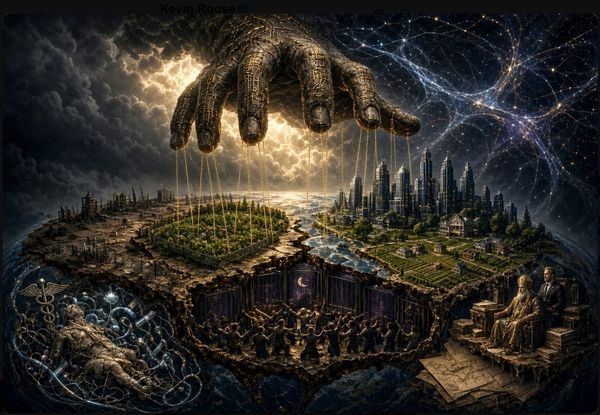
They Raised Your Housing Costs by Doing Nothing: The Economist They Erased
Henry George’s book was one of the bestselling works in America. He argued that a neighborhood creates the value of the land, while the owner simply collects it. Most people have never heard of him. Look at the vacant lots all around us.
Picture a vacant lot sitting between two busy buildings in a growing American city. Imagine two very different futures for that same piece of land.
In one future, a nonprofit group turns the lot into a community garden. Volunteers grow food there and give it to a local food bank. Everyone on the block treats the soil like something they all share.
In the other future, an investor buys the lot, puts a fence around it, and leaves it empty. The investor does nothing with the land. But every year the land itself becomes more valuable anyway. That’s because the people living and working around the lot keep improving the neighborhood. They go to jobs, open stores, and make the area better overall.
Walk down almost any block in a typical American city and you’ll see lots that look more like the second story than the first. The owner didn’t earn the extra value that built up over time. The neighborhood did. That same neighborhood could have been growing food on that land instead of looking at a fenced-off empty lot.
For more than a hundred years, almost nobody outside a small group of economists has been taught to notice this difference or to ask why empty lots held for profit are so common while useful community spaces are so rare.
I didn't notice it either, not until a man named Marty Rowland sat down to write the foreword for my book. Marty spent years as editor of The American Journal of Economics and Sociology. He's a trustee and lecturer at the Henry George School of Social Science,1 an institution dedicated to preserving and teaching the ideas of one of the most important (yet largely overlooked) thinkers in American history. When Marty agreed to write that foreword, and later sent over a thoughtful set of questions for a Q&A for their blog, he enlightened me about a name I should have learned in high school and never did. That introduction placed me on a path of knowledge that would change how I see the plentiful land that surrounds us.

That name is Henry George. And, once I read more about this man and understood who he was, I couldn't stop seeing the pattern George spotted a hundred and fifty years ago, repeating itself everywhere I looked.
The Question Nobody Taught You to Ask
Take two identical houses. Same architect, same materials, same year built. Put one in Manhattan and one in a Nebraska cornfield. The Manhattan house sells for millions. The Nebraska one might fetch a hundred thousand dollars on a generous day.
Nobody poured extra concrete into that Manhattan house. So where did the extra value come from?
Henry George spent his life chasing that question. Born in Philadelphia in 1839, he dropped out of school young and spent his twenties drifting through work as a sailor, a typesetter, and a struggling newspaperman out west.2 In California he watched gold rush fortunes pile up, and the men getting rich usually weren't the ones swinging picks. They were the ones who already owned the land the gold sat under, or the strip the railroad needed, or the lots near a harbor about to boom. The people actually digging, building, and shopkeeping stayed broke.
That contradiction stuck with him. How does a country get richer while poverty refuses to budge?
In 1879 he published his answer in a book called Progress and Poverty. It became one of the bestselling books in American history.3 George ran for Mayor of New York City in 1886 and nearly won, finishing ahead of a young Theodore Roosevelt.4 Crowds packed lecture halls just to hear him talk. For a stretch of his life, Henry George wasn't an obscure economist scribbling in the margins. He was one of the most talked-about men in the country.
Land Is Not Like Anything Else You Own
Strip away the old-fashioned language and George's argument fits in a single breath. Nobody made the land. Nobody created the dirt under New York City, the river running past a particular farm, or the stretch of coastline with the best view of the water. People showed up to a planet that was already finished. The land existed before anyone alive was born and it'll still be here after we're gone.
That puts land in a different category from a house, a car, or a cellphone. Those things came from someone's labor, and George had no problem with people keeping what they earned from their own work. His question was sharper than that. When the value of a piece of land climbs, who actually caused the climb?
His answer: the community causes it, not the person whose name sits on the deed. That Manhattan lot is worth a fortune because millions of people built the subways, the schools, the businesses, and the fire departments around it, generation after generation. The owner standing on top of it didn't build any of that. The city did, together. Yet the owner gets to pocket the entire rise in value as if it were a personal achievement.

George had a name for that kind of unearned gain. He called it economic rent, and he believed it was the real reason poverty stuck around even as nations grew wealthier overall.5 Workers had to fight for every dollar of their wages. Landowners could get rich just by holding onto dirt while everyone around them did the work that made the dirt worth something.
His Fix Was Almost Embarrassingly Simple
Instead of taxing wages, instead of taxing sales, instead of taxing the buildings people actually construct, George wanted to tax the bare value of the land underneath. Not the house sitting on it. Not the crops growing in it. Just the value of the location itself, separated entirely from anything any individual built.
Tax wages and you punish people for working. Tax sales and you punish people for trading. Tax buildings and you punish people for putting up homes and shops the whole neighborhood benefits from. Tax land value instead, and you only capture wealth that no private owner created in the first place. You hand back to the public something the public generated just by existing and building together over time.
George called it the Single Tax.6 Picture that vacant lot from the opening of this piece. Hold it for thirty years downtown, betting the price climbs while our neighbors do all the work that makes the area desirable. Under George's plan, that bet stops paying off, because the tax on the land rises with its value whether anyone builds on it or not. Sitting on dirt for profit becomes a losing strategy. Putting land to use, whether for housing, business, or a community garden feeding the block, becomes the only move that makes sense.
The Land Was Already Spoken For
George wrote about land mainly as a natural resource whose value grows because of the community around it. He argued that this increase belongs to society as a whole rather than to individual owners. But he gave little attention to how most land in America had already been taken from Native nations before his time. Once you see that earlier history, his central point about unearned land value becomes even sharper.
The Virginia Company, chartered in London in 1606, sent settlers to Jamestown not to build a nation but to extract a profit for its investors back in England. When the Powhatan people resisted losing their territory, the company armed settlers, seized Powhatan land through the 1620s, and built a tobacco economy on top of it, worked first by indentured servants and later by enslaved labor. The profits were meant to flow back to London investors who never set foot on the land they owned on paper. The company itself went broke and lost its charter in 1624, but the seized land stayed seized, and the planters who held it kept building their fortunes on top of it. The Plymouth Company and the Massachusetts Bay Company ran the same playbook further north, trading land grants for settler loyalty while pushing Native nations off the ground their ancestors had lived on for thousands of years.7
England wasn't alone, and the Virginia Company wasn't even close to the only operator. The Dutch West India Company carved New Netherland out of Lenape and other Indigenous land along the Hudson River under its own 1621 charter. France's Company of One Hundred Associates claimed the St. Lawrence River valley under a royal monopoly Cardinal Richelieu granted six years later, in 1627. Sweden chartered its own New Sweden Company on the Delaware before the Dutch absorbed it outright.8 By the time the seventeenth century closed, chartered corporations backed by at least four European powers had run the identical operation on this continent: a private company gets a government charter, claims land that already has people living on it, and calls the result trade. One chartered company, one colony's worth of stolen land. That was just the opening move.
The same pattern moved west with the country and got bigger every time. In California, the Spanish crown and later the Mexican government handed out enormous land grants, called ranchos, to soldiers and well-connected citizens, carving up territory that belonged to the Chumash, the Tataviam, the Kitanemuk, and other peoples who were never asked.9 One of the largest examples still stands today. Between 1843 and 1846, the Mexican government granted four ranchos covering nearly 200,000 acres in what's now Kern County to a handful of well-connected Californios. Within two decades of the last grant, an American military officer named Edward Beale had bought up all four grants for a fraction of their worth. His family eventually sold the combined property, known as Tejon Ranch, to a syndicate led by Los Angeles Times publisher Harry Chandler in 1912. It's publicly traded today, still the largest single block of private land in California at roughly 270,000 acres, controlled in large part by Wall Street investors who never plowed a field on it.10 A handful of grants, one ranch. Bigger than Jamestown by a wide margin, and the country still wasn't done scaling it up.
The federal government topped both of those a generation later. Starting with the Pacific Railway Act of 1862, Congress handed railroad companies alternating square-mile sections of land along their routes, a checkerboard pattern reaching ten to forty miles out on either side of the tracks, depending on the line and the year, in exchange for building the line. By the time the giveaways ended, railroad corporations had received something like ten percent of the entire continental United States, land that had belonged to Native nations before the government ever claimed the authority to hand it out.11 That land never really left railroad hands. It moved from one corporate owner to the next as the railroads merged, split, and spun off real estate divisions over the following century. The Central Pacific and Southern Pacific's original 1862 land grant eventually passed to a company called Catellus, which by 1990 controlled two million acres across thirteen states, and pieces of that empire still circulate today. In the late 1990s, a firm called Nevada Land and Resource Company bought roughly 1.3 million acres of the old Central Pacific checkerboard in Nevada, and its successor, New Nevada Lands, still holds about half a million of those acres, plus mineral rights across well over a million more, along the I-80 corridor. Researchers who study this pattern have found that in many western states, the largest landowners today are still the original land grant railroads or the corporate heirs that absorbed them.12 The tracks changed hands a dozen times. The land underneath the tracks barely did.
Look at the climb across all three. A trading company, a handful of ranchos, then a tenth of an entire continent, each one larger and more deliberately engineered than the last, and not one acre of it earned by the hands that ended up holding the deed. Before George could ever ask who deserves the rising value of a city block, somebody first had to take the whole continent out of the hands of the people who were already living on it.
Then He Just Disappeared
For decades his ideas got taught in classrooms, argued over in Congress, and debated at kitchen tables across the English speaking world. Single Tax clubs sprang up by the hundreds. Reformers in Britain, Australia, and Canada built real political movements around his work.13 A handful of cities tried taxing land value the way he proposed, and the results lined up with what he predicted: less land sitting idle, more building, more productive use of the ground people already had.14
Then, across the early decades of the twentieth century, his name started slipping off the syllabus. There's a piece of this I want to be careful with, because I'd rather underclaim than overclaim. I can't point to a memo that ordered George erased from economics departments. What I can point to is a documented pattern from that same period: universities increasingly dependent on the same fortunes built on land speculation, railroads, and resource monopolies, and foundations that funded research and shaped which questions got taken seriously in the classroom and which got quietly dropped.15 George's disappearance fits that pattern closely enough to deserve real scrutiny, neither swallowed whole nor waved away.
What I can say with more confidence is what happened to the conversation that replaced him. Once George stopped being taken seriously, the acceptable debate on the left and right narrowed to a fight between state ownership and deregulated market capitalism, communism's heirs against neoliberalism's heirs, each one a useful enemy for the other to defeat in public. Both sides of that argument leave one question completely unexamined: whether the unearned value created by land, monopoly, and now AI and financialization should belong to the people who created it together, instead of to whoever happened to be positioned to capture it. A debate that never reaches that question is a debate elites on every side can survive comfortably.
By the time my generation sat through a high school economics class, Henry George had been reduced to a footnote, if he showed up at all. An idea that once filled lecture halls and swayed elections slipped quietly out of the conversation. Not because anyone proved it wrong. Because it was inconvenient to the people who got to decide what counted as serious economics.
What the Earth Actually Is
Long before I'd ever heard Henry George's name, I'd been researching comparative religion, quantum physics, and ancient history, trying to answer a much older question: what is the relationship between God and the universe? I eventually landed on something I call Emergent Holopanentheism.16 Strip away the big words and the idea is simple. The sacred isn't sitting outside the universe, watching from a distance. It grows right inside the universe through all the connections, complexity, and change happening over time. It's like a conversation that becomes something bigger than either person could have created alone.
If that's true, the Earth isn't just a storehouse of stuff waiting for the first person to claim it. It's a living part of something sacred that's still growing and changing. We aren't outsiders watching a finished show. We're inside the story, helping to create it as it unfolds.
That idea changes George's argument in a big way. If land was just another economic tool, like a hammer or a factory machine, we could argue forever about the smartest way to divide it up and never go deeper than policy debates. But if the Earth is part of a living, sacred story that every conscious being helps write, then taking the value the whole community creates isn't just bad policy. It feels like breaking a promise we never should have broken. This world wasn't made for a handful of people to hoard. It was made so every living person could thrive. We are caretakers of an inheritance that stretches across generations of humans we will never meet. Turning the rising value of a place into our own private prize isn't only bad economics. It goes against the deeper responsibility we carry simply because we were born here on this Earth.
Why This Still Matters to You
Look at the housing market our generation is facing. Buying a home feels almost impossible for many people our age, in a way it wasn’t for our grandparents. Rent often takes half a paycheck in any decent city. Big investment funds buy up whole neighborhoods not to live in them, but to hold as assets while families compete for whatever is left. Farmland gets scooped up by hedge funds that have no interest in actually farming it. Vacant lots sit empty in cities that desperately need housing, because the owners are happy to watch the price climb while doing nothing at all.
I tried to find one clear number showing what share of American land is held in trusts or other setups designed to pass it down through families, but that exact figure doesn’t exist. No one tracks land that broadly. Still, the best numbers we have point exactly where Henry George would have expected. The USDA’s most recent survey of farmland, released in March 2026, found that nearly 80 percent of all rented farmland is owned by landlords who don’t farm it themselves. Most of those owners got the land through inheritance, a trust, or a gift instead of buying it outright. The survey also projects that over the next five years, owners plan to pass roughly 168 million acres to the next generation through wills and trusts rather than selling it on the open market. The average non-farming landlord is around 69 years old. More than a third are 75 or older, and that older group alone controls over 40 percent of the rental income and land value tied to it.17
None of that is illegal or even unusual. People are allowed to leave land to their children. Most do it simply because they love their families, not because they are trying to hurt everyone else.
But step back and look at the bigger picture. A huge share of the most valuable, productive land in the country belongs to people who never worked it. It was passed down through inheritance rather than earned or purchased. It is locked inside legal arrangements designed to keep it in the family forever. Henry George spent his life pointing out exactly this kind of gain. The rise in value that nobody named on the deed actually created. What he could not have known is how big that pattern would grow. Or how quietly it would keep moving from one generation of owners to the next while everyone trying to buy in for the first time gets priced further and further out.
And land was never the only place it shows up. The same gap George spotted in a city block now turns up in corporate monopoly power, in the fees a fund manager collects from our 401(k) whether our investments perform or not, in the value AI systems extract from data and labor nobody individually agreed to hand over.18 The form keeps changing. The question underneath it hasn't moved in a hundred and fifty years: who actually earns the rising value that an entire community, or an entire society, builds together?
You don't have to agree with every detail of a nineteenth century tax proposal to feel the weight of that question. Whatever the modern answer looks like, it deserves to be asked out loud again, the way it was back when George could still fill a stadium asking it. Why did almost nobody get taught to ask it in the first place?
I only learned about all this because one man took the time to write a foreword instead of letting those old ideas gather dust on a shelf. Now you know it too. What you do with it is up to you.
Notes
1. Marty Rowland, foreword to Eric Daniel Buesing, The Hidden Hand: Wealth, Power, and Control from Pharaohs to Corporations (Walterville, OR: TrineDay, 2026), x–xii.
2. Edward T. O'Donnell, Henry George and the Crisis of Inequality: Progress and Poverty in the Gilded Age (New York: Columbia University Press, 2015), pt. 1; “Henry George,” Britannica Money, accessed June 29, 2026, https://www.britannica.com/money/Henry-George; “Henry George,” Encyclopedia.com, accessed June 29, 2026, https://www.encyclopedia.com/people/social-sciences-and-law/economics-biographies/henry-george.
3. O'Donnell, Henry George and the Crisis of Inequality; “Henry George,” EBSCO Research Starters, accessed June 29, 2026, https://www.ebsco.com/research-starters/history/henry-george.
4. J. R. Stobo, “Organized Labor, Housing Issues, and Politics: Another Look at the 1886 Henry George Mayoral Campaign in New York City” (unpublished paper, 1993; rev. 2008), http://www.columbia.edu/~jrs9/GEORGE-Housing.pdf; Myron Magnet, “1886: The Men Who Would Be Mayor,” City Journal, March 23, 2023, https://www.city-journal.org/article/1886-the-men-who-would-be-mayor; O'Donnell, Henry George and the Crisis of Inequality.
5. Henry George, Progress and Poverty: An Inquiry into the Cause of Industrial Depressions and of Increase of Want with Increase of Wealth: The Remedy (New York: D. Appleton and Company, 1879).
6. O'Donnell, Henry George and the Crisis of Inequality; George, Progress and Poverty.
7. Eric Daniel Buesing, The Hidden Hand: Wealth, Power, and Control from Pharaohs to Corporations (Walterville, OR: TrineDay, 2026), 58–59; Wesley Frank Craven, Dissolution of the Virginia Company: The Failure of a Colonial Experiment (New York: Oxford University Press, 1932).
8. “Chartered Company,” Britannica Money, accessed June 29, 2026, https://www.britannica.com/money/chartered-company; “Colonization and Companies,” Encyclopedia.com, accessed June 29, 2026, https://www.encyclopedia.com/history/encyclopedias-almanacs-transcripts-and-maps/colonization-and-companies; “The 1621 Charter of the Dutch West India Company,” Historical Society of the New York Courts, accessed June 29, 2026, https://history.nycourts.gov/about_period/charter-1621/; “New Sweden,” Britannica, accessed June 29, 2026, https://www.britannica.com/place/New-Sweden.
9. John S. Caragozian, “The Demise of California's Ranchos,” California Supreme Court Historical Society, accessed June 29, 2026, https://www.cschs.org/wp-content/uploads/2022/09/History-Resources-Caragozian-Demise-of-Californias-Ranchos-8-30-22.pdf; California State Lands Commission, “Grants of Land in California Made by Spanish or Mexican Authorities,” accessed June 29, 2026, https://www.slc.ca.gov/land-types/grants-of-land-in-california-made-by-spanish-or-mexican-authorities/.
10. Natalie Hoberman, “Who Is Tejon Ranch? A NY-Backed Firm Plots Massive Communities in California,” The Real Deal, October 18, 2018, https://therealdeal.com/new-york/2018/10/18/who-is-tejon-ranch-a-ny-backed-firm-plots-massive-communities-in-california/; “How to Access Tejon Ranch, California's Largest Private Parcel,” PBS SoCal, accessed June 29, 2026, https://www.pbssocal.org/shows/socal-wanderer/how-to-access-tejon-ranch-californias-largest-private-parcel.
11. “Railroads, Federal Land Grants to,” Encyclopedia.com, accessed June 29, 2026, https://www.encyclopedia.com/history/encyclopedias-almanacs-transcripts-and-maps/railroads-federal-land-grants-issue; “Yellowstone Checkerboard Land Patterns,” University of Washington School of Environmental and Forest Sciences, accessed June 29, 2026, http://fs-web.sefs.uw.edu/classes.esrm.459/yellowstone/yellowstone/Project4/project4.html.
12. “Catellus Development Corporation Railroad Land Grant Records, 1852–1982,” Online Archive of California, California State Railroad Museum Library and Archives, accessed June 29, 2026, https://oac.cdlib.org/findaid/ark:/13030/c89g5tqc/; “Railroads and Clearcuts,” landgrant.org, accessed June 29, 2026, http://www.landgrant.org/corps.html; “About New Nevada,” New Nevada Resources, accessed July 18, 2026, https://newnevadaresources.com/; “Nevada Land Readies $31 Million Sale,” Northern Nevada Business Weekly, September 18, 2011, https://www.nnbw.com/news/2011/sep/18/nevada-land-readies-31-million-sale/.
13. Avner Offer, Property and Politics, 1870–1914: Landownership, Law, Ideology, and Urban Development in England (Cambridge: Cambridge University Press, 1981); “Prosper's History,” Prosper Australia, accessed June 29, 2026, https://www.prosper.org.au/about/our-history/; O'Donnell, Henry George and the Crisis of Inequality, epilogue.
14. Wallace E. Oates and Robert M. Schwab, “The Impact of Urban Land Taxation: The Pittsburgh Experience,” National Tax Journal 50, no. 1 (March 1997): 1–21.
15. Eric Daniel Buesing, The Hidden Hand: Wealth, Power, and Control from Pharaohs to Corporations (Walterville, OR: TrineDay, 2026), chap. 10.
16. Eric Daniel Buesing, Emergent Holopanentheism: The Quantum Bridge Between Science, Spirit, and Cosmic Meaning (self-published, 2025).
17. U.S. Department of Agriculture, National Agricultural Statistics Service, 2024 Tenure, Ownership, and Transition of Agricultural Land (TOTAL) Survey, released March 12, 2026, https://www.nass.usda.gov/Surveys/Guide_to_NASS_Surveys/TOTAL/; “USDA Survey: Most Rented Farmland Is Owned by Non-Farmers,” Farm and Dairy, March 13, 2026, https://www.farmanddairy.com/news/usda-survey-most-rented-farmland-is-owned-by-non-farmers/907464.html.
18. Eric Daniel Buesing, “Q&A with Eric Daniel Buesing, Author of The Hidden Hand,” interview by Marty Rowland, Reality Economics (blog), Henry George School of Social Science, 2026.
Bibliography
Britannica Money. “Chartered Company.” Accessed June 29, 2026. https://www.britannica.com/money/chartered-company.
Britannica. “New Sweden.” Accessed June 29, 2026. https://www.britannica.com/place/New-Sweden.
Britannica Money. “Henry George.” Accessed June 29, 2026. https://www.britannica.com/money/Henry-George.
Buesing, Eric Daniel. Emergent Holopanentheism: The Quantum Bridge Between Science, Spirit, and Cosmic Meaning. Self-published, 2025.
Buesing, Eric Daniel. The Hidden Hand: Wealth, Power, and Control from Pharaohs to Corporations. Walterville, OR: TrineDay, 2026.
Buesing, Eric Daniel. “Q&A with Eric Daniel Buesing, Author of The Hidden Hand.” Interview by Marty Rowland. Reality Economics (blog). Henry George School of Social Science, 2026.
California State Lands Commission. “Grants of Land in California Made by Spanish or Mexican Authorities.” Accessed June 29, 2026. https://www.slc.ca.gov/land-types/grants-of-land-in-california-made-by-spanish-or-mexican-authorities/.
Caragozian, John S. “The Demise of California's Ranchos.” California Supreme Court Historical Society. Accessed June 29, 2026. https://www.cschs.org/wp-content/uploads/2022/09/History-Resources-Caragozian-Demise-of-Californias-Ranchos-8-30-22.pdf.
Craven, Wesley Frank. Dissolution of the Virginia Company: The Failure of a Colonial Experiment. New York: Oxford University Press, 1932.
Encyclopedia.com. “Colonization and Companies.” Accessed June 29, 2026. https://www.encyclopedia.com/history/encyclopedias-almanacs-transcripts-and-maps/colonization-and-companies.
Encyclopedia.com. “Henry George.” Accessed June 29, 2026. https://www.encyclopedia.com/people/social-sciences-and-law/economics-biographies/henry-george.
Encyclopedia.com. “Railroads, Federal Land Grants to.” Accessed June 29, 2026. https://www.encyclopedia.com/history/encyclopedias-almanacs-transcripts-and-maps/railroads-federal-land-grants-issue.
EBSCO Research Starters. “Henry George.” Accessed June 29, 2026. https://www.ebsco.com/research-starters/history/henry-george.
Farm and Dairy. “USDA Survey: Most Rented Farmland Is Owned by Non-Farmers.” March 13, 2026. https://www.farmanddairy.com/news/usda-survey-most-rented-farmland-is-owned-by-non-farmers/907464.html.
George, Henry. Progress and Poverty: An Inquiry into the Cause of Industrial Depressions and of Increase of Want with Increase of Wealth: The Remedy. New York: D. Appleton and Company, 1879.
Historical Society of the New York Courts. “The 1621 Charter of the Dutch West India Company.” Accessed June 29, 2026. https://history.nycourts.gov/about_period/charter-1621/.
Hoberman, Natalie. “Who Is Tejon Ranch? A NY-Backed Firm Plots Massive Communities in California.” The Real Deal, October 18, 2018. https://therealdeal.com/new-york/2018/10/18/who-is-tejon-ranch-a-ny-backed-firm-plots-massive-communities-in-california/.
landgrant.org. “Railroads and Clearcuts.” Accessed June 29, 2026. http://www.landgrant.org/corps.html.
Magnet, Myron. “1886: The Men Who Would Be Mayor.” City Journal, March 23, 2023. https://www.city-journal.org/article/1886-the-men-who-would-be-mayor.
New Nevada Resources. “About New Nevada.” Accessed July 18, 2026. https://newnevadaresources.com/.
Northern Nevada Business Weekly. “Nevada Land Readies $31 Million Sale.” September 18, 2011. https://www.nnbw.com/news/2011/sep/18/nevada-land-readies-31-million-sale/.
Oates, Wallace E., and Robert M. Schwab. “The Impact of Urban Land Taxation: The Pittsburgh Experience.” National Tax Journal 50, no. 1 (March 1997): 1–21.
O'Donnell, Edward T. Henry George and the Crisis of Inequality: Progress and Poverty in the Gilded Age. New York: Columbia University Press, 2015.
Offer, Avner. Property and Politics, 1870–1914: Landownership, Law, Ideology, and Urban Development in England. Cambridge: Cambridge University Press, 1981.
Online Archive of California. “Catellus Development Corporation Railroad Land Grant Records, 1852–1982.” California State Railroad Museum Library and Archives. Accessed June 29, 2026. https://oac.cdlib.org/findaid/ark:/13030/c89g5tqc/.
PBS SoCal. “How to Access Tejon Ranch, California's Largest Private Parcel.” Accessed June 29, 2026. https://www.pbssocal.org/shows/socal-wanderer/how-to-access-tejon-ranch-californias-largest-private-parcel.
Prosper Australia. “Prosper's History.” Accessed June 29, 2026. https://www.prosper.org.au/about/our-history/.
Rowland, Marty. Foreword to The Hidden Hand: Wealth, Power, and Control from Pharaohs to Corporations, by Eric Daniel Buesing, x–xii. Walterville, OR: TrineDay, 2026.
Stobo, J. R. “Organized Labor, Housing Issues, and Politics: Another Look at the 1886 Henry George Mayoral Campaign in New York City.” Unpublished paper, 1993; rev. 2008. http://www.columbia.edu/~jrs9/GEORGE-Housing.pdf.
University of Washington School of Environmental and Forest Sciences. “Yellowstone Checkerboard Land Patterns.” Accessed June 29, 2026. http://fs-web.sefs.uw.edu/classes.esrm.459/yellowstone/yellowstone/Project4/project4.html.
U.S. Department of Agriculture, National Agricultural Statistics Service. 2024 Tenure, Ownership, and Transition of Agricultural Land (TOTAL) Survey. Released March 12, 2026. https://www.nass.usda.gov/Surveys/Guide_to_NASS_Surveys/TOTAL/.