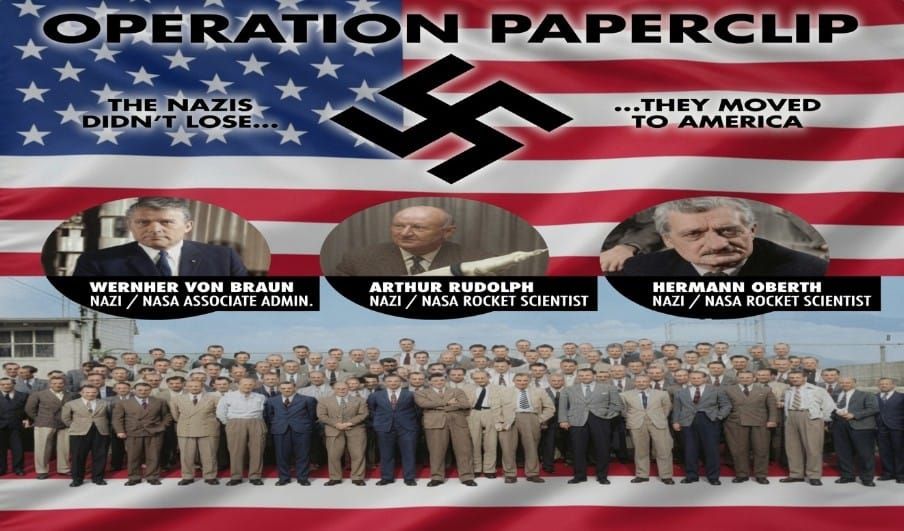
The Nazi Birth of the New World Order
The Four Mechanisms at Work: How Coercion, Alignment, Amnesia, and Conflict Transferred the Third Reich's Technical Elite and Intelligence Apparatus into the Foundations of American Power
The official account holds that the Third Reich ended in a Berlin bunker in April 1945. A body burned in a shell crater. A surrender signed at Reims. The machinery dismantled, the criminals tried, the danger past. That account is not false. But it is incomplete in a particular direction, and that direction is the whole story. The bunker was essentially theater and the transfer was purely administrative.
What ended in 1945 was a government, a flag, and an army. What did not end was a cadre of men, a body of technical knowledge purchased with human lives, an intelligence network, and a set of operating assumptions about the relationship between those who hold information and those who do not. Those things were not defeated. They were catalogued, laundered through falsified paperwork, and installed at the foundation of the institutions the United States was standing up to govern the postwar world.
This is not an inference drawn from silence. It sits in the National Archives, in declassified CIA internal histories, in congressional hearing records, and in a wartime military intelligence report that has been public for decades and read by almost no one. Where the record is complete, I will say so. Where it is inferred from pattern, I will label it inference. Where it remains speculative, I will call it speculation and let you weigh it yourself. That distinction is the only thing separating investigation from assertion, and the institutions under examination here have spent eighty years depending on people failing to make it.
In The Hidden Hand: Wealth, Power, and Control from Pharaohs to Corporations, I identified four mechanisms elites deploy to secure and hold power in every era I examined. Coercion operates through dependency rather than force: Egyptian priests opened the grain stores during famine, and the farmers who ate walked out carrying obligations they would never discharge. The same arrangement is being rebuilt now as programmable money, where an account that can be frozen or conditioned on behavior makes obedience a prerequisite for eating. Alignment converges interests in advance so that nobody ever has to issue an order. Roman patrons gathered their clients at dawn to renew the relationship; the modern instrument is the compliance rating and the corporate loyalty pledge, which turn dissent from official consensus into career suicide without anyone needing to forbid it. Amnesia governs what a population is able to remember. Venice erased its rivals' trade routes from the record, and the current tools are the curated search result and the automated content label, which destroy nothing and simply ensure that certain material never reaches anyone positioned to act on it. Conflict keeps the governed fighting each other rather than examining the arrangement above them, and where tribal warfare once justified royal authority, algorithmic amplification of division now performs the same function at a fraction of the cost. The postwar transfer is the cleanest single case study I have found. All four mechanisms appear, fully formed, inside a sixty-month window, and unlike the ancient cases, where inference has to carry the weight, this one leaves a paper trail.
Strasbourg: The Plan Filed Under Alignment
August 10, 1944. The Maison Rouge hotel at Strasbourg in occupied France. Germany is losing and every man in the room knows it. SS officers and executives from Germany's largest industrial concerns have assembled to resolve a single problem: how do you preserve power when the state that granted it is about to be destroyed?
A French intelligence agent was also present. His report of the meeting reached American hands and became U.S. Military Intelligence Report EW-Pa 128, forwarded to the State Department in November 1944, known since to the small number of people who have read it as the Red House Report.1 It has been declassified for decades.
Their plan had three stages and it was highly specific. Move capital out of Germany immediately, into Switzerland and neutral countries, beyond Allied reach. Establish front companies abroad that would pass as ordinary postwar businesses. Place Party members inside those companies as technical experts and wait. The report records the operational instruction directly: the existence of these cells was "to be known only by very few people in each industry and by chiefs of the Nazi Party."2
I. G. Farben sent representatives. Farben was the largest chemical concern on earth and one of the primary corporate engines of the Holocaust. It manufactured the Zyklon B used in the concentration camps and operated the synthetic rubber works at Auschwitz that consumed tens of thousands of slave laborers. The Allies broke Farben apart after the war. Every Farben executive convicted at Nuremberg was free by 1951. The successor firms, BASF, Bayer, and Hoechst, became pillars of the global pharmaceutical industry and still trade under those names today.3
The Allies possessed this report before the war ended. They knew the structure of the plan, the names of the participating industries, and the intended mechanism. The plan was successful and proceeded regardless of this knowledge.
Jim Marrs correctly describes Strasbourg in The Rise of the Fourth Reich. He shows it was not a last-minute scramble, but the public face of a planned effort to move money, people, and technical knowledge out of Allied reach before the war ended.4 The wealth stolen from occupied Europe paid for front companies in South America, neutral European countries, and later here in the United States.
What Strasbourg describes is alignment in its original sense: not agreement compelled by force but interests quietly converged in advance, so that when the moment arrives no coordination is required. The industrialists in that room did not need ongoing instructions. They needed a shared understanding of where their interests pointed. That is a far more durable arrangement than a conspiracy, because it survives the death of everyone who attended, and because it produces coordinated outcomes without anyone having to issue an order that could later be discovered.
The Occult Foundation and the Order Above the State
The Thule Society was founded in Munich in 1918 by a man who called himself Rudolf von Sebottendorff. That was not his real name. Publicly, it claimed to be a study group focused on ancient Germanic history. In reality, it operated as a political group built around racial mysticism and the occult. Its members believed that Aryan bloodlines held ancient powers that only properly initiated men could unlock. Sebottendorff, Dietrich Eckart, and others in their circle thought they could contact non-human intelligences through the right rituals, pure blood, and correct rank.5
Thule money and Thule men built the German Workers' Party. That party became the NSDAP. Eckart became Hitler's mentor and the dedicatee of the second volume of Mein Kampf. Hess, Rosenberg, and Frank all moved through the same orbit.
This wasn't just for show. Himmler controlled the Ahnenerbe, which sent expeditions to Tibet and Iceland in search of evidence for Aryan origins. He turned Wewelsburg Castle into a major SS ritual center, using concentration camp prisoners for the construction work and pouring huge amounts of money into the project even as the war was falling apart around him.
Marrs argues the occult foundation was constitutive rather than incidental, and on the evidence he is right about the operational consequence even for readers who assign no reality whatever to the metaphysics.6 The belief system gave the SS its self-conception as a separate order, answerable to something above the German state and outside its law. That self-conception is precisely what permitted Himmler to run weapons programs outside normal military command, and it is why the SS became the institutional home for the Reich's most classified late-war projects.
Every mechanism I traced in The Hidden Hand requires the same precondition: a class of men who understand themselves as exempt from the rules binding the the rest of us. Egyptian priests had divine mandate. Venetian oligarchs had the Great Council and its secret ballots. The SS had a mythology of ancient bloodlines. The specific content of the exemption varies by era and matters far less than the structural fact of the exemption itself. What transferred to the United States after 1945 was never the mythology. Nobody at Langley believed in Thule. What transferred was the structure: a body of men holding information the public could not access, operating under authority the public could not review, convinced their exemption was justified by the stakes.
Kammler, the Bell, and the Boundary of the Record
Hans Kammler was among the most powerful men in Nazi Germany by 1945 and among the least examined since. An SS-Obergruppenführer and civil engineer, he oversaw construction of the camps themselves, Auschwitz and Majdanek among them, including the gas chamber expansions.7 He then received Hitler's trust over every advanced weapons program the Reich possessed: V-2 rockets, jet aircraft, and the underground production complexes carved out by slave labor. In the final months his authority over Nazi secret weapons exceeded everyone's but Hitler's.
In April 1945, with Allied forces closing in, Kammler intervened personally to stop the execution of Wernher von Braun and the rocket team under Hitler's scorched-earth orders. He gathered the most valuable technical personnel in Germany and moved them toward the American lines. Then he disappeared.
The official account says Kammler killed himself on May 9, 1945. The difficulty with the official account is a U.S. Air Force intelligence document dated May 30, 1945, three weeks after his supposed death, listing Kammler among senior German prisoners available for American interrogation. German ZDF researchers located it.8 It has never been officially explained. Contemporary accounts of his death contradict one another in at least three directions. No body was ever found.
The project Kammler was running in those final months beyond the V-2 is where the documentary record ends and the contested research begins. Polish military journalist Igor Witkowski reported in Prawda o Wunderwaffe that he was shown classified Polish intelligence transcripts from the postwar interrogation of SS-Gruppenführer Jakob Sporrenberg describing a project designated Die Glocke, the Bell.9 A bell-shaped apparatus roughly fifteen feet tall containing counter-rotating cylinders filled with a mercury-like substance, drawing power on the scale of a small city. Witkowski recorded that five of seven assigned scientists died during early testing. The concrete test rig, a heavy ring structure locals call the Henge, still stands near the Wenceslas Mine in Lower Silesia.

Nick Cook, defense editor at Jane's Defence Weekly for more than a decade, pursued Witkowski's research and concluded in The Hunt for Zero Point that the Bell was likely moved to the United States under an arrangement between Kammler and American intelligence.10 Marrs carries the same thread to its final conclusion: the Reich's most classified technical projects did not go to Nuremberg but to Huntsville, to Langley, and to institutions exempt from congressional oversight.11
The most sensitive Paperclip files stayed classified for decades and many remain sealed. The Kammler document showing him alive after his official death has never been explained by anyone. The complete record of what the Reich's most advanced programs were building has never been released.
This is amnesia functioning as designed. In The Hidden Hand I traced the mechanism from the burning of libraries to the curation of Internet search results, and the operative insight is that amnesia rarely requires destroying evidence. It requires only that evidence remain unavailable long enough for the people who would have recognized its significance to die off. Inside a permanent classification regime, absence of evidence is not a finding. It is an output. The system is built to produce exactly that result, and then the result is offered as proof that nothing occurred.
Operation Paperclip: Coercion's Inventory
Between 1945 and 1959 the United States imported more than sixteen hundred German scientists, engineers, and technical specialists under a classified program called Operation Paperclip.12
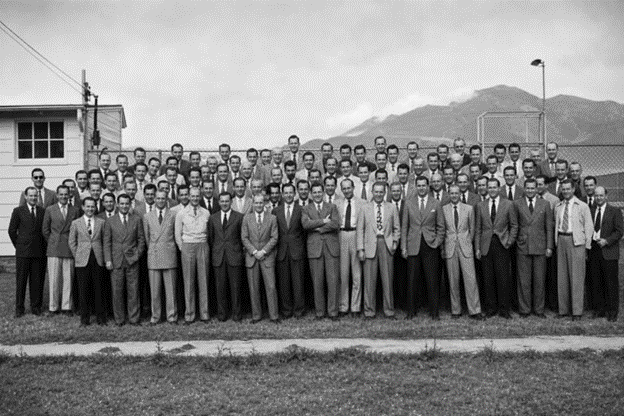
However, President Truman's authorization explicitly barred anyone who had been an active Nazi or a participant in the regime's crimes. The Joint Intelligence Objectives Agency resolved that obstacle by rewriting the files. The dossiers were sanitized. SS memberships disappeared. "Ardent Nazi" was revised to "nominal party member." War crimes documentation was reclassified or lost. The men were then certified admissible under a standard that, applied as written, would have disqualified most of them. Annie Jacobsen and Linda Hunt each reconstructed the mechanics from the archives.13 No serious researcher has ever disputed this.
Consider the Nazi's who made it through:
Wernher von Braun. Party member from 1937, SS officer at the rank of Sturmbannführer, technical director of the V-2 program at Peenemünde. The rockets were assembled inside the Mittelwerk tunnels by prisoners from Mittelbau-Dora. Historians estimate the V-2 killed roughly twenty thousand people in its construction, more than it ever killed in flight.14 Von Braun visited Mittelwerk. He later described the conditions as horrifying and himself as powerless. In America he became chief architect of the Saturn V and a recurring guest on Disney television programming, explaining the future to American children.
Kurt Debus. SS member, V-2 engineer, and a man who reported a colleague to the Gestapo for anti-Nazi remarks. He became the first director of the Kennedy Space Center. His name is on the building.
Hubertus Strughold. Director of the Luftwaffe's aeromedical institute while its researchers ran hypothermia and altitude experiments on prisoners at Dachau, immersing men in freezing water and sealing them in pressure chambers to document how they died. He denied participation and no charges were ever brought up against him. In America he was celebrated for decades as the father of space medicine, until the Space Medicine Association and the Aerospace Medical Association both withdrew his name from their highest honors.15 Institutions move that slowly only when evidence has become impossible to deny.
Reinhard Gehlen. Hitler's chief of military intelligence for the Eastern Front. With Allied forces closing he buried his archive in the Bavarian Alps, surrendered to the Americans, and traded the contents and his entire agent network for his freedom. The CIA funded and operated what became the Gehlen Organization through the early Cold War and in 1956 transferred it wholesale into the West German government as the Bundesnachrichtendienst. Gehlen ran the BND until 1968. The organization was staffed throughout with former SS and SD officers. The CIA's own declassified internal history concedes the arrangement was a "double edged sword" that "boosted the Warsaw Pact's propaganda efforts" and "suffered devastating penetrations by the KGB."16 A spy service founded by Nazis, financed by Americans, reporting to Moscow. The CIA wrote that assessment itself and classified it for fifty years.
Marrs notes that Operation Paperclip was only the visible layer.17 Parallel programs, Operation National Interest and Project 63, ran alongside with looser vetting. Some men arrived with no program designation, reconstituted under new identities. The full count has never been established, and establishing it would require releasing files still classified on men that have been dead for decades.
Coercion in operates through dependency rather than force in nearly every mature case I examined. Egyptian grain stores did not compel obedience at spear point; they created obligations that outlasted the famine. Operation Paperclip functions identically in reverse. The United States did not coerce these men. It acquired them, and in doing so acquired a permanent dependency on personnel whose full histories the government itself had destroyed. Every subsequent decision about potential disclosure ran into the same wall: releasing the files would indict the institution that falsified them. The forgery created the obligation, and the obligation is why the files are still sealed to this day.
Three Agencies, One Inheritance
The claim that the CIA, the National Security Council, and the National Security Agency absorbed Nazi-era architecture from the ground up is the load-bearing claim of this entire investigation, and it deserves more than assertion. Each of the three was created inside the same sixty-month window. Each took something specific from the wreckage of the Reich. What each one took is documented, and the documents are now public.
Start with the Central Intelligence Agency, because its inheritance was the most direct. The Agency did not merely employ former Nazi intelligence officers as individual assets. It took possession of an entire functioning foreign intelligence service, complete with its officer corps, its agent networks inside the Soviet bloc, its filing systems, and its institutional habits, and it operated that service as its principal source on the adversary that would define the next forty years. Gehlen did not apply for a job. He delivered an organization, and the Agency took delivery.
Nor was Gehlen the only channel. In 1948 the State Department, working with Army intelligence and soon under CIA auspices, launched Operation Bloodstone, a program to recruit Eastern European émigrés, Wehrmacht veterans, and collaborators with wartime records for use in propaganda, sabotage, and stay-behind work against the Soviets.18 Christopher Simpson, whose Blowback remains the foundational scholarly account, documented that senior officials at the CIA, the National Security Council, and the wider emerging security establishment turned to former Nazis, Waffen-SS men, and collaborators on a scale far exceeding anything Paperclip alone would suggest, and that a substantial number of those recruits had participated directly in the Final Solution.19 Simpson later served on the historical advisory panel of the Interagency Working Group created under the Nazi War Crimes Disclosure Act of 1998, and his assessment of the Agency's conduct during that disclosure process was that it ran an ongoing campaign against accountability.20 A member of the government's own review panel said that, in print, about the agency the panel was reviewing.
Now the National Security Council, where the connection is structural rather than personal and is therefore the one most often missed. Nobody has produced evidence that former SS officers sat on the NSC. That is not the point and never was. The NSC's contribution was to write the rules that made everything else possible, and it wrote them fast. In December 1947, five months after the National Security Act created it, the Council issued NSC 4-A, authorizing covert psychological operations. In June 1948 it issued NSC 10/2, which established the Office of Policy Coordination under Frank Wisner and defined covert operations as activities planned and executed so that American responsibility would not be evident, and so that if they were uncovered the government could "plausibly disclaim any responsibility."21
Read that definition again and notice what it is. It is not a description of a program. It is the invention of a legal category for actions the government intends to deny having taken. Plausible deniability was not a scandal that emerged later from abuse of the system. It was written into the founding directive, by the Council, in 1948, and every subsequent operation that used former Nazi personnel operated inside the space that sentence created. Wisner's OPC then became the home of the émigré networks, the stay-behind programs, and the propaganda apparatus. The NSC did not need to hire a single German. It authored the framework in which hiring them left no fingerprints.
That leaves the National Security Agency, and its inheritance is the least discussed of the three because it stayed classified the longest. While Paperclip collected rocket engineers, a parallel Allied program called TICOM, the Target Intelligence Committee, was collecting the men and machines of German signals intelligence.22 TICOM teams moved into Germany in the war's final weeks with a specific mission: locate and seize Axis cryptologic personnel, documents, and equipment before the Soviets reached them.
The single most valuable capture tells you why this mattered. On May 21, 1945, a TICOM team acting on a prisoner's tip recovered roughly seven and a half tons of equipment including the "Russian Fish," a set of German wide-band receivers built to intercept high-level Soviet radio teletype traffic.23 The Germans had been reading Soviet communications. The Americans took the hardware, the methods, and the men who understood both.
The product of that seizure was compiled into a nine-volume classified study issued on May 1, 1946, by the Chief of the Army Security Agency, the direct institutional predecessor of the National Security Agency.24 An internal American assessment in 1952, the year the NSA was created, judged the TICOM material to have been of invaluable help to cryptanalytic sections still working active targets seven years after the war ended. The agency then classified the whole body of TICOM records under a seventy-five-year rule and released the bulk of it only in the 2000s, decades after comparable wartime codebreaking material, including the Enigma story itself, had been made public.
In other words, American signals intelligence against the Soviet Union began, in significant part, with German equipment, German techniques, and German expertise against Soviet communications, acquired in the same months and by the same logic as Operation Paperclip. The agency built on that foundation kept the record sealed for the better part of a century.
So the pattern holds across all three institutions, and it holds differently in each. The CIA inherited personnel and an intact organization. The NSC inherited nothing and instead manufactured the doctrine of deniability that let the inheritance function unexamined. The NSA inherited the technical capability to listen to the new enemy, purchased from the old one, and then buried the receipt. Coercion produced the dependency, alignment supplied the shared understanding that made the arrangement obvious to everyone involved and invisible to everyone else, and amnesia sealed all three sets of files under classification regimes that have now outlasted nearly every man they protect. The architecture was not corrupted later by bad actors. It was assembled this way, on purpose, by men who believed the stakes justified it.
Europe, Wired for Conflict
Beyond Paperclip and Gehlen, the CIA built a lattice of concealed weapons caches, clandestine agents, and shadow organizations across Western Europe, intended for activation if Soviet forces moved west. The networks carried different names in different countries. In Italy the name was Gladio. Coordination ran through NATO under classified arrangements most host parliaments knew nothing about.
When the Italian Senate finally investigated in 1990, it emerged that the network had not spent forty years dormant awaiting an invasion that never arrived. It had been operational: running influence campaigns, entangled with domestic political violence, shaping electoral outcomes. Prime Minister Giulio Andreotti confirmed the program's existence in testimony. Parliamentary inquiries in Belgium and Switzerland found parallel structures.25
These networks recruited heavily from anti-communist personnel with fascist and Nazi backgrounds. The founding assumption, that European electorates could not be trusted to choose correctly without covert management from above, is the identical assumption Paperclip imported.
Marrs identifies the lineage as the institutional descendant of the SS concept of Weltanschauungskrieg, worldview warfare, the doctrine that control over what a population believes is as decisive as control over its territory.26 Conflict as I traced it in The Hidden Hand has never primarily concerned defeating an external enemy. It concerns keeping a population divided along manufactured lines so that its energy exhausts itself internally and never consolidates against the arrangement itself. Gladio was not built to fight Soviets. It was built, and used, to manage Western European domestic politics. The Soviet threat supplied the justification. The domestic application was the function.
Bernays, Goebbels, and Tools Without Loyalty
The transfer of method ran in both directions, and it began well before the war.
In my forthcoming book, The Illusion Architects: How Elites Shape Culture, Consciousness, and Reality, I document the moment Edward Bernays learned what had become of his work. In 1933 the Hearst correspondent Karl von Wiegand came to dinner at Bernays's home after returning from Berlin and told him Goebbels had shown off his personal propaganda library, using Crystallizing Public Opinion as the working basis for the Nazi campaign against the Jews.27
Bernays wrote about it in his 1965 autobiography. "This shocked me," he recorded. "Obviously the attack on the Jews of Germany was no emotional outburst of the Nazis, but a deliberate, planned campaign." Then he added the line that has unsettled every reader since: "I knew any human activity can be used for social purposes or misused for antisocial ones."28 He was not defending Goebbels. He was describing what his tools were. They had no loyalty built into them. The tools of propaganda could not discern from friend or foe.
Randall Bytwerk documented the connection in Bending Spines, confirming through close analysis of Nazi propaganda records and Goebbels's own diaries that Nazi propagandists studied American advertising and public relations directly, with particular attention to Bernays's published work.29
This matters for the postwar question because it establishes that the traffic in technique was never one-directional and did not begin in 1945. Bernays built tools for selling cigarettes. Goebbels used them to move a nation toward genocide. Then the Reich's own practitioners of Weltanschauungskrieg were imported back into the American system, where the tools had originated. The methods were morally indifferent in exactly the way a hammer is indifferent to what it builds or destroys, and by 1947 they were housed inside an agency that answered to nobody the public could reach.
The Doctors, and the One Box That Survived
Operation Paperclip was never only about rockets and spies. Kurt Blome was deputy surgeon general of the Third Reich and worked directly on biological weapons. Walter Schreiber was surgeon general of the Wehrmacht. Both drew active interest from American military and intelligence services after the war. That expertise flowed into programs at Camp King in West Germany, where American personnel ran experiments involving psychoactive compounds and coercive interrogation on human subjects.30
The programs then came home under successive cryptonyms: Bluebird, Artichoke, MKUltra. What united them was the systematic attempt to predict, control, and modify human behavior using methods first refined on prisoners with no say in the matter. As I document in The Illusion Architects, MKUltra tested LSD and other compounds on Americans without their knowledge or consent, with the explicit goal of determining whether such substances could weaken resistance, increase suggestibility, and render individuals more open to outside control.31 A parallel Army program at Edgewood Arsenal ran its own chemical research on more than a thousand soldiers, and the Army's own inspector general later found that even the so-called volunteers had not been properly informed.32
In 1973, Director of Central Intelligence Richard Helms ordered the MKUltra files destroyed. The shredders ran.33 Everything the public knows about MKUltra exists because a single box of financial records sat misfiled in the wrong cabinet and escaped the purge. The 1977 Senate joint hearing was built substantially on that surviving box.34 Without it, MKUltra would be a rumor told by people the press describes as unstable and conspiracy theorists. With it though, MKUltra is a matter of the official congressional record.
Such incredible irony! One mistake; a simple filing error is the entire difference between documented history and dismissible conspiracy theory, on a program that ran for two decades across eighty institutions. The question nobody in a position to answer ever addresses is what the successfully destroyed files contained. And the deeper point, the one that should trouble anyone who reads the hearing transcript: the destruction was ordered by the director of the agency, it was legal at the time, and no one was punished for it. Amnesia here was not a failure of the system. It was a function performed correctly by an official acting within his authority.
The Money, and a Family Name
The financial layer had its own continuity. Prescott Bush, father of one American president and grandfather of another (both of them Skull & Bones members), sat as a director of the Union Banking Corporation, which functioned as an American clearing house for accounts tied to the German industrialist Fritz Thyssen. Thyssen was among the earliest and largest financiers of the Nazi Party. In 1942 the United States government seized UBC and affiliated entities under the Trading with the Enemy Act.35
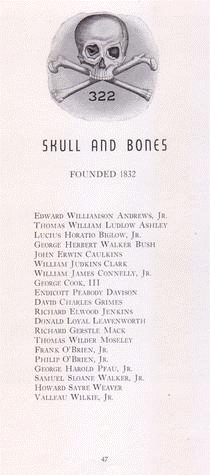
No one was prosecuted though. Prescott Bush entered the United States Senate in 1952. His son ran the Central Intelligence Agency and then the country. His grandson ran the country after that.
Marrs documents how the same interlocking networks of transatlantic finance that moved money into Germany during the 1930s were positioned to move it back out in 1945.36 The Strasbourg fronts, the Swiss accounts, and the patents moved ahead of the Allied advance formed the financial substrate onto which Nazi-era personnel were grafted into American and global corporate structures.
Antony Sutton spent a career documenting this pattern from the Hoover Institution archives, working from corporate reports and shipping manifests, and was exiled from academic respectability for it. Carroll Quigley, granted access to Council on Foreign Relations records, described the objective in Tragedy and Hope as the creation of a world system of financial control in private hands able to dominate the political system of every country. Both men were documenting the same structure from opposite ends. Neither has been refuted. Both were removed from serious consideration by the professional mechanism that removes people who document such things, which is not censorship and does not need to be.
Sixty months was all it took.
In that narrow window the United States did not simply dismantle a defeated regime. It catalogued the Reich's most valuable technical cadre, intelligence networks, and experimental methods, laundered them through falsified records, and installed them as the permanent foundation of the national security state it still operates today.
1944. Strasbourg. Capital, personnel, and technology directed into postwar corporate structures.
1945 to 1947. Operation Paperclip personnel placed. The Gehlen network absorbed. Kammler disappears. Strasbourg fronts activate across South America and neutral Europe.
July 1947. The National Security Act creates the Central Intelligence Agency, the National Security Council, and the Department of Defense in a single stroke. James Forrestal becomes the first Secretary of Defense.
1949. Forrestal is forced from office, confined at Bethesda Naval Hospital, and falls from a sixteenth-floor window on May 22. The naval board of inquiry, the Willcutts Report, is withheld from the public for fifty-five years and surfaces only in April 2004 after researcher David Martin's third Freedom of Information Act request. The report does not conclude suicide. It concludes death by fall and absolves hospital personnel of responsibility. That is the entire finding.37
1949 to 1952. The Gehlen Organization expands on CIA funding. Camp King accelerates. The stay-behind networks are wired into NATO.
1952. The National Security Agency is created by classified presidential directive. Its existence is not publicly acknowledged for years.
By the end of those sixty months the architecture was complete. The permanent secrecy apparatus the United States still operates today had been stood up, and the technical cadre, intelligence networks, and experimental methods of the regime it had just spent four years destroying had been fully absorbed into its foundations. The racial ideology was discarded. It was tactically embarrassing and strategically unnecessary. The operational methods, however, were retained.
The Year They Finally Said It
September 11, 1990. A joint session of Congress. President George H. W. Bush used the phrase "New World Order," and used it repeatedly across that period, describing an era of rules-based international cooperation and American-led global governance.38 Note the speaker. A former Director of Central Intelligence, Bonesman, and the son of a man whose bank was seized under the Trading with the Enemy Act. He spoke at the moment the Cold War scaffolding came down and the structure beneath became visible enough to name.
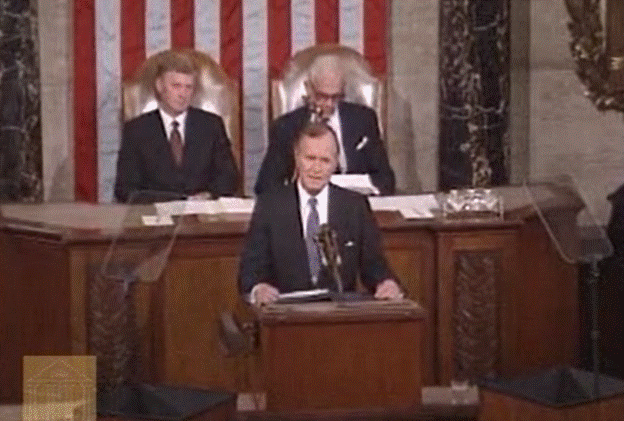
He was not announcing a project. He was describing a completed one. The architecture had been built between 1945 and 1952 by the Paperclip and Gehlen generation: the secrecy infrastructure that permitted absorption of a thousand-plus Nazi-era specialists without public debate, the behavioral research programs that treated the domestic population as experimental substrate, the financial networks that survived the war by routing through neutral capitals, and an intelligence apparatus designed from the first draft to operate outside democratic review.
Marrs contends that what Bush named was never a conspiracy hiding in shadows but an operating system that had run in the open for forty years, protected less by secrecy than by the reasonable assumption of decent people that such a thing could never be true.39 On the documentary record, that contention holds. The racial mythology was dropped. The authoritarian methods, the elite continuity across borders, and the founding conviction that humans must be managed rather than informed were kept and institutionalized.
All four mechanisms are visible in that sentence, and they are the same four I traced from Sumer forward. Coercion through dependency on personnel whose records the state had itself destroyed. Alignment through interests converged in a Strasbourg hotel and never needing coordination again. Amnesia through classification regimes that outlast every witness. Conflict through networks built to manage domestic politics under cover of an external enemy.
What changed in 1990 was not the system. It was that the system had matured enough to be finally spoken aloud without consequence.
What the Silence Tells You
The most important part of this whole record is what is still locked away. Paperclip files exist on men who have been dead for forty years and still remain classified. The official reason is "national security." At this point that reason simply means the founding records of the American national security state will never be opened.
How many other men came in under different names or through programs with even less checking than Paperclip? No one has ever given a full number. What exactly did Kammler hand over, and where did it go? What was in the MKUltra files that were successfully destroyed? These are not clever questions meant to sound mysterious. They are straightforward questions with real answers. The agencies responsible have refused to answer them for their entire existence.
That creates a built-in trap. If the people who started an institution arrived through fake paperwork, and the institution itself is designed so no outsider can ever fully examine it, then how can anyone outside ever learn the truth? There is no real way to correct mistakes. There is no independent inspector with real power. All that remains are the rare boxes that were misfiled by accident and the Freedom of Information releases that arrive fifty years too late to help anyone who was harmed.
Looked at from 30,000 feet, the story is simple.
In the spring of 1945 a government, a flag, and an army were destroyed. Almost everything else of real value was saved. The technical experts, the intelligence networks, the advanced research, and the basic idea that ordinary people should be managed rather than informed were carefully weaved into new American institutions.
The four mechanisms made the move possible. Alignment had already lined up the industrialists and Party men years earlier. Coercion created a lasting dependency on men whose true records had been erased. Amnesia locked the files and let the witnesses die. Conflict kept the public focused on outside enemies while the new system was built in secret.
Sixty months was enough. By 1952 the permanent secrecy apparatus that still exists today was established. The racial mythology was thrown away because it was no longer useful, although the methods and the people who knew how to use them were kept.
Forty-five years later a former head of the CIA stood before Congress and gave the finished system a name: the New World Order. He was not starting something new. He was describing what had already been put in place.
The files that would prove every detail are still closed. That is not an accident. It is the last part of the same design. The institutions built this way were never meant to be fully examined from the outside. That is why the silence continues, and why the questions about who else came through, what Kammler delivered, and what was destroyed in 1973 still have no answers.
The Third Reich did not simply lose the war. Its most useful parts were transferred, cleaned up, and put to work.
The New World Order was the result.
Notes
1 Supreme Headquarters Allied Expeditionary Force, "Report on a Meeting of German Industrialists to Make Postwar Plans, Strasbourg, August 10, 1944," Military Intelligence Report EW-Pa 128, November 7, 1944, enclosure to dispatch no. 19,489, U.S. Embassy London, November 27, 1944, https://archive.org/stream/Ew-pa128Report/Ew-pa128Report_djvu.txt.
2 SHAEF, EW-Pa 128.
3 Peer Heinelt, "The I. G. Farben Successor Firms," Wollheim Memorial, Fritz Bauer Institut, Goethe-Universität Frankfurt am Main, http://www.wollheim-memorial.de/en/nachfolgefirmen_en.
4 Jim Marrs, The Rise of the Fourth Reich: The Secret Societies That Threaten to Take Over America (New York: William Morrow, 2008), chap. 2.
5 Nicholas Goodrick-Clarke, The Occult Roots of Nazism: Secret Aryan Cults and Their Influence on Nazi Ideology (New York: New York University Press, 1992), chap. 9; Marrs, Rise of the Fourth Reich, chap. 1.
6 Marrs, Rise of the Fourth Reich, chap. 1; Eric Buesing, The Hidden Hand: Wealth, Power, and Control from Pharaohs to Corporations (Walterville, OR: TrineDay, 2026), chap. 1.
7 Rainer Karlsch and Heiko Petermann, cited in "Hans Kammler, Hitler's Last Hope, in American Hands," Wilson Center, https://www.wilsoncenter.org/publication/hans-kammler-hitlers-last-hope-american-hands.
8 "Hitler's Secret Weapons Manager: The Two Lives of Hans Kammler," ZDF Studios documentary, https://www.zdf-studios.com/en/program-catalog/international/unscripted/history-biographies/hitlers-secret-weapons-manager-two-lives-hans-kammler.
9 Igor Witkowski, Prawda o Wunderwaffe (Warsaw: WIS-2, 2000).
10 Nick Cook, The Hunt for Zero Point: Inside the Classified World of Antigravity Technology (New York: Broadway Books, 2001).
11 Marrs, Rise of the Fourth Reich, chap. 4.
12 Annie Jacobsen, Operation Paperclip: The Secret Intelligence Program That Brought Nazi Scientists to America (New York: Little, Brown, 2014), 1–12.
13 Jacobsen, Operation Paperclip; Linda Hunt, Secret Agenda: The United States Government, Nazi Scientists, and Project Paperclip, 1945 to 1990 (New York: St. Martin's Press, 1991).
14 Michael J. Neufeld, Von Braun: Dreamer of Space, Engineer of War (New York: Alfred A. Knopf, 2007), chap. 6.
15 Jacobsen, Operation Paperclip, chap. 21.
16 Kevin C. Ruffner, ed., Forging an Intelligence Partnership: CIA and the Origins of the BND, 1945–49, 2 vols. (Washington, DC: Central Intelligence Agency, History Staff, Center for the Study of Intelligence, 1999; declassified 2002), 1:xxix, https://www.cia.gov/readingroom/.
17 Marrs, Rise of the Fourth Reich, chap. 5.
18 Christopher Simpson, Blowback: America's Recruitment of Nazis and Its Destructive Impact on Our Domestic and Foreign Policy (New York: Weidenfeld and Nicolson, 1988), chap. 7.
19 Simpson, Blowback, introduction and chaps. 1–3.
20 Christopher Simpson, new introduction to Blowback (New York: Open Road Media, 2014), written in his capacity as a member of the Historical Advisory Panel to the Nazi War Criminal Records Interagency Working Group; see also Nazi War Criminal Records Interagency Working Group, National Archives and Records Administration, https://www.archives.gov/iwg.
21 National Security Council, NSC 10/2, "Office of Special Projects," June 18, 1948, in Foreign Relations of the United States, 1945–1950, Emergence of the Intelligence Establishment, doc. 292, https://history.state.gov/historicaldocuments/frus1945-50Intel/d292; see also NSC 4-A, December 14, 1947.
22 Randy Rezabek, "TICOM: The Last Great Secret of World War II," Intelligence and National Security 27, no. 4 (2012): 513–30.
23 Rezabek, "TICOM"; see also National Security Agency declassified TICOM records, https://www.nsa.gov/.
24 National Security Agency, European Axis Signal Intelligence in World War II as Revealed by "TICOM" Investigations and by Other Prisoner of War Interrogations and Captured Material, Principally German, WDGAS-14, Chief, Army Security Agency, 1 May 1946, 9 vols., declassified, https://www.nsa.gov/.
25 Daniele Ganser, NATO's Secret Armies: Operation Gladio and Terrorism in Western Europe (London: Frank Cass, 2005).
26 Marrs, Rise of the Fourth Reich, chap. 8; Buesing, The Hidden Hand, chap. 8.
27 Eric Buesing, The Illusion Architects: How Elites Shape Culture, Consciousness, and Reality (Walterville, OR: TrineDay, forthcoming 2026), chap. 6.
28 Edward L. Bernays, Biography of an Idea: Memoirs of Public Relations Counsel Edward L. Bernays (New York: Simon and Schuster, 1965), 652.
29 Randall L. Bytwerk, Bending Spines: The Propagandas of Nazi Germany and the German Democratic Republic (East Lansing: Michigan State University Press, 2004).
30 Jacobsen, Operation Paperclip, chap. 18; Hunt, Secret Agenda, chap. 11.
31 U.S. Senate Select Committee on Intelligence and Subcommittee on Health and Scientific Research of the Committee on Human Resources, Project MKULTRA, the CIA's Program of Research in Behavioral Modification, Joint Hearing, 95th Cong., 1st sess., August 3, 1977 (Washington, DC: Government Printing Office, 1977); see also John Marks, The Search for the "Manchurian Candidate": The CIA and Mind Control (New York: Times Books, 1979); Buesing, The Illusion Architects, chap. 5.
32 U.S. Army Inspector General, Use of Volunteers in Chemical Agent Research (Washington, DC: Department of the Army, 1975), declassified 1993.
33 U.S. Senate, Project MKULTRA, 4–6, https://www.intelligence.senate.gov/wp-content/uploads/2024/08/sites-default-files-hearings-95mkultra.pdf.
34 U.S. Senate, Project MKULTRA, 5.
35 "Union Banking Corporation Vesting Order No. 248," Office of Alien Property Custodian, October 20, 1942, Federal Register 7, no. 218 (November 7, 1942); Marrs, Rise of the Fourth Reich, chap. 3.
36 Marrs, Rise of the Fourth Reich, chap. 3; Antony C. Sutton, Wall Street and the Rise of Hitler (Seal Beach, CA: '76 Press, 1976); Carroll Quigley, Tragedy and Hope: A History of the World in Our Time (New York: Macmillan, 1966), 324.
37 "Report of the Board of Investigation into the Death of James V. Forrestal" (Willcutts Report), U.S. Naval Hospital, Bethesda, MD, convened May 23, 1949, released under FOIA April 2004, copy held at Seeley G. Mudd Manuscript Library, Princeton University; David Martin, The Assassination of James Forrestal (McLean, VA: DCDave Press, 2019).
38 George H. W. Bush, "Address Before a Joint Session of Congress," September 11, 1990, transcript, Miller Center, University of Virginia, https://millercenter.org/the-presidency/presidential-speeches/september-11-1990-address-joint-session-congress.
39 Marrs, Rise of the Fourth Reich, conclusion.
Bibliography
Bernays, Edward L. Biography of an Idea: Memoirs of Public Relations Counsel Edward L. Bernays. New York: Simon and Schuster, 1965.
Buesing, Eric. The Hidden Hand: Wealth, Power, and Control from Pharaohs to Corporations. Walterville, OR: TrineDay, 2026.
Buesing, Eric. The Illusion Architects: How Elites Shape Culture, Consciousness, and Reality. Walterville, OR: TrineDay, forthcoming 2026.
Bush, George H. W. "Address Before a Joint Session of Congress." September 11, 1990. Transcript. Miller Center, University of Virginia. https://millercenter.org/the-presidency/presidential-speeches/september-11-1990-address-joint-session-congress.
Bytwerk, Randall L. Bending Spines: The Propagandas of Nazi Germany and the German Democratic Republic. East Lansing: Michigan State University Press, 2004.
Cook, Nick. The Hunt for Zero Point: Inside the Classified World of Antigravity Technology. New York: Broadway Books, 2001.
Ganser, Daniele. NATO's Secret Armies: Operation Gladio and Terrorism in Western Europe. London: Frank Cass, 2005.
Goodrick-Clarke, Nicholas. The Occult Roots of Nazism: Secret Aryan Cults and Their Influence on Nazi Ideology. New York: New York University Press, 1992.
Heinelt, Peer. "The I. G. Farben Successor Firms." Wollheim Memorial. Fritz Bauer Institut, Goethe-Universität Frankfurt am Main. http://www.wollheim-memorial.de/en/nachfolgefirmen_en.
Hunt, Linda. Secret Agenda: The United States Government, Nazi Scientists, and Project Paperclip, 1945 to 1990. New York: St. Martin's Press, 1991.
Jacobsen, Annie. Operation Paperclip: The Secret Intelligence Program That Brought Nazi Scientists to America. New York: Little, Brown, 2014.
Marks, John. The Search for the "Manchurian Candidate": The CIA and Mind Control. New York: Times Books, 1979.
Marrs, Jim. The Rise of the Fourth Reich: The Secret Societies That Threaten to Take Over America. New York: William Morrow, 2008.
Martin, David. The Assassination of James Forrestal. McLean, VA: DCDave Press, 2019.
National Security Agency. European Axis Signal Intelligence in World War II as Revealed by "TICOM" Investigations and by Other Prisoner of War Interrogations and Captured Material, Principally German. WDGAS-14. Chief, Army Security Agency, 1 May 1946. 9 vols. Declassified.
National Security Council. NSC 10/2, "Office of Special Projects." June 18, 1948. In Foreign Relations of the United States, 1945–1950, Emergence of the Intelligence Establishment. Washington, DC: Government Printing Office. https://history.state.gov/historicaldocuments/frus1945-50Intel/d292.
Neufeld, Michael J. Von Braun: Dreamer of Space, Engineer of War. New York: Alfred A. Knopf, 2007.
Quigley, Carroll. Tragedy and Hope: A History of the World in Our Time. New York: Macmillan, 1966.
Rezabek, Randy. "TICOM: The Last Great Secret of World War II." Intelligence and National Security 27, no. 4 (2012): 513–30.
Ruffner, Kevin C., ed. Forging an Intelligence Partnership: CIA and the Origins of the BND, 1945–49. 2 vols. Washington, DC: Central Intelligence Agency, History Staff, Center for the Study of Intelligence, 1999. Declassified 2002.
Simpson, Christopher. Blowback: America's Recruitment of Nazis and Its Destructive Impact on Our Domestic and Foreign Policy. New York: Weidenfeld and Nicolson, 1988. Reprint, New York: Open Road Media, 2014.
Supreme Headquarters Allied Expeditionary Force. "Report on a Meeting of German Industrialists to Make Postwar Plans, Strasbourg, August 10, 1944." Military Intelligence Report EW-Pa 128, November 7, 1944. https://archive.org/stream/Ew-pa128Report/Ew-pa128Report_djvu.txt.
Sutton, Antony C. Wall Street and the Rise of Hitler. Seal Beach, CA: '76 Press, 1976.
U.S. Army Inspector General. Use of Volunteers in Chemical Agent Research. Washington, DC: Department of the Army, 1975. Declassified 1993.
U.S. Senate. Select Committee on Intelligence and Subcommittee on Health and Scientific Research of the Committee on Human Resources. Project MKULTRA, the CIA's Program of Research in Behavioral Modification. Joint Hearing, 95th Cong., 1st sess., August 3, 1977. Washington, DC: Government Printing Office, 1977. https://www.intelligence.senate.gov/wp-content/uploads/2024/08/sites-default-files-hearings-95mkultra.pdf.
Witkowski, Igor. Prawda o Wunderwaffe. Warsaw: WIS-2, 2000.
Declaration of Generative AI Use
I use generative AI solely to research diverse topics, organize thoughts, correct language, improve clarity, and format citations in CMOS style. Every idea, argument, and conclusion in this work is my own. I have reviewed the piece carefully before submitting and take full responsibility for its content. It is also worth noting that the topics I typically write on are ones generative AI would refuse to engage with fully anyway.
A word on AI detection tools: they are not reliable. These tools routinely flag polished, well-structured, or academic writing as machine-generated, regardless of who actually wrote it. A high score on an AI detector is not evidence of AI authorship. It is, just as often, evidence of clarity.